
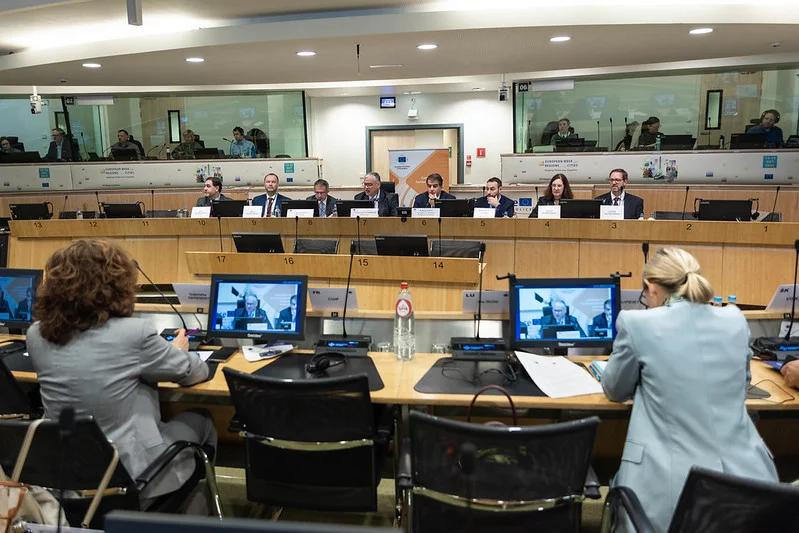
Coimbra: Regional partnership plans became the sharpest dividing line in the debate on cohesion policy after 2027 when members of the European Parliament and the European Committee of the Regions met on 15 October 2026. The joint meeting of the Parliament’s regional development committee and the Committee of the Regions’ territorial cohesion commission took place the day after the European Week of Regions and Cities closed.
The Commission’s post-2027 proposals would replace today’s patchwork with National and Regional Partnership Plans and update the rules for the European Regional Development Fund, the Cohesion Fund and Interreg. The meeting came as EU leaders gathered in Brussels for a European Council focused on the 2028-2034 budget, so the timing gave every speaker a reason to defend their share.
Vasco Alves Cordeiro, chair of the Committee of the Regions’ territorial cohesion commission, said cohesion policy rests on three inseparable principles: partnership, the place-based approach and multilevel governance. He warned that merging more than 400 programmes into 27 national plans could sever the link between the Union and its citizens. Regions and cities drive nearly half of public investment in Europe, he noted, and he asked the Commission to make multilevel governance a binding condition for approving the regional partnership plans.
Dragoș Benea, chair of the Parliament’s regional development committee, framed the budget debate as a question of what kind of Union to build after 2027. He said regions must be active partners, not just recipients, and called for putting them at the heart of decision-making. Members from both bodies argued that over-centralising investment decisions in national governments would weaken the power of cohesion policy to reduce disparities, and they asked for clearer legal guarantees on the role of local and regional authorities in the regional partnership plans.
Raffaele Fitto, Executive Vice-President for Cohesion and Reforms, gave the keynote. He said future cohesion policy should address housing, energy, climate resilience and dual-use infrastructure. He cited recent strategies for cities, eastern border regions, islands and outermost regions, and said a “right to stay” strategy is expected early next year. Responding to the concerns, Fitto agreed that the role of regions needs strengthening in the coming negotiations, though he noted that several articles already define it.
Competitiveness featured as a bridge rather than a rival. More than 58 per cent of 2021-2027 cohesion funding, or €220 billion, goes toward the goals of the EU Competitiveness Compass, speakers said. The question for the coming months is whether negotiators will write stronger safeguards into the final rules, and whether regional partnership plans will keep local authorities in the room when money is allocated.


