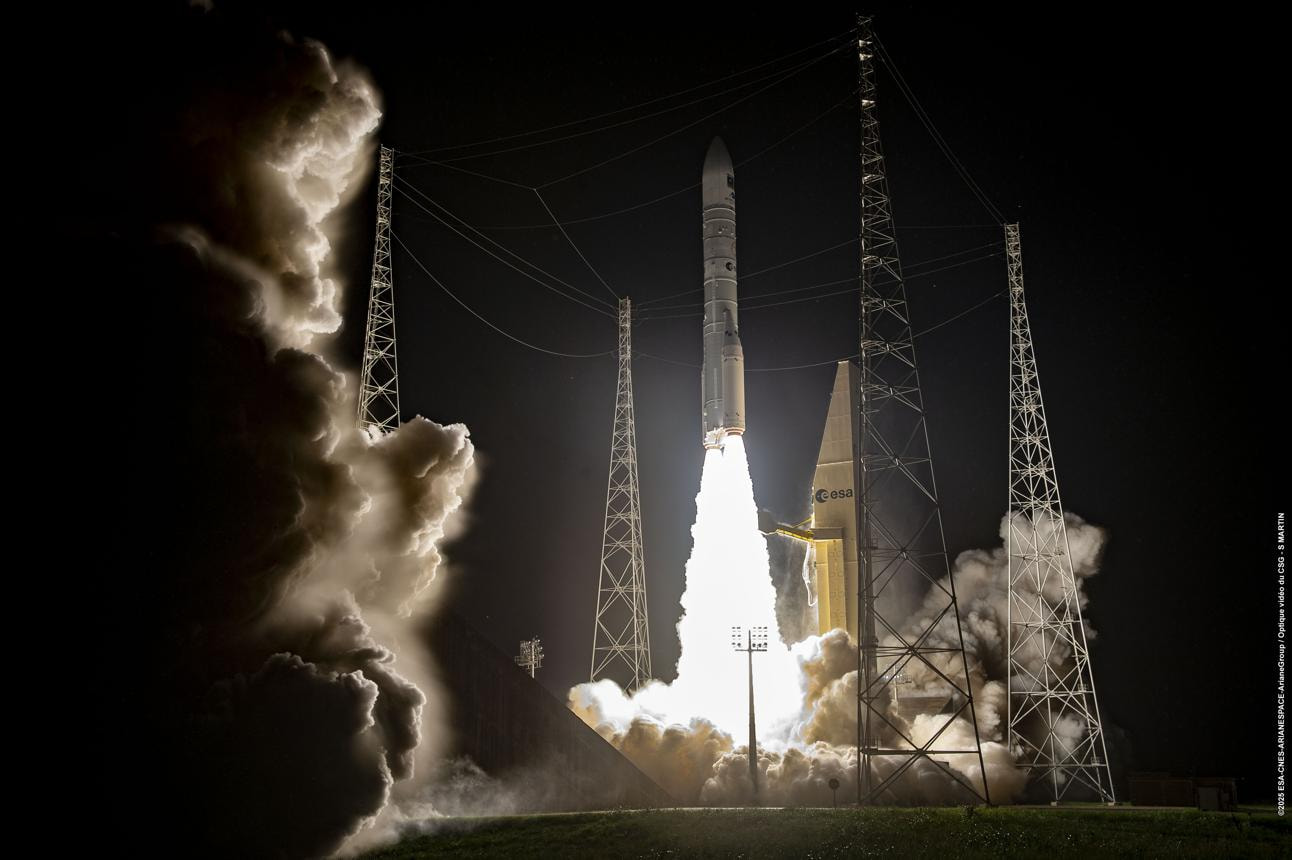
Toulouse: In the workshops of Europe’s aerospace heartland, engineers are assembling the pieces of a constellation meant to wean the continent off its dependence on foreign satellite networks. The project, known as IRIS², is the European Union’s third flagship space programme after the Galileo navigation system and the Copernicus earth-observation fleet, and it has spent the past months collecting the partners and technologies it needs to leave the drawing board.
The ambition is substantial. IRIS² is to be a multi-orbital constellation of roughly 290 satellites, combining spacecraft in medium earth orbit with a layer in low earth orbit to deliver resilient, encrypted connectivity to governments across the bloc. The design is a deliberate answer to a strategic anxiety that has sharpened in recent years, that critical European communications, from military links to emergency services, run over commercial networks owned and controlled outside the union. The most prominent of those, Starlink, has become both a model and a cautionary tale.
What distinguishes the European effort is its bet on quantum security. A satellite called Eagle-1, being developed by an industrial consortium of twenty European companies, is intended to become the continent’s first in-orbit demonstrator of quantum key distribution, a technique that uses the laws of physics to make intercepted communications detectable and, in principle, unbreakable. A launch is targeted for this year, and if the demonstration succeeds it would validate technology that could eventually underpin the whole constellation’s defences against eavesdropping by hostile states.
The political coalition behind the programme has also been widening. In late March, Norway and Iceland signed agreements to take part in both IRIS² and the related governmental satellite communications scheme, with Oslo expected to contribute around forty million euros and Reykjavik a smaller sum over the next two years. Their entry, as the first non-EU states to formally join, signals that the network is being conceived as a wider European asset rather than a strictly union one, mirroring the way neighbouring countries plug into other parts of the bloc’s space infrastructure.
Momentum has been building on the industrial side too. At a major space gathering in the Spanish capital in May, a fresh cooperation agreement reinforced the role of southern Europe in developing the low-orbit segment, part of a broader push to spread the work and the expertise across more member states. Spreading the workload also spreads the political ownership, a calculation that matters for a programme whose costs and timelines have already drawn scrutiny.
Those timelines remain the programme’s softest point. Initial governmental services are not expected to begin until 2030, a distant horizon in a sector where commercial rivals iterate in months and where the strategic case for sovereignty grows more urgent by the year. Critics worry that by the time IRIS² is operational, the gap with established constellations may have widened rather than closed.
Supporters counter that resilience, not speed, is the point. A network designed from the outset for government use, hardened with quantum cryptography and governed by European rules, offers something no commercial provider can guarantee, a communications backbone that stays under European control no matter how geopolitics shift. Whether the union can hold its nerve, and its budget, long enough to deliver it is the question hanging over Toulouse and every other workshop now bending metal for the project.