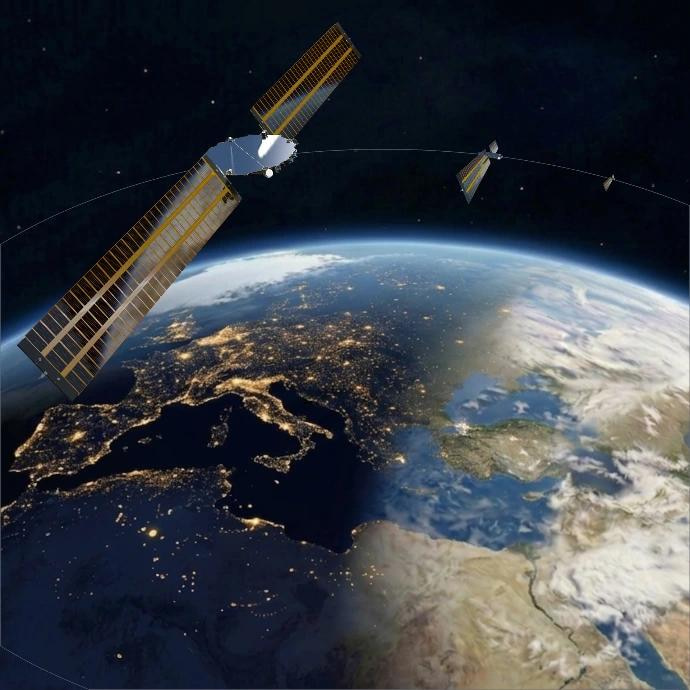
Ottobrunn: Airbus announced on 27 October 2026 that it will build two more second-generation Galileo satellites, which lifts the European order for the new fleet from six to eight. The European Space Agency signed the contract on behalf of the EU Agency for the Space Programme, acting under a delegation from the European Commission. The company did not disclose the contract value or a launch date.
The two extra second-generation Galileo satellites will come out of the same industrial chain as the first six. Airbus builds them across five sites, in Backnang, Friedrichshafen, Getafe, Ottobrunn and Toulouse, which spreads the work over Germany, Spain and France. That footprint reflects the political bargain behind most EU space programmes, in which several member states expect a share of the work.
Each satellite weighs more than two tonnes and carries a design life of 15 years. The spacecraft add enhanced atomic clocks and inter-satellite links, and they include anti-jamming and anti-spoofing features. Those protections matter because jamming and spoofing of navigation signals have become a routine concern for aviation, shipping and defence users across Europe.
Laurent Jaffart, the ESA Director of Resilience, Navigation and Connectivity, described the contracts as an investment in Europe’s ability to navigate its own future. Alain Fauré, Head of Space Systems at Airbus, said the company will deliver the next-generation satellites. Both statements frame the order as a question of strategic autonomy rather than a routine procurement, and they show how European officials now talk about space infrastructure as part of security policy.
Engineers designed the second-generation Galileo satellites to succeed the first batch that has served users since the system began to deliver services. A larger order gives the second-generation Galileo satellites more flexibility, because extra units can replace a failed spacecraft or extend coverage without waiting for a fresh tender. It also supports the EU Agency for the Space Programme, which runs the service and relies on a steady supply of reliable hardware.
Industrial planners also gain predictability from the order, because suppliers in five sites can schedule production lines and staff for a longer run. Unanswered questions remain for the 2026 planning cycle. The contract value stays confidential, and nobody has published a launch window, so it is hard to judge how quickly the new capacity will reach orbit. Policymakers will also watch whether the extra pair signals more orders later, since Galileo competes with American, Russian and Chinese systems and cannot afford gaps. For now, the second-generation Galileo satellites on order stand at eight, and the next milestone is a launch schedule that industry and users can plan around.