
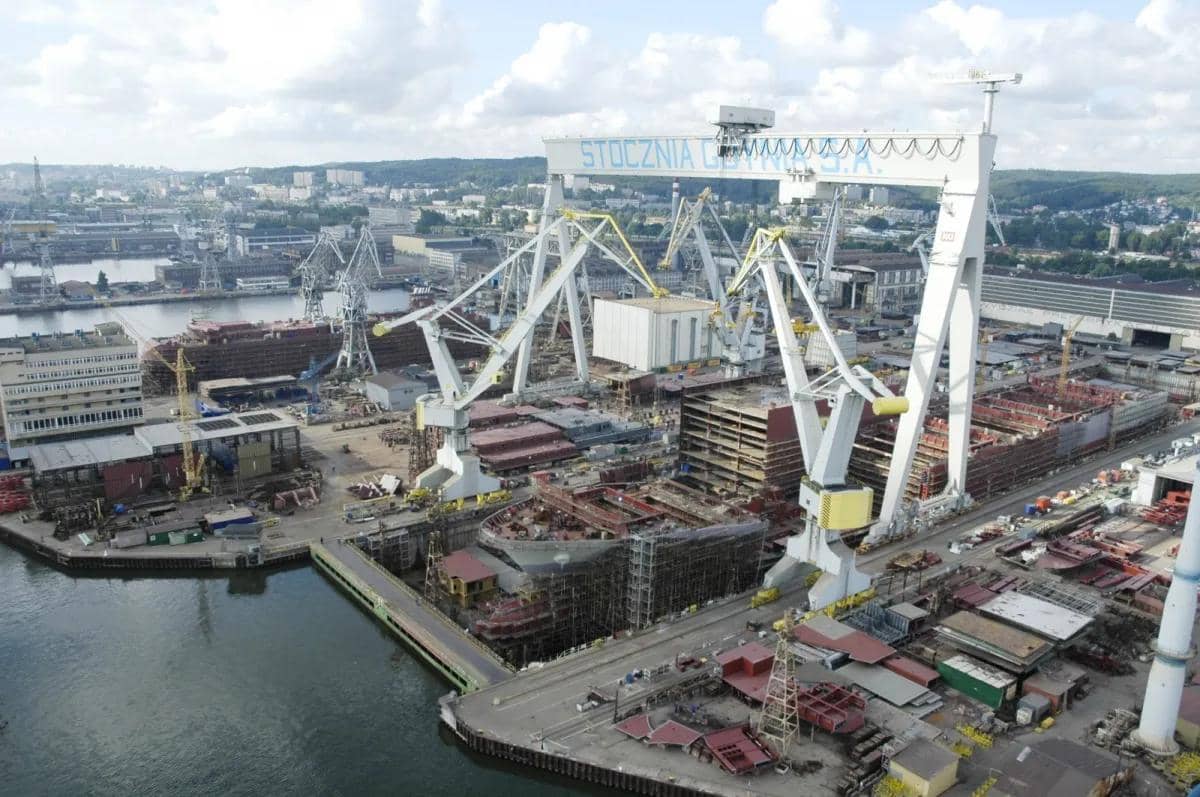
Gdynia: The cranes along this Baltic waterfront belong to a European industry that builds a small fraction of the world’s merchant tonnage and knows it. Last week the Commission opened the EU Industrial Maritime Value Chains Alliance and invited that industry to sign up, with a first application cut-off of 16 October.
The maritime alliance follows six months after the Industrial Maritime Strategy promised it. Membership is open to shipyards, equipment manufacturers, shipowners, technology suppliers, investors, national and regional authorities, social partners and universities, provided they meet eligibility criteria and commit to the objectives. The call stays open continuously after October, so the deadline sets the founding cohort rather than closing the door.
Europe still leads in marine equipment. Engines, propulsion systems, navigation electronics and increasingly the technology for alternative fuels come disproportionately from European suppliers, and those suppliers sell into Asian yards. What Europe has lost is volume hull construction, and the loss compounds, because a yard that stops building large ships eventually loses the welders, the designers and the local supply chain that made it competitive.
The alliance’s stated purpose is to map industrial capacity across that value chain and to channel investment toward digital and circular transformation of yards, with an ambition to supply or retrofit as many as ten thousand sustainable vessels by 2035. Retrofit is the part worth watching. Existing ships must cut emissions under fuel and carbon rules already in force, and refitting a vessel needs dock space near the trade routes it serves. European yards have that geography.
Alliances are a familiar Brussels instrument, used previously for batteries, raw materials, hydrogen and processors. They carry no budget of their own. They convene, they produce roadmaps, and they give the Commission a structured interlocutor when it later designs something with money attached. Sometimes that sequence works, as it arguably did for batteries. Sometimes it produces a well-attended working group and little else.
Defence sits underneath the file without dominating it. Naval construction and civil shipbuilding share yards, welders and classification expertise, and governments rearming at speed have discovered they need domestic capacity for both. That overlap gives the maritime alliance political friends it would not otherwise have, and it also complicates state aid questions that the Commission would prefer to keep separate.
The obvious risk is competitive. Yards bidding against each other for the same contracts will sit in the same capacity-mapping exercise, and firms rarely volunteer commercially useful information to rivals. The Commission will need to aggregate carefully to get data worth having, and participants will need convincing that mapping leads somewhere.
For workers in Gdynia, Chantiers yards in France or the Adriatic basins, the question is simpler than any of this. An alliance is a promise of attention. Orders are a promise of employment. The six weeks to October will show how many firms think the first eventually produces the second.