
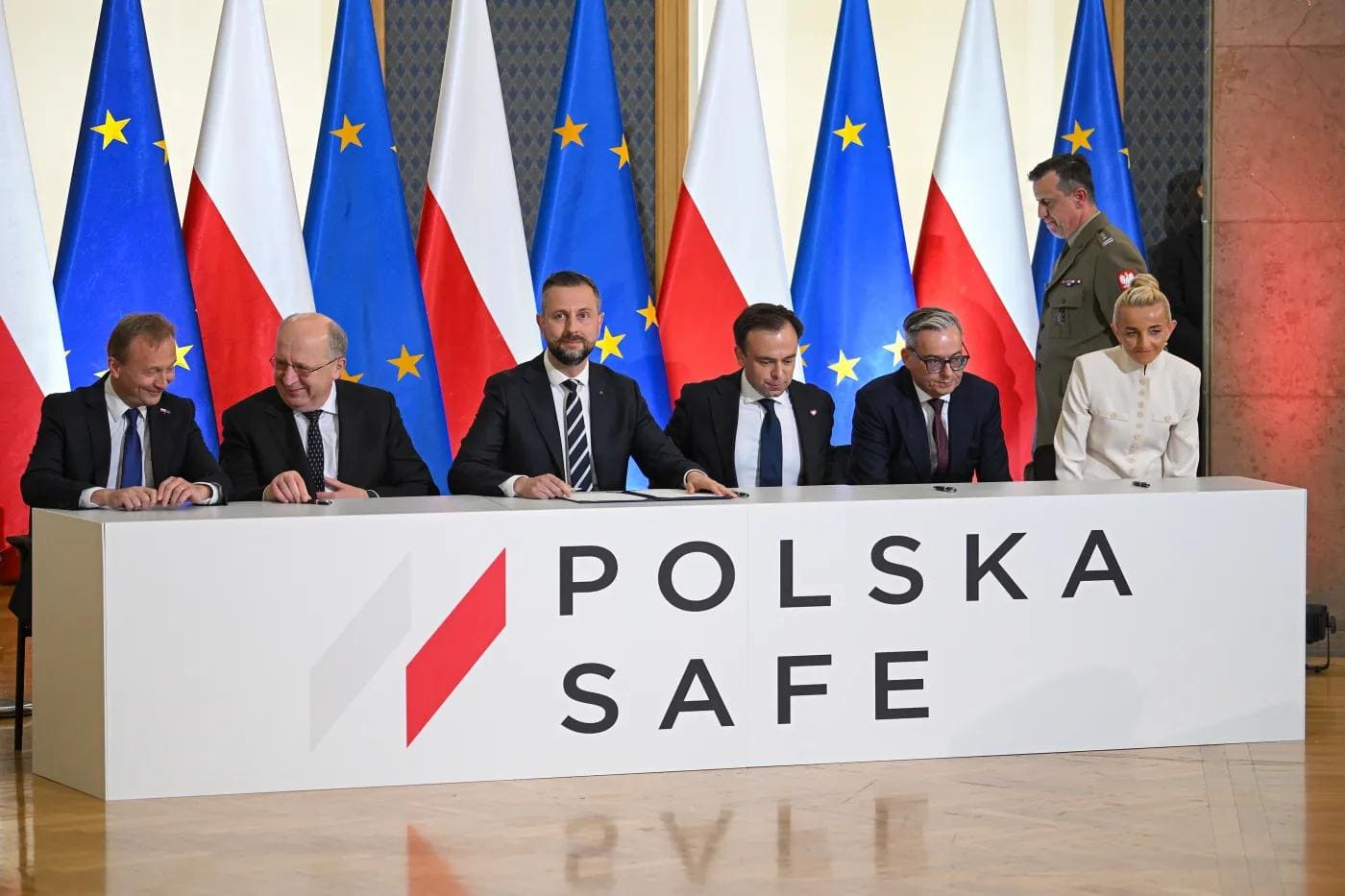
Brussels: SAFE defence loans have moved from a legal text in Brussels to real money in national treasuries, with about €11.9 billion of pre-financing paid to nine member states by 28 August 2026, according to Commission records. The €150 billion instrument lends at EU borrowing costs for joint procurement, and the pace of payments now shows which governments are ready to spend.
How SAFE defence loans are divided
Nineteen of the 27 member states joined the scheme, and Germany stayed out, which leaves the Union’s largest economy outside the first wave of European defence borrowing. Poland holds the largest allocation at €43.7 billion, followed by Romania with €16.7 billion and France with about €15.1 billion, which the Commission approved on 10 April 2026. Belgium secured €8.34 billion and Lithuania €6.375 billion.
Hungary reserved roughly €16.2 billion while Viktor Orbán governed, but its plan stalled. On 25 September 2026 the Commission confirmed that Budapest had cut its request to €5.4 billion. The smaller request shrinks the share of the envelope that Hungary can claim, and it leaves the money available for other governments.
Who has received the first cash
Each government that signs a loan agreement can draw 15 percent as pre-financing. Poland signed on 8 May and received €6.56 billion on 29 May. Lithuania followed with €956 million on 24 June, and Romania collected €2.5 billion on 26 August.
Smaller payments reached Latvia (€525 million), Bulgaria (€489 million), Estonia (€352 million), Croatia (€255 million), Cyprus (€177 million) and Greece (€118 million). Poland alone accounts for more than half of the cash paid out, so the headline total hides a very uneven start for SAFE defence loans across the Union.
Why Italy’s request changes the picture
Italy first reserved €14.9 billion, then submitted a formal request of about €8 billion on 26 August. The Commission approved its updated plan on 13 October 2026. Council approval, signature and a first tranche still lie ahead.
The reduction matters because it shows the fiscal trade-off governments face. A loan counts as debt, and highly indebted states weigh cheap EU financing against their own borrowing limits. Italy’s smaller ask suggests that cost of capital is not the only constraint on SAFE defence loans.
What the idle money tells us
The unclaimed share matters for credibility. If SAFE defence loans leave a large part of the envelope unused, critics will say the scheme oversold demand. If governments fill the second round quickly, supporters will say the first round simply taught capitals how to apply.
Commissioner Andrius Kubilius said on 13 October that about €20 billion of the envelope remains uncommitted. The Commission is preparing a second application round before the end of 2026. Hungary’s smaller request and Italy’s cut help explain why so much money remains unclaimed.
Three tests will decide whether the programme meets its aim of buying European defence equipment together. First, signed contracts must follow the pre-financing. Second, orders must go to joint procurement groups rather than single national buyers. Third, industry must deliver on schedule, because delays would erode political support for any successor instrument.
What happens next
The coming weeks bring Italy’s Council approval and the design of the second round. Watch two numbers: the share of the €150 billion that governments commit to contracts, and the share of orders placed with EU or associated suppliers. If both rise, SAFE defence loans will prove that common borrowing can fund common capability. If they stall, the €20 billion gap will feed arguments that Europe needs a different financing model.


