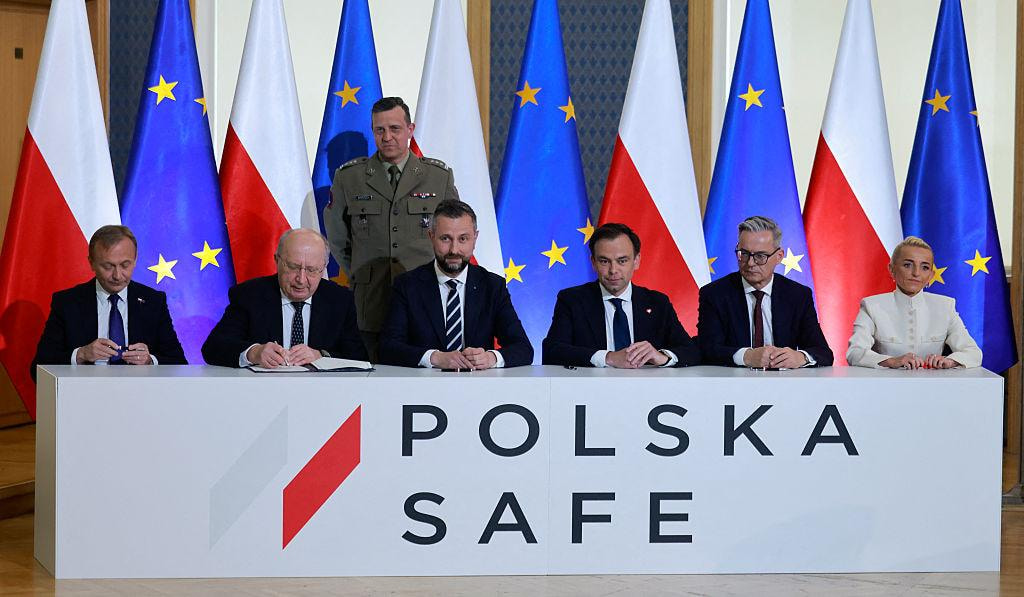
SAFE defence loans have become the largest financing tool in the history of the European Union’s defence policy, and the way the money is divided shows which governments feel most exposed. The Security Action for Europe instrument, adopted on 27 May 2025, offers up to €150 billion in loans funded by EU bonds, and the latest allocations reveal a heavy tilt towards Poland and Romania.
The question for autumn 2026 is whether that money will translate into jointly bought weapons or into twenty-seven parallel shopping lists. The answer depends on rules about European content and joint procurement that will shape what armed forces order for the next decade.
How SAFE defence loans are structured
The instrument lends to member states that request support, and the Union borrows on capital markets to fund it. Loans are tied to common procurement, so purchases must involve at least two member states. A Buy European clause limits the cost of components from outside the Union to a maximum of 35 percent, which pushes orders towards the European defence industrial base.
Eligible spending covers ammunition, missiles, air defence, drones, cybersecurity, electronic warfare and space assets. These categories reflect the threats that planners consider most urgent. Pre-financing of up to 15 percent of each country’s allocation was designed to start spending quickly, before contracts are fully signed.
Which countries receive the largest allocations
The distribution is uneven. As of February 2026, Poland led with €43.7 billion, followed by Romania with €16.7 billion, Italy with €14.9 billion and Lithuania with €6.4 billion. Approvals came in three waves: €38 billion across eight countries first, then €74 billion across eight more endorsed by the Commission, and about €34 billion from France, Czechia and Hungary under review.
Those numbers say something about geography. Countries on the eastern flank borrow most because their security needs are immediate and their own fiscal room is limited. Cheap Union borrowing is attractive for them, since the interest rate reflects the credit standing of the Union and not of a single capital.
Do SAFE defence loans build a common market?
The political promise of SAFE defence loans is integration. European armies still operate dozens of different weapon types, which raises costs and complicates joint operations. Requiring joint procurement is meant to create larger orders, lower unit prices and compatible equipment.
The evidence on SAFE defence loans so far is mixed. A joint purchase by two states is a low bar, and nothing prevents two neighbours from simply coordinating separate orders. The Buy European clause also leaves room for debate about what counts as a European component, particularly for engines, sensors and software where supply chains cross borders. Industry will watch how the Commission interprets these rules in practice.
The debt and budget question
Loans must be repaid, and that detail separates SAFE defence loans from grants. Governments that borrow take on long-term obligations for equipment they will use for decades. Fiscally cautious states may prefer to spend from national budgets, while those with high debt may hesitate to add to it even at favourable terms.
The instrument also sits beside smaller tools. The European Defence Industry Programme, adopted on 8 December 2025, offers €1.5 billion in grants for 2025 to 2027, including €300 million for Ukraine. Compared with €150 billion in loans, grants are modest, which suggests that Brussels expects national budgets and borrowing to carry most of the rearmament effort.
What happens next
Three indicators will show whether the programme works. First, how quickly contracts follow allocations, since unspent loans achieve nothing. Second, how much of the money goes to genuinely joint projects rather than coordinated national orders. Third, whether the next multiannual budget creates a successor instrument or leaves the field to national spending.
For defence ministries and suppliers, the practical lesson is to align procurement plans with the European content rules now. For taxpayers, SAFE defence loans are a bet that shared borrowing and shared buying will deliver more security per euro than twenty-seven separate efforts, and the first delivery schedules will test that bet.