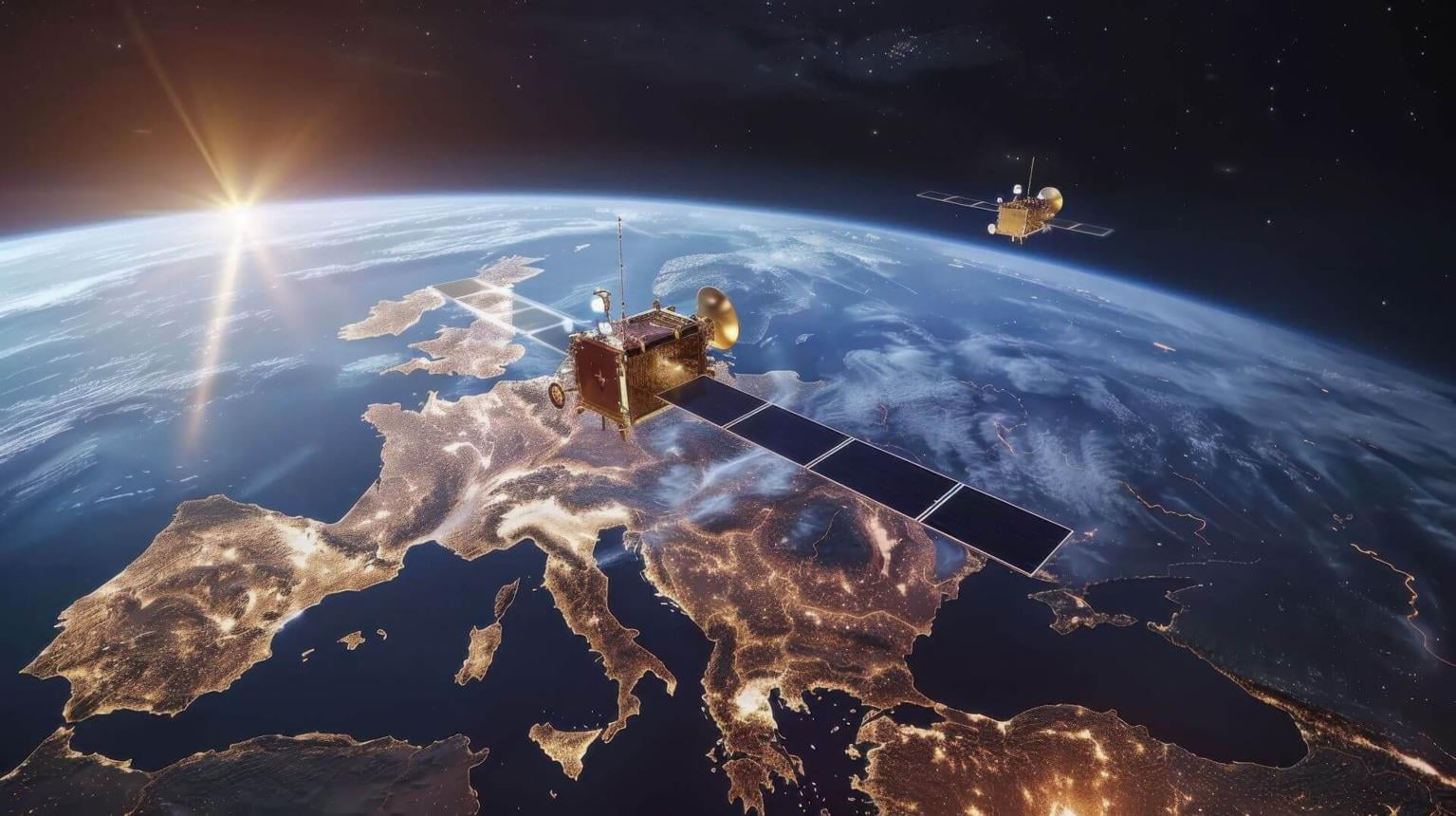
Oslo: Two countries outside the European Union have just tied themselves more tightly to its most ambitious space project, a sign of how far the bloc’s secure-connectivity push now reaches beyond its own borders. On 26 March 2026 Norway and Iceland signed agreements to take part in GOVSATCOM and its successor, IRIS2, the constellation the Union is building to give governments communications it does not have to rent from anyone else. The move came weeks after GOVSATCOM, the bridge programme that pools existing national satellite capacity, became operational on 27 January, knitting together eight satellites contributed by five member states.
IRIS2, short for Infrastructure for Resilience, Interconnectivity and Security by Satellite, is meant to be the Union’s third space flagship after the Galileo navigation system and the Copernicus earth-observation network. The plan is for roughly 290 satellites spread across medium and low orbits, delivering encrypted links for institutions, ministries and embassies alongside commercial broadband and coverage for the connectivity dead zones that still scar parts of the continent. A consortium of three established operators, Eutelsat, SES and Hispasat, trading as SpaceRISE, holds a twelve-year concession to design, deploy and run the system, with full services not expected until 2030.
The strategic logic is easy to state and harder to deliver. Europe has watched a single American company, SpaceX, turn its Starlink network into an instrument that governments depend on and that one entrepreneur can switch on or off. For a Union that talks constantly about strategic autonomy, owning a sovereign alternative for the traffic that cannot safely run over commercial or foreign infrastructure has become a near-existential point of pride. The participation of Norway and Iceland, both deeply integrated into European security through other channels, extends that sovereign umbrella across the Arctic approaches where coverage is thinnest and surveillance needs are growing.
Yet the programme carries familiar risks. Its budget, north of ten billion euros once private contributions are counted, has already drawn scrutiny from auditors wary of optimistic forecasts, and a 2030 service date leaves a long gap during which Europe remains reliant on the very providers IRIS2 is supposed to replace. Building a multi-orbit constellation on schedule has humbled better-funded ventures, and the concession model hands enormous responsibility to commercial operators whose own finances have wobbled in recent years.
For now, the direction of travel is clear enough. GOVSATCOM going live gives governments something usable today, while the accession of two non-member states suggests the political appetite for a European answer to satellite dependence is broadening rather than fading. The harder test arrives later this decade, when the first IRIS2 satellites must prove that Europe can not only fund the ambition but fly it.