Europe’s wildfire response has become a summer-long emergency, and the pressure on shared firefighting resources has rarely looked heavier. As blazes tore through southern France and Spain in late July and into August, the bloc leaned on its collective fleet to plug gaps that national services could no longer fill.
The wildfire response runs through the EU Civil Protection Mechanism, the system that lets a country ask for help once a fire outgrows its own capacity. The Emergency Response Coordination Centre in Brussels then matches offers of planes, crews and equipment to whoever needs them and helps pay to move them.
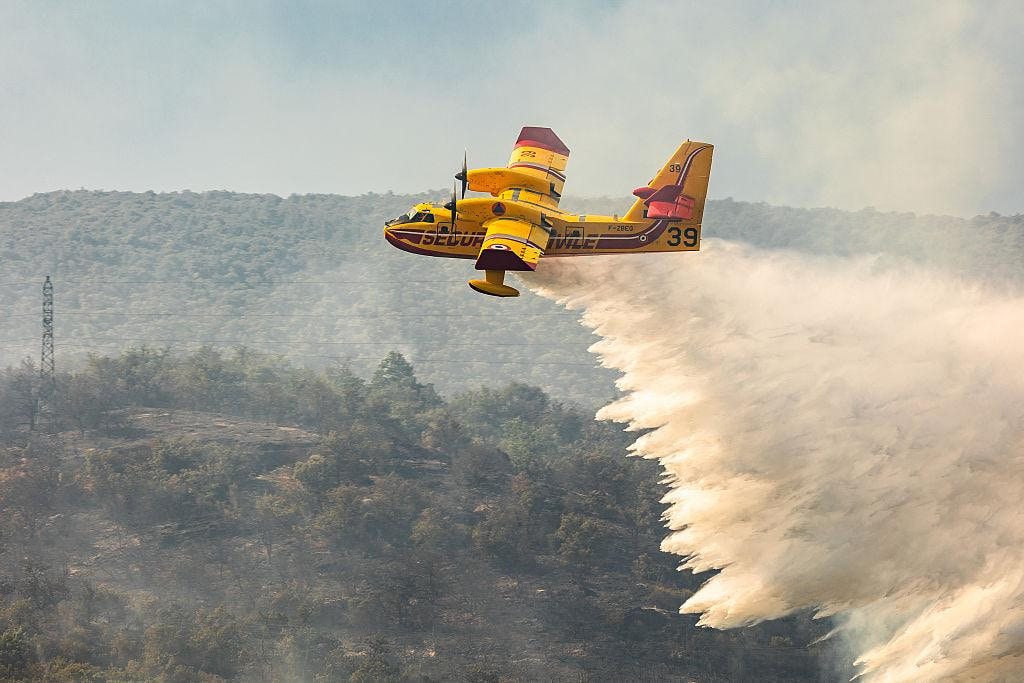
The scale this year is striking. The bloc pre-positioned its largest ever seasonal deployment, with the rescEU reserve fielding 22 firefighting aeroplanes and several helicopters on standby across a dozen countries, backed by hundreds of firefighters stationed in the most exposed regions. The Commission set out the detail in its wildfire readiness plan.
When France called for help, the mechanism sent seven planes and four helicopters drawn from Czechia, Croatia, Germany, Portugal, Slovakia, Sweden and Turkiye. Spain received six planes from Greece, Italy and Turkiye, along with more than a hundred personnel and dozens of vehicles from Portugal. You can read the Commission’s deployment summary here.
The human toll has been grim. By early August fires had killed civilians, firefighters and helicopter crew, and forced hundreds of thousands of people from their homes in Spain and France alone. Copernicus, the EU’s satellite service, has produced rapid emergency maps to guide crews on the ground.
Officials have been unusually blunt about the strain. Commission staff warned that the system was running out of capacity as several large fires burned at once, a candid admission that pooled assets can wear thin when a whole region ignites in the same week.
That worry has sharpened a political debate. The European People’s Party, the Parliament’s largest group, has called for a dedicated European prevention plan and a stronger rescEU, arguing that Europe cannot keep treating each summer as a fresh surprise.
The deeper shift moves from firefighting to fire resilience. Policymakers increasingly favour prevention, land management and early warning over simply scrambling aircraft once flames appear. The logic is simple: a fleet that is always maxed out cannot be the only line of defence.
Money runs through all of it. rescEU assets are financed by the EU and deployed only when national and pooled capacities fall short, which is why the next long-term budget debate matters for civil protection too.
For now, the coordination centre stays in constant contact with national authorities, weighing what more it can send. The season is not over, and the wildfire response has already tested how much solidarity Europe can mobilise before the next heatwave arrives.