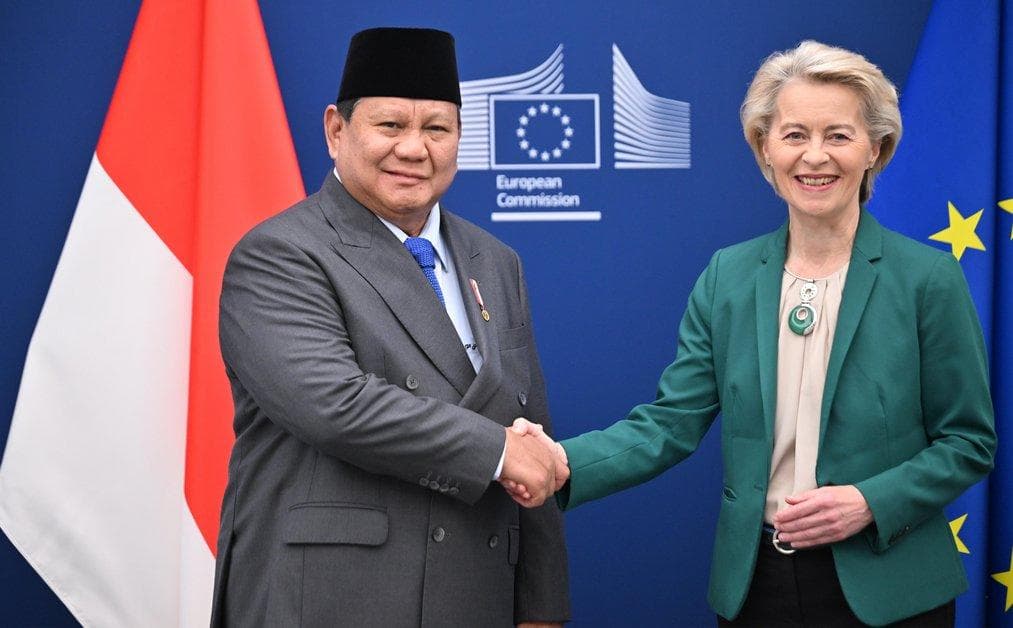
Jakarta: After nearly ten years of stop-start negotiation, the European Union and Indonesia have turned their Comprehensive Economic Partnership Agreement from an aspiration into a finished text. The significance is easy to undersell precisely because it arrived without theatre. A political agreement struck between Commission President Ursula von der Leyen and President Prabowo Subianto in mid-2025 hardened into concluded negotiations later that year, and the deal is now moving toward formal signature in 2026, with entry into force targeted for early 2027 once the European Parliament and Indonesia’s legislature give their consent.
The headline numbers explain why Brussels persisted. The agreement removes duties on roughly 98.5 percent of tariff lines, covering almost all trade by value between the two economies. For European exporters that means cheaper access for cars, machinery and agri-food into a market of more than 280 million people. For Indonesia it locks in tariff-free entry for textiles, footwear and processed goods, and lends Jakarta the kind of rules-based anchor that a mid-sized power values when the trading order around it looks increasingly transactional.
The deeper story is strategic. Europe has spent three years trying to diversify away from concentrated dependence on China, and Southeast Asia is where that ambition is being tested. Indonesia is the largest economy in ASEAN and a major supplier of the nickel, cobalt and other inputs that European battery and clean-tech supply chains need. By tying market access to commitments on raw-material access and investment protection, the CEPA is as much an industrial-policy instrument as a trade deal. It sits alongside Brussels’ separate pacts with Vietnam and its talks with the Philippines as bricks in a wider Indo-Pacific wall.
None of this makes ratification a formality. Indonesia’s export restrictions on raw nickel ore, designed to force processing onshore, have already produced friction at the World Trade Organization, and the CEPA’s compromises on those measures will be scrutinised in Jakarta as keenly as its tariff schedule is in Strasbourg. European civil-society groups, meanwhile, warn that the deal’s environmental safeguards are too soft to police palm-oil expansion and deforestation, and they will press the Parliament to extract firmer guarantees before granting consent. Indonesian officials counter that the EU’s own deforestation rules already amount to a non-tariff barrier dressed as climate policy, a grievance that the agreement papers over rather than resolves.
What the pact does achieve is to convert a long-running courtship into a durable framework, and frameworks matter more than communiqués. The hard work now shifts to implementation plans, regulatory alignment and the unglamorous business of customs procedures that determine whether headline tariff cuts translate into real trade. If Brussels can show that a deal with the developing world delivers for both sides without hollowing out European standards, it strengthens its hand everywhere else it is negotiating. If it cannot, the CEPA will become a cautionary tale. The signatures expected this year are therefore a beginning, not a conclusion, and the most consequential arguments over what this partnership actually means are only now starting.