
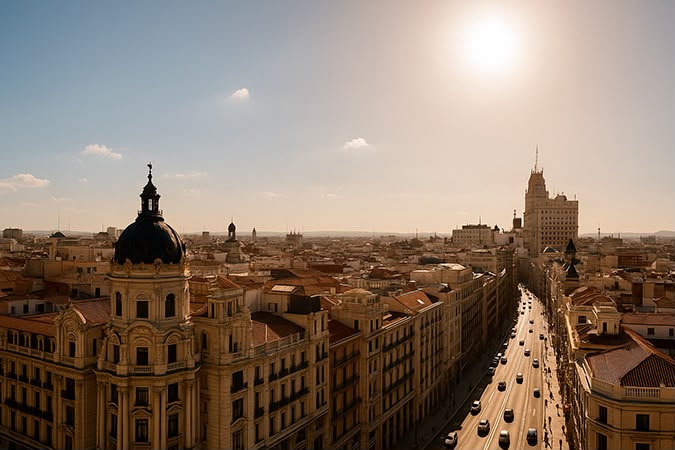
Europe has built the most sophisticated apparatus in the world for governing a warmer future, and almost nothing to survive the warmer present. That imbalance is no longer an abstraction traceable in budget lines. It is measurable this month in mortuary returns. The World Health Organization recorded more than thirteen hundred excess deaths across the continent in the first days of the June emergency alone, with France accounting for roughly a thousand1, and the World Weather Attribution network has judged the June heat all but impossible in a climate untouched by fossil-fuel warming.2 The heatwave in Europe is not a warning of what may one day arrive. It is an audit of what has already been left undone.
This Editorial Board has supported the bloc’s decarbonisation programme consistently, and continues to. Emissions reduction is the only measure that addresses the cause rather than the symptom, and abandoning it would condemn every future summer to worse than this one. The economic logic is equally settled: the Network for Greening the Financial System, the coalition of central banks that includes the European Central Bank, estimates that unchecked warming could cost the world economy some fifteen percent of output by mid-century,3 a sum that dwarfs the price of decarbonising now. Sustained mitigation spending is therefore not merely a climate obligation but a rational long-term investment, and nothing that follows disputes it.
The season has, however, exposed a governing assumption that can no longer stand: that cutting emissions and shielding citizens from heat are the same endeavour separated only by time. They are not. One is the work of half a century, paying its dividend in catastrophes averted decades hence. The other decides whether an elderly resident of Cologne or Córdoba survives the second week of August. A budget can honour the first imperative in full and still fail the second entirely, and this summer it has.
The arithmetic of a misallocated decade
The figures leave little room for defence. Between 2021 and 2025, 72 percent of the climate spending drawn from the Union’s joint budget went to mitigation, the discipline of preventing future warming. Eighteen percent went to adaptation, the work of surviving the warming already committed; the balance touched both.4 A continent that the European Environment Agency confirms is warming faster than any other on earth5 has assigned the smaller share of its climate money to the danger taking lives today. The heatwave in Europe has made that misjudgement impossible to ignore.
That allocation was a defensible bet a decade ago, when the gravest impacts still sat in the future tense. It is indefensible now. The warming that adaptation addresses is no longer a forecast but the ambient condition of a European summer, and the gap between a mitigation-weighted budget and an adaptation-shaped emergency widens with each season the proportions go uncorrected. The Agency’s own assessment describes a resilience effort still fragmented across member states, uneven in method, and short of the financing the threat demands.
The human toll of the heatwave in Europe
The cost of the heatwave in Europe gives that accounting its weight. Spain’s Carlos III Health Institute attributed more than a thousand deaths to June’s heat alone.6 Southern Sweden received warnings once reserved for the Mediterranean. In Almería, the deadliest wildfire in recent Spanish memory killed at least twelve people as residents fled the flames,7 and the fire season now opens a month ahead of schedule.
The longer record is graver still. Hans Kluge, the WHO’s European director, has stated that extreme heat killed more than two hundred thousand Europeans across four years, nearly all of those deaths preventable8, a toll surpassing the combined lethality of every other natural hazard the continent faces. Yet heat commands a fraction of the attention granted to floods and storms, partly because it kills without spectacle: not a broken riverbank but a temperature reading and a strained heart in a bedroom no camera records. A building stock raised to hold warmth rather than repel it, and a low penetration of cooling, turn that quiet hazard into a structural one. Europe is, in the literal sense, built for a climate that has departed.
Subsidiarity has hardened into an alibi
Brussels grasps the diagnosis the heatwave in Europe has forced on it. The Commission has pledged to reinforce its response and will publish an integrated framework for climate resilience in the final quarter of the year.9 Climate Commissioner Wopke Hoekstra has argued that Brussels cannot instruct Greeks in fighting wildfires or Spaniards in cooling their cities, that adaptation is local knowledge best held near the ground where the fire burns.
The position has merit and deserves a good-faith answer. Adaptation is local in execution. A heat-resilient hospital in Seville and a firebreak above the Pyrénées-Orientales are not drawn up in a Brussels directorate, and subsidiarity exists precisely because nearness to a problem so often confers competence over it.
But the argument has been conscripted into duty it was never meant to perform. Localism as a description of who implements has slipped into localism as an account of who pays. The Union finances the distant cure generously, then consigns the immediate defence to regions without the fiscal means to mount it. The result is not devolution but evacuation of responsibility. The heatwave in Europe has found the exact seam between what Brussels designs and what member states can afford, and it is there that people have died.
What this paper expects of the autumn framework
The resilience framework due in the fourth quarter is the Union’s formal answer to the heatwave in Europe, and it must be received as a foundation, not a milestone. Three tests will show whether it answers the summer or merely memorialises it.
It must carry money, not method alone. A strategy that harmonises best practice while the adaptation share of the budget lingers near a fifth of climate spending will have restated the problem in more polished prose. The multiannual financial framework now under negotiation for 2028 to 203410 is the instrument through which that proportion is corrected or cemented for another seven years, and a budget is where a declared priority meets the evidence of what it was willing to fund.
It must accord extreme heat the seriousness reserved for sudden catastrophe. A hazard that has claimed two hundred thousand lives in four years warrants dedicated financing, binding standards of preparedness, and health systems provisioned for a summer that now begins in May. Heat has earned, through sheer mortality, the standing of a first-order emergency.
And it must settle the financial question Hoekstra’s localism leaves open. If adaptation is delivered locally, its resources must be guaranteed centrally, through a dedicated and ring-fenced stream rather than the residue of budgets built for other ends. Absent that guarantee, subsidiarity becomes a mechanism for transferring blame downward as the temperatures climb.
Europe did not choose this climate. It did choose where to spend against it, and it chose the horizon over the present. The dead of this summer are the price of preparing diligently for 2050 while leaving 2026 to improvise its own survival. The heatwave in Europe has returned its verdict on that choice, written in a mortality count no strategy document can soften. Whether the Union revises the choice or merely annotates it is the sole question the autumn is left to answer.
Sources:
- Tedros Adhanom Ghebreyesus, WHO Director-General, statement of 28 June 2026: more than 1,300 excess deaths across Europe since 21 June. https://www.who.int/europe
- World Weather Attribution, rapid attribution study, June 2026. https://www.worldweatherattribution.org/fossil-fuel-emissions-have-rapidly-worsened-european-heatwaves-in-just-a-few-decades/
- Network for Greening the Financial System, Phase V climate scenarios and COP30 declaration. https://www.ngfs.net/en/press-release/ngfs-issues-declaration-economic-cost-climate-inaction-cop30
- European Commission climate-mainstreaming data on EU joint-budget spending, 2021–2025 (72% mitigation / 18% adaptation); figures reported by Reuters. https://commission.europa.eu/strategy-and-policy/eu-budget/long-term-eu-budget_en
- European Environment Agency, Europe’s climate resilience assessment, 2026. https://www.eea.europa.eu/en/newsroom/news/extreme-weather-and-uneven-climate-adaptation-challenge-europes-resilience
- Instituto de Salud Carlos III (Spain), June 2026 heat-mortality estimate. https://www.isciii.es/
- Almería wildfire, southern Spain, July 2026; agency reporting. https://www.who.int/europe
- Hans Kluge, WHO Regional Director for Europe, statement of 11 June 2026. https://www.who.int/europe/news/item/11-06-2026-statement—europe-lost-200-000-people-to-heat-in-4-years-yet-nearly-all-of-them-were-preventable
- European Commission, integrated framework for climate resilience (in preparation). https://climate.ec.europa.eu/eu-action/adaptation-and-resilience-climate-change/about-climate-adaptation-and-resilience_en
- European Commission, multiannual financial framework 2028–2034. https://commission.europa.eu/strategy-and-policy/eu-budget/long-term-eu-budget_en
The Weekly Editorial
This is the editorial position of The European Post, published weekly on matters of European and international strategic significance. It represents the view of the Editorial Board.