

Twice in July, Brussels removed the expiry date from a countermeasure it holds against Washington. One deadline is now left standing, and it falls on 31 December.
Three weeks apart this summer, and with no announcement on either occasion, the European Union deleted the expiry date from two separate sets of countermeasures it holds against the United States. Neither decision reached a front page. Read together, they say more about how Brussels intends to enforce the transatlantic bargain than anything spoken aloud since Turnberry, and what they say is: not on any particular day.
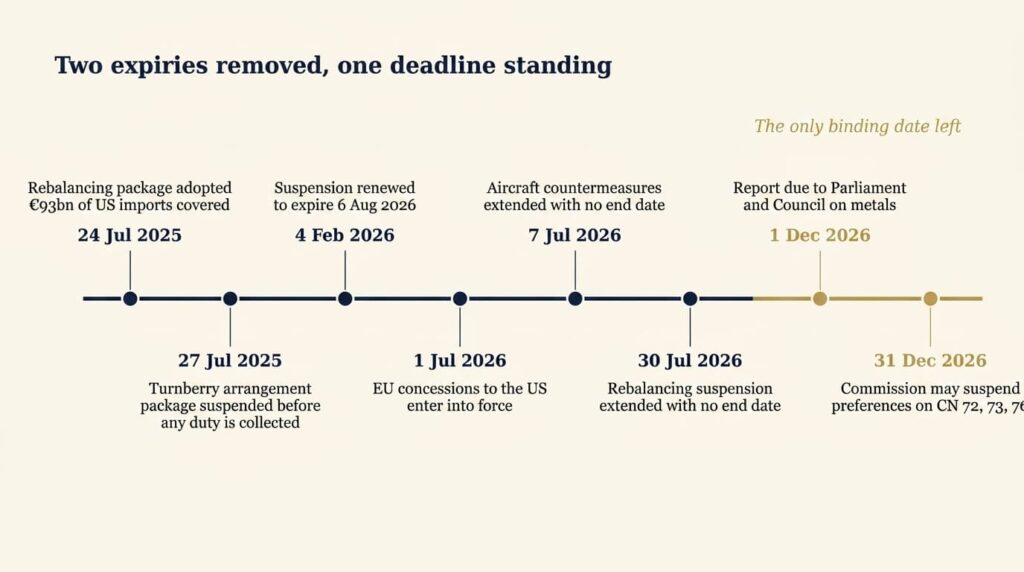
The second of the two came due yesterday. Under the implementing act adopted in February, the Union’s suspension of its rebalancing measures against the United States ran out on 6 August. Somebody in Brussels would have had to open the transatlantic file, form a judgement about whether Washington had kept its side of the bargain, and either extend the pause or allow a countermeasure package covering 93 billion euro of imports to come back to life.
That judgement was never made. On 30 July the Commission adopted a fresh implementing regulation removing the end date altogether. The rebalancing measures stay dormant, now with no term attached to them.
In its statement of 31 July the Commission called the move “another important step in favour of greater certainty and stability in transatlantic trade,” adding that it expects Washington to honour its own commitments under the Joint Statement in the same spirit. Within that frame of reference the claim is accurate. Nothing changed at any tariff line on 6 August. What changed is that the suspension of the rebalancing measures no longer forces the Union to state a view about American compliance on any fixed schedule.
What The Rebalancing Measures Were Actually For
The package dates from 24 July 2025. Adopted under the Enforcement Regulation as American tariff threats reached their height, it covered 93 billion euro of European imports from the United States and imposed an export restriction worth 95 million euro. Three days later the Turnberry meeting produced a political arrangement, and the whole package went into suspension before a single duty was collected.
Read as economics, the rebalancing measures were always a modest instrument. Read as procedure, they were something better. Twice a year the Commission had to conclude, in writing and in public, that the transatlantic arrangement still merited the benefit of the doubt. Parliament could interrogate that conclusion. European industry could organise around the date. The expiry was not friction in the system. It was the system.
The Case For Taking The Date Away
The Commission’s reasoning deserves a fair hearing, because on its own terms it holds. A countermeasure package renewed every six months generates a manufactured crisis every six months. Exporters price that recurrence into their contracts. Each renewal window invites speculation about a trade conflict neither capital wants. The power to reactivate the rebalancing measures survives untouched, and the implementing act keeps the suspension under continuous review.
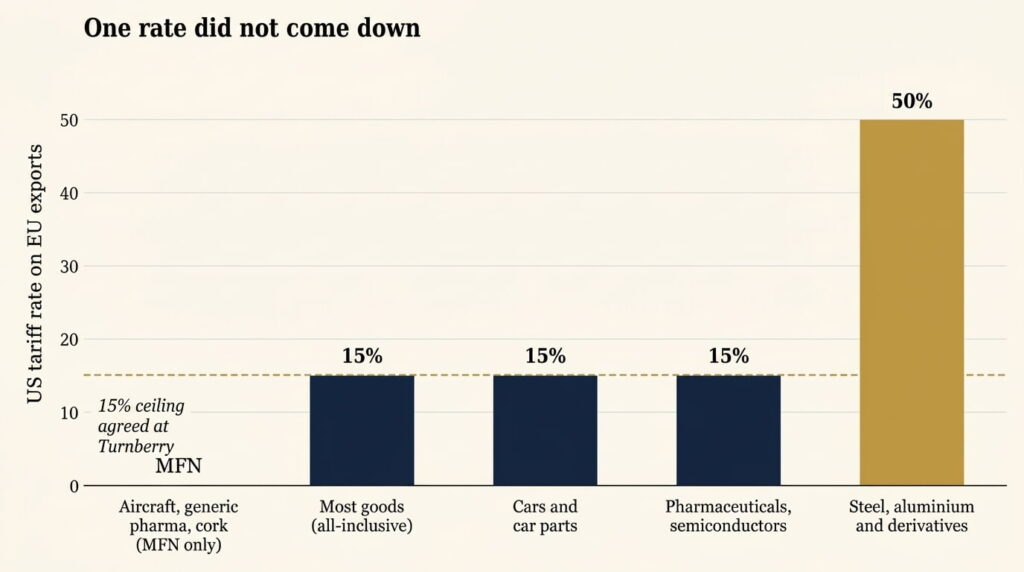
The underlying settlement has also delivered. Since 1 July, European cars entering the American market pay 15% rather than 27.5%. Pharmaceuticals and semiconductors sit beneath the same ceiling, with no stacking on top of it. Aircraft, generic medicines, and cork face most favoured nation treatment alone. Set against gains of that order, rebalancing measures nobody ever intended to fire look like a reasonable thing to stop arguing about.
The Asymmetry The Calendar Was Concealing
One difficulty remains. What Europe undertook at Turnberry is now binding law. Regulation (EU) 2026/1455 stripped duties from American industrial goods and opened agricultural lines, and it has applied since the beginning of July. What Washington undertook on metals is not law, and it has not happened. European steel, aluminium, and their derivatives still meet a rate of 50%. In August 2025 the American administration widened that treatment to a further 407 derivative categories. A year past Turnberry, by the Commission’s own account, the metals file has not moved.
A suspension that expires must be defended. A suspension without a term must be attacked.
This is why a change of form matters more than its authors suggest. Renewal placed the burden on whoever wished to continue the pause. An open-ended suspension places it on whoever wishes to end it. Within an executive that assembles positions across twenty-seven governments and several directorates-general, the location of that burden is not administrative detail. It decides what happens.
Reactivation has not become impossible. It has become an initiative rather than a default, and anyone who has watched the Union reach a trade decision under time pressure understands the distance between those two things. A deadline supplies what consensus institutions cannot manufacture on demand, which is a reason to conclude something this week rather than next quarter.
The Same Decision, Taken Twice
July’s other deletion attracted even less notice, and it is the more instructive of the pair. The countermeasures arising from the large civil aircraft disputes, imposed in November 2020 on roughly four billion dollars of American goods, were suspended in July 2021 for a fixed period of five years. That period ran out on 11 July this year. Days before it did, the Commission adopted a further act keeping the duties dormant, this time with no fresh date attached, on the reasoning that Washington had not revived its own measures and that the conditions justifying suspension were unchanged.
The aircraft precedent matters because the five-year term was no accident of drafting. It was negotiated. Both capitals wanted a horizon in 2021, and the cooperative framework built around it assumed that a settlement would either arrive by a stated point or be revisited at one. What has replaced that horizon is a disposition. Twice in a single month, under the same enforcement regulation, the Union converted a dated pause into an indefinite one, and on each occasion the ground given was stability.
Brussels has not surrendered its instruments. It has surrendered the days on which it was obliged to consider using them.
The One Date That Still Binds
What survives is a single hard date. Under the main regulation, the Commission may adopt an implementing act suspending preferences on goods falling within chapters 72, 73, and 76 of the Combined Nomenclature if, on 31 December 2026, the United States is still applying more than 15% to European steel and aluminium derivatives. A report to Parliament and Council on the tariff treatment of those products falls due by 1 December.
Everything else in the architecture runs long or runs indefinitely. The main regulation stands until the close of 2029. The rebalancing measures now carry no term whatsoever, and neither do the aircraft duties. December is the entirety of Europe’s enforcement calendar, compressed into one paragraph of one legal text.
The recent record with dates offers little reassurance. Parliament’s trade committee put off its vote twice in January, first when American tariff threats over Greenland unsettled the file, then after a ruling in Washington on emergency economic powers. The plenary approved the main regulation in March, and the co-legislators had by then strengthened it with a sunset clause and a safeguard mechanism the original proposal lacked. Each postponement carried a defensible reason. The pattern is what deserves attention: when the calendar met political weather, the calendar gave way.
An expiry date is the cheapest enforcement mechanism a trading bloc owns. The Union has stopped paying for it.
What December Will Actually Ask
The Commission will publish its report into conditions it has made more comfortable for itself. Nothing lapses. No package revives unaided. Acting on metals would oblige the institution to reverse, by deliberate act, an arrangement it declared open-ended five months earlier, and to argue against the position it adopted in July, that predictability is worth more than pressure.
Europe did not lose the transatlantic negotiation at the tariff line. It made a defensible exchange under genuine duress, and it wrote guardrails into the result. Every instrument it built remains on the statute book, available and intact. The calendar obliging anyone to reach for one has gone. Enforcement was never really a question of how large a package was. The question was whether a day existed on which somebody had to decide. Europe has one such day left, and it falls on the last of December. A power that will not say when it acts has already answered whether it will.
ABOUT THE AUTHOR
Lukas Weber is a Brussels-based senior analyst and the international editor of The European Post, and writes on European external relations and geopolitics.