
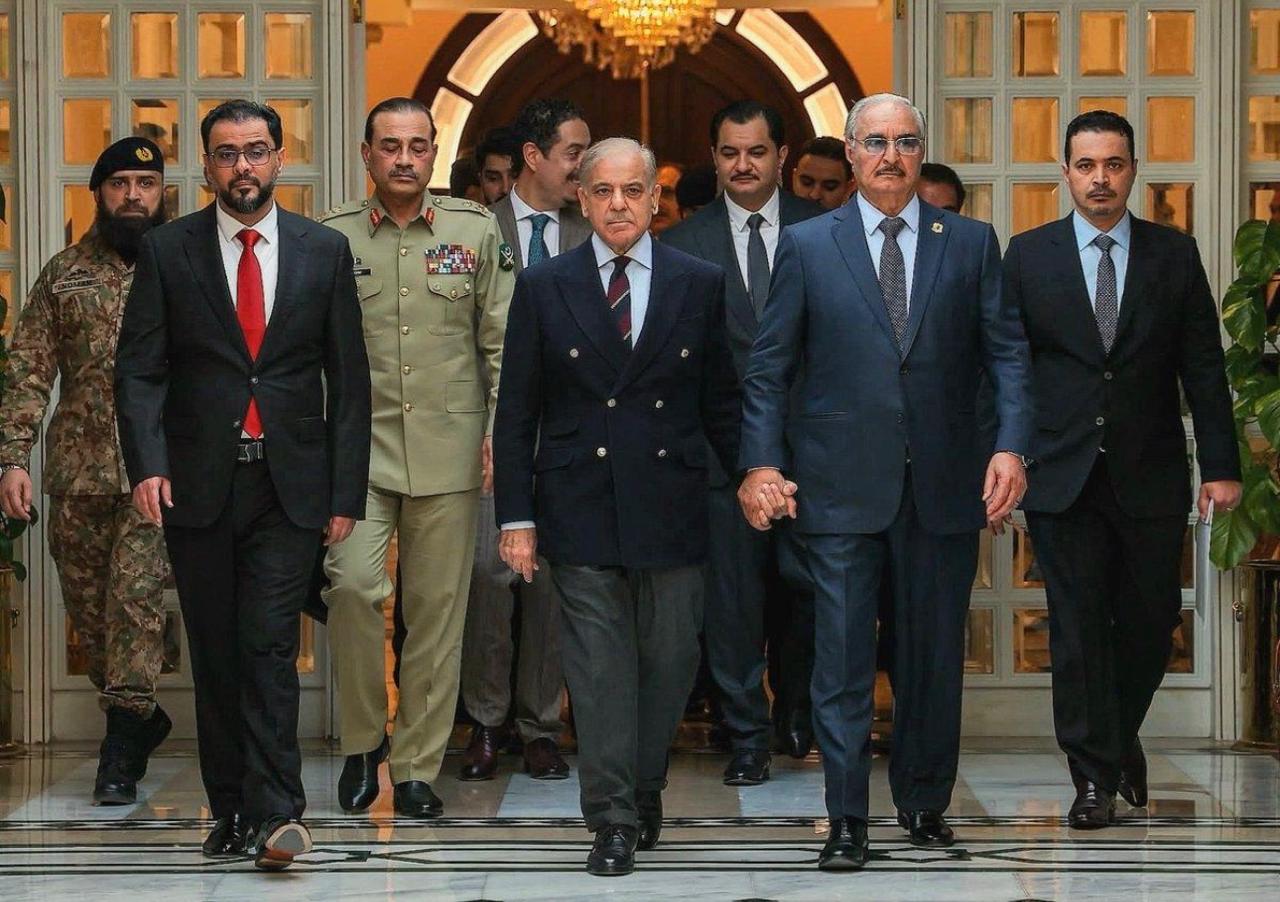

Seventy-nine years on, Pakistan was asked to broker Libya’s reunification. The European Union, the country’s biggest donor, was not asked at all. Why not?
Fifteen years after NATO aircraft flew over Tripoli, the question of who governs Libya is being worked on in Islamabad. Reuters reported on 6 July, citing two Pakistani sources, that Pakistan had quietly begun brokering between the Government of National Unity in the west and the eastern power centre commanded by Field Marshal Khalifa Haftar. Both sources said the effort began late last year and that both Libyan sides had requested it.
A summary of the proposed Libya Reunification Plan shared with the agency sets out a thirty-six month transition under a Government of National Consensus and a Presidential Council, with Abdulhamid Dbeibah staying on as prime minister, Saddam Haftar chairing the Council, and Khalifa Haftar’s camp holding authority over the national budget. One of the sources cautioned that the proposal was still being discussed in detail.
The same account records the surrounding endorsements: one source described the United States as fully aware and involved, both said Saudi Arabia was supporting the effort, and both said Qatar and Turkey had encouraged Islamabad to take the role on. That list deserves a caveat rather than a flourish. None of those governments has confirmed any of it. The agency reported that Pakistan’s foreign ministry, its military media wing, and the foreign ministries of Qatar, Turkey, Saudi Arabia, and the United States did not respond to requests for comment. Readers should weigh a two-source account accordingly, and this article makes no claim beyond what those sources said.
What is not in dispute is the shape of the thing. Brussels does not appear in the sentence.
Why Both Camps Accepted Pakistan’s Libya Mediation
The credit owed to Islamabad is specific, and it is worth stating precisely rather than generously. Pakistan did not out-manoeuvre anyone. It was chosen, which is harder.
Every other actor with weight in Libya arrived carrying a horse. Turkey armed and rescued the government in Tripoli. The United Arab Emirates and Egypt built up the east. France and Italy have pursued divergent lines for a decade, with Rome tied to energy operations in the west and Paris historically closer to the eastern command. Russia turned the country into a logistics corridor. Each of these parties can offer a Libyan faction something. None of them can easily persuade the other side that its involvement arrives without a preferred outcome.
Pakistan’s position is less compromised, though it is not spotless, and the qualification matters. Reuters reported in December that Pakistani officials had pursued defence ties with the eastern-based Libyan National Army, including the possible sale of JF-17 fighter jets and Super Mushshak trainer aircraft, in circumstances covered by a United Nations arms embargo. A broker holding live defence conversations with one party is not a disinterested broker in the textbook sense.
Part of the explanation sits in a record that turns seventy-nine years old today. United Nations peacekeeping records show that Islamabad has served in more than forty missions since its first Congo deployment in 1960, with its heaviest commitments in Africa. That record may help explain why Pakistani uniforms can be read as an international presence rather than as one power’s expeditionary force, and it is standing no European government has built by the same route.
The point survives the qualification for a straightforward reason. The western government, according to an unreported document seen by the agency, has separately sought direct talks with Islamabad anyway. Tripoli knows about the eastern contacts and asked regardless, which tells us something about the alternatives on offer. Add the mediating role Pakistan played between Washington and Tehran this year, credited publicly by the American administration, and a proposition emerges that European planners should sit with. Pakistan’s advantage may be the combination of access and limited stakes: enough relationship to be heard in both capitals, and too little economic or territorial interest in Libya for either camp to fear what it would do with a settlement. Weight, on this reading, is what disqualifies a broker rather than what recommends one.
Pakistan’s Libya mediation should therefore be read as a judgement Libyans made about the available brokers, not as a triumph Islamabad engineered. That is the more interesting fact, and the more uncomfortable one for Brussels.
The Case For How Europe Has Played It
The European position deserves its strongest defence before it is criticised.
Brussels made a deliberate choice to work through the United Nations rather than around it. The European External Action Service has consistently framed Union policy as support for the UN-led intra-Libyan process and the Berlin framework, and there is principle in that. Libya has suffered from a surplus of outside plans, not a shortage.
Twenty-seven states with three or four competing national lines would struggle to hold a single negotiating position, and a European track running against the UN track would have handed the factions one more auction to run.
The technical record has defenders too. The Union has funded stabilisation programmes, deployed the EUBAM border assistance mission, and run Operation Irini with an arms embargo mandate. Migration cooperation, whatever its costs, answers a domestic pressure that European governments cannot wish away.
There is a coherent argument here: Europe kept its hands clean of factional patronage, funded the state rather than its warlords, and left the political settlement to the body holding the mandate.
What The Ledger Shows Instead
The argument does not survive the ledger. Andrea Cellino, writing for the Stimson Center in 2026, describes a Union that remains Libya’s largest donor while operating as a marginal political actor, having ceded ground to Russia, Turkey, and the Emirates by choosing technocratic intervention over strategic engagement. Money went in. Standing did not come out.
The reason is that Europe did not stay neutral. It bought access, which is a different thing. An SWP Berlin comment published in September 2025 traces how migration cooperation since 2017 drew European governments into arrangements with Libyan security actors who then escalate their demands. Reporting in June 2026 indicated that member states had agreed to extend the same cooperation eastward.
Libyans understood the bargain, and European analysts recorded it. The European Council on Foreign Relations describes Libyan officials treating migration and counterterrorism less as shared policy problems than as instruments for extracting recognition, funds, and support against domestic rivals.
A party that pays Libyan forces to stop departures is not read as a neutral party. It is read as a customer. Customers do not get asked to chair the table, because both sides know what the customer wants and can price it accordingly.
That may well be the mechanism behind the missing invitation, and it is worth separating from the familiar complaint about European strategic weakness. Nothing in the reporting says the Libyan camps weighed Brussels and rejected it over migration policy. What the evidence supports is narrower and still damaging: the relationships Europe had already built had cost it some of the credibility a chair needs, and the parties knew the terms.
A Crowded August
The point sharpens this month. Turkish Foreign Minister Hakan Fidan met Dbeibah in Tripoli and both Khalifa and Saddam Haftar in Benghazi on 12 August, and afterwards presented the trip as a demonstration of an approach that draws no distinction between Libya’s west, east, and south. American mediation runs on a separate track through presidential adviser Massad Boulos. Wolfram Lacher, writing in the New York Review of Books on 5 August, reports that the core of the Boulos proposal is a unified executive making Saddam Haftar president while Dbeibah remains prime minister, and argues that the plan should be taken seriously mainly for the damage it could do.
So the field is busy: Ankara moving between both capitals in a single visit, Washington pressing an executive formula, Pakistan’s Libya mediation holding a channel both camps requested. Europe funds much of the terrain on which this is taking place, and sits in none of the principal rooms where the current settlement is being shaped.
The stakes are not abstract. Libya is where European energy supply, Mediterranean security, and the migration politics that have reshaped several member state governments all converge. Few files in the southern neighbourhood carry more domestic consequence, and none shows a wider gap between exposure and influence.
What Would Have to Change
The corrective is not another European plan. It is a decision to separate the migration relationship from the political one, so that Europe can hold a position on Libya’s constitutional future that is not hostage to what it needs from Libyan security forces next month. Until those two files are prised apart, any European approach to a Libyan faction will be read, correctly, as a transaction.
A second step follows, and it is not really a complaint about Brussels. The gap that counts runs between a common European policy and member states that go on pursuing separate national interests in Libya. Rome, Paris, and Athens working three lines produces three prices and no bargaining weight worth the name. Neither the Commission nor the External Action Service can close that gap alone, because the divergence sits in the capitals rather than in the institutions.
One mechanism would test whether it can be closed at all. The Union does not lack representation in Libya. It keeps a delegation in Tripoli headed by an EU ambassador. What it lacks is a negotiator carrying a mandate from the member states to speak for all of them at a settlement table. An ambassador represents a presence. A mandate from the Council confers the authority to trade, and trading authority is precisely what the other brokers in Libya hold and Europe does not.
None of this requires new money. All of it requires accepting that influence in Libya is not purchased. It is conceded by parties who believe you have no stake in which of them wins.
The Conditional Feather
Nothing is settled. Tarek Megerisi of the advisory firm Informmi cautioned to Reuters that there is no guarantee a signed deal would hold, drawing a comparison with agreements elsewhere that did not survive contact with the ground. The Council on Foreign Relations makes the related point that any settlement lacking firm backing from both Dbeibah and Haftar is likely to deepen polarisation rather than end it. Libya has broken every framework that came before, usually where oil revenues and security appointments have to be divided.
If Pakistan’s Libya mediation holds, it is another feather that could go in Islamabad’s cap, earned honestly, and worth saying so from Brussels. But the sentence Europe should be reading is the earlier one, the one about who was asked. Libya’s rival camps looked across the field of available brokers and settled on a South Asian state with no oilfield, no militia client, and no border arrangement to protect.
They did not look north. The Union should want to know why not, because much of the answer is written in its own accounts.
ABOUT THE AUTHOR
Azfar Bukhari is a senior analyst specialising in geopolitics, public diplomacy, migration, international trade, and investment. He is the Vice President (External Relations & Diplomacy) and a regular contributor to The European Post.