August 22, 2026
LATEST
What the EU Taiwan Framework Would Actually Have to DoKorea Signed a Digital Trade Deal That Nobody Has RatifiedCritical Minerals in Mongolia Still Have to Cross Two BordersCan an Indonesia Trade Deal Survive Two Years of RatifyingCross-Border Data Orders Went Live Before the Plumbing DidPlatform Work Rules Take Effect in December and Few Are ReadyCan Europe’s Firefighting Fleet Keep Pace With EU WildfiresThe AI Act Deadline Passed on 2 August and Nothing BitWhy Construction Keeps Shrinking While Confidence ImprovesAccession Talks Stall Again and September 1 Is the TestBrussels Applied a Trade Deal It Cannot Yet RatifyAfrica’s Power Market Now Needs Money More Than BlueprintsLong-Term Budget Talks Enter Autumn Without a Council LineForeign Subsidies Enforcement Now Turns on a Dublin RaidWho Writes Europe’s Telecom Rules Once Copper DisappearsDisability Cards Exist on Paper and Nowhere Else Until 2028Losing Visa-Free Travel Now Takes a Thirty Percent SwingTwenty Flagship Actions Will Test Whether the Culture Compass WorksEurope’s Quality Jobs Act Now Rests on What Unions Do by SeptemberDoes a Three Euro Parcel Duty Change Anything About Cheap ImportsWhat the EU Taiwan Framework Would Actually Have to DoKorea Signed a Digital Trade Deal That Nobody Has RatifiedCritical Minerals in Mongolia Still Have to Cross Two BordersCan an Indonesia Trade Deal Survive Two Years of RatifyingCross-Border Data Orders Went Live Before the Plumbing DidPlatform Work Rules Take Effect in December and Few Are ReadyCan Europe’s Firefighting Fleet Keep Pace With EU WildfiresThe AI Act Deadline Passed on 2 August and Nothing BitWhy Construction Keeps Shrinking While Confidence ImprovesAccession Talks Stall Again and September 1 Is the TestBrussels Applied a Trade Deal It Cannot Yet RatifyAfrica’s Power Market Now Needs Money More Than BlueprintsLong-Term Budget Talks Enter Autumn Without a Council LineForeign Subsidies Enforcement Now Turns on a Dublin RaidWho Writes Europe’s Telecom Rules Once Copper DisappearsDisability Cards Exist on Paper and Nowhere Else Until 2028Losing Visa-Free Travel Now Takes a Thirty Percent SwingTwenty Flagship Actions Will Test Whether the Culture Compass WorksEurope’s Quality Jobs Act Now Rests on What Unions Do by SeptemberDoes a Three Euro Parcel Duty Change Anything About Cheap Imports
August 22, 2026
LATEST
What the EU Taiwan Framework Would Actually Have to DoKorea Signed a Digital Trade Deal That Nobody Has RatifiedCritical Minerals in Mongolia Still Have to Cross Two BordersCan an Indonesia Trade Deal Survive Two Years of RatifyingCross-Border Data Orders Went Live Before the Plumbing DidPlatform Work Rules Take Effect in December and Few Are ReadyCan Europe’s Firefighting Fleet Keep Pace With EU WildfiresThe AI Act Deadline Passed on 2 August and Nothing BitWhy Construction Keeps Shrinking While Confidence ImprovesAccession Talks Stall Again and September 1 Is the TestBrussels Applied a Trade Deal It Cannot Yet RatifyAfrica’s Power Market Now Needs Money More Than BlueprintsLong-Term Budget Talks Enter Autumn Without a Council LineForeign Subsidies Enforcement Now Turns on a Dublin RaidWho Writes Europe’s Telecom Rules Once Copper DisappearsDisability Cards Exist on Paper and Nowhere Else Until 2028Losing Visa-Free Travel Now Takes a Thirty Percent SwingTwenty Flagship Actions Will Test Whether the Culture Compass WorksEurope’s Quality Jobs Act Now Rests on What Unions Do by SeptemberDoes a Three Euro Parcel Duty Change Anything About Cheap ImportsWhat the EU Taiwan Framework Would Actually Have to DoKorea Signed a Digital Trade Deal That Nobody Has RatifiedCritical Minerals in Mongolia Still Have to Cross Two BordersCan an Indonesia Trade Deal Survive Two Years of RatifyingCross-Border Data Orders Went Live Before the Plumbing DidPlatform Work Rules Take Effect in December and Few Are ReadyCan Europe’s Firefighting Fleet Keep Pace With EU WildfiresThe AI Act Deadline Passed on 2 August and Nothing BitWhy Construction Keeps Shrinking While Confidence ImprovesAccession Talks Stall Again and September 1 Is the TestBrussels Applied a Trade Deal It Cannot Yet RatifyAfrica’s Power Market Now Needs Money More Than BlueprintsLong-Term Budget Talks Enter Autumn Without a Council LineForeign Subsidies Enforcement Now Turns on a Dublin RaidWho Writes Europe’s Telecom Rules Once Copper DisappearsDisability Cards Exist on Paper and Nowhere Else Until 2028Losing Visa-Free Travel Now Takes a Thirty Percent SwingTwenty Flagship Actions Will Test Whether the Culture Compass WorksEurope’s Quality Jobs Act Now Rests on What Unions Do by SeptemberDoes a Three Euro Parcel Duty Change Anything About Cheap Imports

Why Europe Is Betting on a Cable Beneath the Caspian Sea

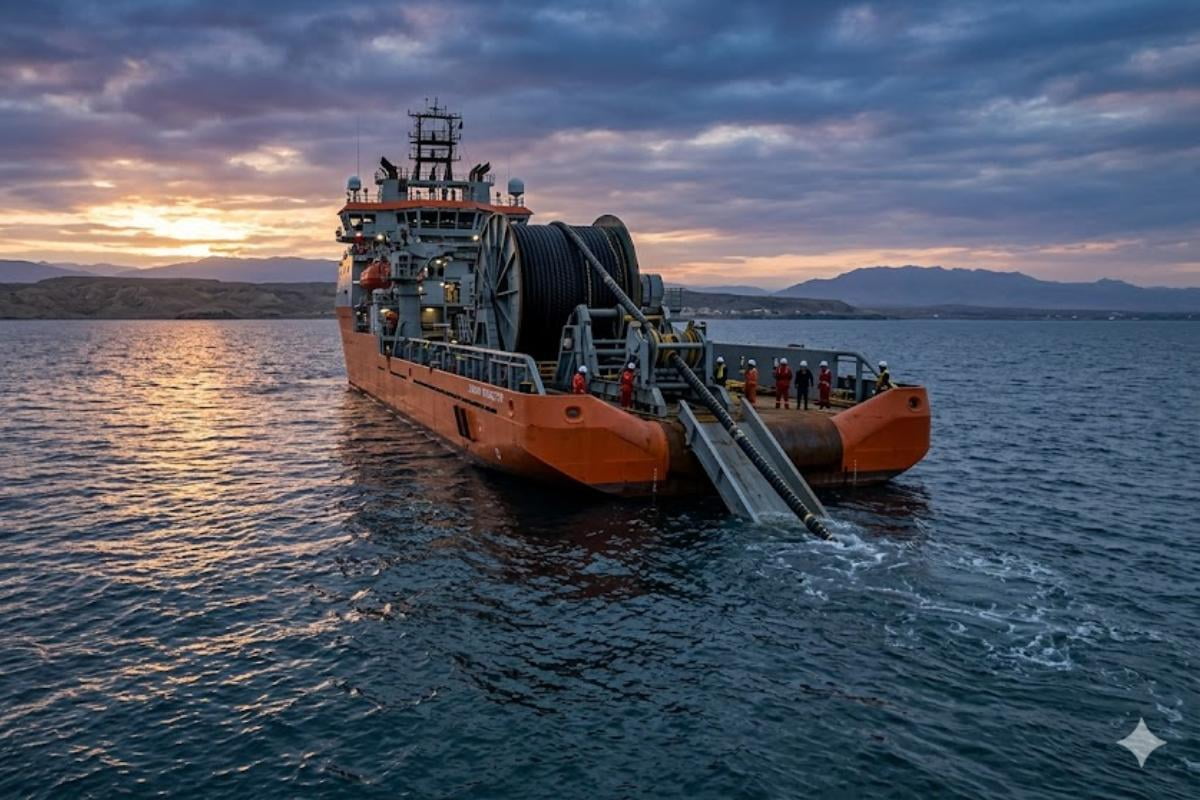
Aktau: The Middle Corridor spent three years living mostly inside slide decks, and this month it acquired something harder to argue with. Engineers hauled a 380-kilometre submarine cable ashore on this stretch of Kazakh coast in early August, finishing the most technically awkward stage of the first fibre-optic line ever laid across the Caspian Sea. Kazakhtelecom and its Azerbaijani partner ran the link from Sumgayit, and both sides expect commercial traffic before the year closes.

Brussels did not lay that cable. It has, however, spent lavishly on the reasoning behind it. At the EU-Central Asia summit the Union pledged twelve billion euro under Global Gateway, earmarking three billion for the Middle Corridor on top of ten billion promised the previous year. Add the European investment banks and national development agencies and roughly twenty-two billion euro now stands behind a single proposition, that goods and data moving between China and Europe should have a route that avoids both Russian rail and the Red Sea.

The engineering case is strong. The finished cable will carry more than 400 terabits per second across a sea that until now forced every packet through Russian or Iranian territory. Kazakh officials describe the landing as the point where the project stops being speculative. For European firms weighing cloud investment in Central Asia, a second physical path out of the region changes the risk calculation more than any communique ever did.

The freight numbers deserve more scepticism. The corridor is projected to move roughly 5.2 million tonnes this year. A single large container vessel carries a fraction of that, yet the maritime route between Asia and Europe handles volumes an order of magnitude greater. Even the optimistic forecast, which halves delivery times to about fifteen days, describes a premium niche rather than a replacement artery. Ferries across the Caspian remain the binding constraint, and no fibre-optic cable widens a port.

Politics complicates the picture further. Every westbound tonne must transit Azerbaijan and then either Georgia or Turkey, which hands real leverage to governments the Union criticises on rule-of-law grounds in one meeting and courts as connectivity partners in the next. Kazakhstan and Uzbekistan, meanwhile, still route the bulk of their trade through Russia and have no intention of announcing otherwise. European negotiators know this. They have chosen to build options rather than demand alignment, which is probably the only strategy available.

What Europe gains, then, is narrower than the rhetoric suggests but not trivial. A working digital and physical corridor gives Central Asian states an alternative to Chinese infrastructure finance and Russian transit control, and it gives European exporters a hedge they can price. That is a modest return on twenty-two billion euro if you measure it in tonnage. Measured in leverage, it looks better.

The harder test arrives next year, when the cable carries paying customers and someone has to explain why the rail volumes underneath it have not grown at the same pace. Connectivity money buys assets quickly and habits slowly. Brussels has bought the assets. Whether the freight follows depends on customs officials in five countries agreeing to procedures that no summit can impose on them.