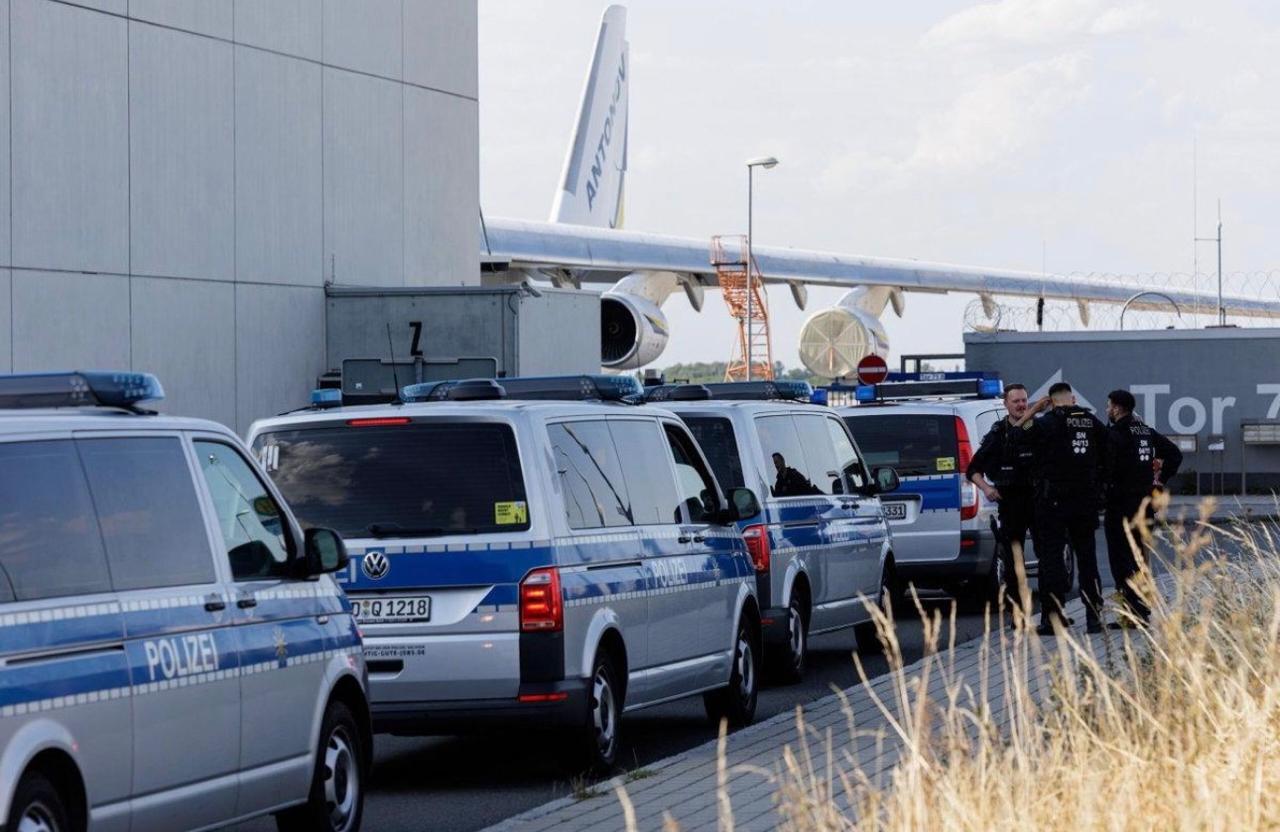

An explosive-laden drone was found on the tarmac at Leipzig airport metres from a Ukrainian cargo plane loaded with ammunition. A German drone-company founder has cancelled his trade-show appearances and moved under police protection after two people allegedly photographed his front door for three months. An ammunition plant outside Rome sent up a plume that residents mistook for an earthquake. A Bulgarian arms warehouse burned down, the fourth such fire at the same manufacturer’s sites since 2011, by the company’s own count. Four drones have now been shot out of Romanian skies since July, the most recent by a Spanish jet flying a NATO air-policing rotation. None of this happened over years. It happened in August, and it is the shape Russia’s hybrid campaign against Europe has settled into.
Read together, the month looks like a single campaign, and European officials increasingly describe it that way. Read one incident at a time, which is how Europe’s institutions are built to read it, most of it does not clear the bar that would let any European institution act on it as one.
A Month That Reads Like a Pattern
The intensity of the hybrid attacks is not in dispute. Bloomberg’s reporting this week found Brussels and national capitals still without a settled posture toward it, with one Atlantic Council fellow, Agnia Grigas, telling the wire service that European responses have “focused on detecting and countering individual provocations,” without ever assembling a track record that actually deters Moscow from continuing. A congressional research service count cited in the same reporting cycle found that recorded Russian hybrid incidents in Europe quadrupled between 2023 and 2024, and nothing since suggests the curve has bent back down.
The intent behind the hybrid attacks is also not seriously disputed. What is disputed, incident by incident, is who carried each one out, and that is where the trouble starts.
The Case For Demanding Proof
Europe’s caution here has a real argument behind it, and the argument deserves to be made before it is answered. A sanctions listing, an expulsion, or a criminal charge that later turns out to rest on the wrong actor does not just embarrass the institution that issued it. It hands Moscow a genuine grievance, wastes the diplomatic capital needed for the next, better-evidenced case, and risks a public appearing before the EU’s own General Court to have the listing struck down. National prosecutors face a version of the same constraint under a heavier duty: a charge that cannot survive a courtroom is worse than no charge at all, since an acquittal reads publicly as exoneration regardless of what intelligence services privately believe. Democracies that skip this discipline because an adversary is in a hurry do not stay democracies for long. On this account, what looks like European paralysis is in fact European institutions doing exactly what they are supposed to do: waiting for proof before they act on it.
Why The Proof Rarely Arrives Clean
The trouble is that this month’s hybrid attacks, graded against that standard, sort into three tiers, and only the smallest tier clears it.
At the top sits Leipzig. US intelligence assessed that the explosive device found near the Ukrainian aircraft on 5 August carried the signature of Russia’s military intelligence directorate, an assessment reached jointly with German services. Germany’s own government has since classified the incident as a hybrid attack scenario, with Interior Minister Alexander Dobrindt calling it a security-relevant incident of a new order of danger, though Dobrindt has pointedly declined to name Russia, speaking instead of unspecified foreign powers even as opposition politicians and the US assessment behind the story point directly at Moscow. German Chancellor Friedrich Merz said publicly that those responsible “will pay the price.” This is as close to a clean case as the month has produced, and even here the government’s own spokesperson stops short of the word its own intelligence services are reported to believe.
In the middle sits the case of Stefan Thumann, founder of the Bavarian drone maker Donaustahl. Germany’s domestic intelligence service treats the file as a suspected assassination plot, and press reporting on the case describes months of surveillance of Thumann’s home and offices. German reporting has gone further still, naming the nerve agent Novichok as the alleged planned method, a detail a Bundestag member from the Christian Democratic Union has since repeated on the record. But the charge sheet Germany’s Federal Prosecutor General actually published names only suspected activity as an agent of a foreign intelligence service, an offence under Germany’s espionage statute, with no mention of a killing, let alone a nerve agent, anywhere in the document. The murder theory sits in the intelligence assessment and the press coverage built on it, not in the legal charge itself. Even the strongest publicly documented case against an individual this month stops short, in the actual paperwork, of what a court has been asked to find.
At the bottom sits everything that reads like sabotage and investigates like an accident. The blast at the KNDS ammunition plant in Colleferro, near Rome, is still without a confirmed cause weeks later, and Italian investigators’ working hypothesis points toward an industrial accident in the powder-pressing line, with early assessments having ruled out sabotage. Three days before it, an explosion tore through the EMCO arms warehouse in Belitsa, Bulgaria, and Bulgaria’s interior minister said the cause was most likely internal rather than foreign. That caution sits oddly next to the record on the same company’s earlier depots: Sofia’s City Prosecutor’s Office has issued European Arrest Warrants, in absentia, against six named Russian intelligence officers charged with terrorism over four Bulgarian arms-depot blasts since 2011, including two at the state producer VMZ Sopot and one at the Arsenal plant in Maglizh, a decision an appellate court has since upheld.
And the drone that a Spanish pilot shot down over Romania in August arrived from Moldovan airspace with an origin NATO called probable, while Romania’s own Ministry of Defence, in its official communique, said only that its systems had detected an aerial target entering national airspace, without naming Russia at all.
This is not a case of Europe failing to notice the hybrid attacks as a pattern. Assessments from institutions across the region, including GLOBSEC’s own analysis, have said openly that individual incidents keep being handled as isolated criminal matters rather than as parts of one Russian doctrine. The doctrine is named. What is missing is a mechanism that can act on a named doctrine without a courtroom-ready case behind every one of its component acts, and every instrument currently available, sanctions listings, expulsions, prosecutions, was built to require exactly that.
None of this is likely to be solved by weight of numbers alone. Brussels is preparing a further sanctions package for the autumn covering hundreds of individuals and entities, but the record of prior rounds gives little reason to expect this one to change Moscow’s calculus on its own. Marek Kohv of Tallinn’s International Centre for Defence and Security has tied Moscow’s willingness to use kinetic means directly to how the war is going on the battlefield, not to the length of a sanctions list. Adding names to a register that has not yet changed that calculation will not change it either, unless the register is paired with something that can act faster than the next listing round.
What a Graduated Response Would Look Like
None of this is an argument for lowering the bar that protects the innocent, or for retaliating on suspicion. It is an argument that Europe is trying to run three very different kinds of decision through one evidentiary gate, when only one of them needs to be there.
Physical protection does not need a verdict. The European Defence Industrial Programme already treats this correctly for one category of risk: its own published call documents assigned 166.4 million euros to hardening energetic-materials handling, without waiting for Colleferro or Belitsa to be solved. That model, protect the site regardless of who eventually gets blamed for threatening it, should extend as standard practice to every facility that appears on this month’s list, whatever tier its cause investigation lands in.
A published register would help more than another statement. National aviation authorities keep public, graded incident records that distinguish a confirmed mechanical failure from a probable cause from an open investigation, and nobody treats the distinction as an admission of weakness. A standing NATO-EU register of hybrid attacks, sorted the same way, GRU-linked and publicly assessed, criminally charged but narrower than alleged, under investigation with no attribution yet, would let the political system respond in proportion to what is actually known at any given moment, instead of waiting for every case to reach the Leipzig standard before it responds to any of them.
And the alliance’s own voice is worth more than it is currently being used for. NATO calling a drone’s origin “probable” without a formal government attribution, as it did after the Romanian shoot-down, already carries a cost to Moscow that a court filing does not, because it does not need to survive one. Used case by case, as it has been, that tool gets a single day of coverage. Used as a standing practice rather than an occasional statement, it becomes the thing the current instruments cannot be: a response that scales with partial evidence instead of waiting for complete evidence that a deliberately deniable campaign is not going to supply.
The Failure Is In The Architecture, Not The Services
The month’s record is not, in the main, a story of European intelligence missing what was in front of it. Poland caught an assassination plot before it happened. Germany caught the Thumann surveillance before it turned into something worse. Detection, on the evidence available, is working about as well as it reasonably can against operatives recruited anonymously online and instructed to keep no trace of who sent them.
What is not working is what happens after detection, and that is not a failure of vigilance. It is the predictable result of building every European response mechanism around proof of a kind that a campaign engineered around deniability was never going to hand over. Fix the architecture rather than the vigilance, and the fall sanctions package Brussels is preparing, whatever it ultimately contains, will finally be aimed at the size of the problem rather than only at the fraction of it that happened to leave a signature behind.
Note on the record: Attribution confidence for each incident cited above is graded from the sourcing available at time of publication: Leipzig rests on a joint US-German intelligence assessment reported by named officials; the Thumann case rests on a filed criminal charge narrower than the intelligence services’ own classification of the threat; the Colleferro and Belitsa incidents carry no attribution from any investigating authority as of publication and are presented as such. Where NATO or national officials used qualified language (“appears,” “probable,” “not officially confirmed”), that qualification is preserved rather than resolved into certainty.
Source Register:
Primary sources
The Federal Prosecutor General of Germany (Generalbundesanwalt), official press release, 24 March 2026: the actual charge against the two Thumann-case suspects, § 99 StGB (acting as an agent of a foreign intelligence service), with no killing or sabotage offence named.
The German Federal Government, official FAQ page on hybrid threats: Interior Minister Dobrindt’s on-record classification of the Leipzig incident as a hybrid attack scenario and a security-relevant incident of a new order of danger, without naming Russia.
The European Commission, Directorate-General for Defence Industry and Space: the official €166.4 million EDIP figure for energetic-components reinforcement.
Romania’s Ministry of National Defence, official communique carried by AGERPRES, 16 August 2026: the ministry’s own account of the Romanian drone shoot-down, which does not attribute the drone to Russia.
Congressional Research Service report via Congress.gov, 11 August 2026: the quadrupling of recorded Russian hybrid incidents in Europe between 2023 and 2024.
Bulgarian News Agency (BTA), the state news agency, 10 August 2026: EMCO’s own statement, carried by BTA, recalling similar incidents at its storage facilities in 2011, 2022 and 2023, the basis for the lede’s “fourth such fire” figure. An earlier build of this piece stated the Belitsa fire was “the second in three weeks,” a claim no source located this cycle supports; it has been corrected against this primary account.
Press reporting of formal legal action (near-primary)
24 Chasa, 30 January 2024, corroborated by News.bg on the appellate confirmation: the Sofia City Prosecutor’s Office’s European Arrest Warrants, issued in absentia against six named Russian intelligence officers on terrorism charges, covering all four Bulgarian arms-depot blasts since 2011 (the EMCO depot, VMZ Sopot twice, and Arsenal Maglizh). This is press reporting of a formal prosecutorial and judicial act, not the charging document itself, which was not opened this cycle.
Tagesspiegel, 8 August 2026: on-record reporting that Interior Minister Dobrindt declined to name Russia after Leipzig, speaking of foreign powers instead, a gap this piece treats as evidence for its own argument rather than a defect to paper over.
Press reporting and secondary analysis
Bloomberg, via the Jefferson City News Tribune syndication, 27 August 2026: the month’s overall pattern, the Grigas quotation, the blocked sanctions options (asset seizure, LNG ban, visa restrictions), and the autumn sanctions package.
ABC News, citing a US intelligence official: the GRU signature assessment on the Leipzig device, an intelligence finding with no published government document behind it.
Euronews, 25 August 2026: Chancellor Merz’s statement and the discovery of a third drone at Leipzig airport.
Planet Today, drawing on Die Zeit’s original reporting: the Thumann surveillance timeline, corroborating the Generalbundesanwalt release above.
The New Voice of Ukraine, citing Bild and Bavarian public broadcaster BR: the Novichok detail, including on-record remarks from Bundestag member Bastian Ernst (CDU) on RTL. This is press reporting of an intelligence assessment relayed through named officials, not a published document, the same evidentiary status as the Leipzig GRU attribution above.
Kyiv Independent, 13 August 2026: the initial Colleferro explosion report.
Brussels Signal: Italian investigators treating Colleferro as an industrial accident and ruling out sabotage in early assessments. No Italian prosecutorial statement was located directly; this remains press reporting of the investigators’ position.
LIGA.net: the Bulgarian interior minister’s statement on the Belitsa blast, relayed rather than drawn from a Bulgarian government release.
RFE/RL’s Bulgarian Service, via GlobalSecurity.org, 20 October 2023: background on the original Insider-Bellingcat identification of GRU Unit 29155 in the 2011 EMCO blast, superseded in this build by the prosecutorial action cited above.
GLOBSEC: the assessment that individual incidents are still handled as isolated crimes rather than as one Russian doctrine, a think-tank analytical judgement rather than a documentary source.
One claim in the piece rests on prior TEP verification rather than a fresh primary source this cycle: the reference to the foiled Warsaw plot in the closing section draws on the sourcing record built for the 18 August 2026 piece on that case, on file with this desk. One category of claim in this piece cannot be anchored to a primary document at all, by design: the GRU signature behind the Leipzig device, which rests on an unpublished intelligence assessment relayed by named officials to the press, a gap the German government’s own avoidance of naming Russia only confirms rather than closes. The Bulgarian prosecutorial pattern, previously flagged as undocumented, is now anchored to press reporting of a formal European Arrest Warrant and its appellate confirmation, though the underlying Bulgarian court filing itself was not opened this cycle.
ABOUT THE AUTHOR
Adrian Laurent is an Opinion Contributor and Policy Specialist specialising in defence and security. He writes on global conflict, military capabilities, and transatlantic security policy for The European Post.