
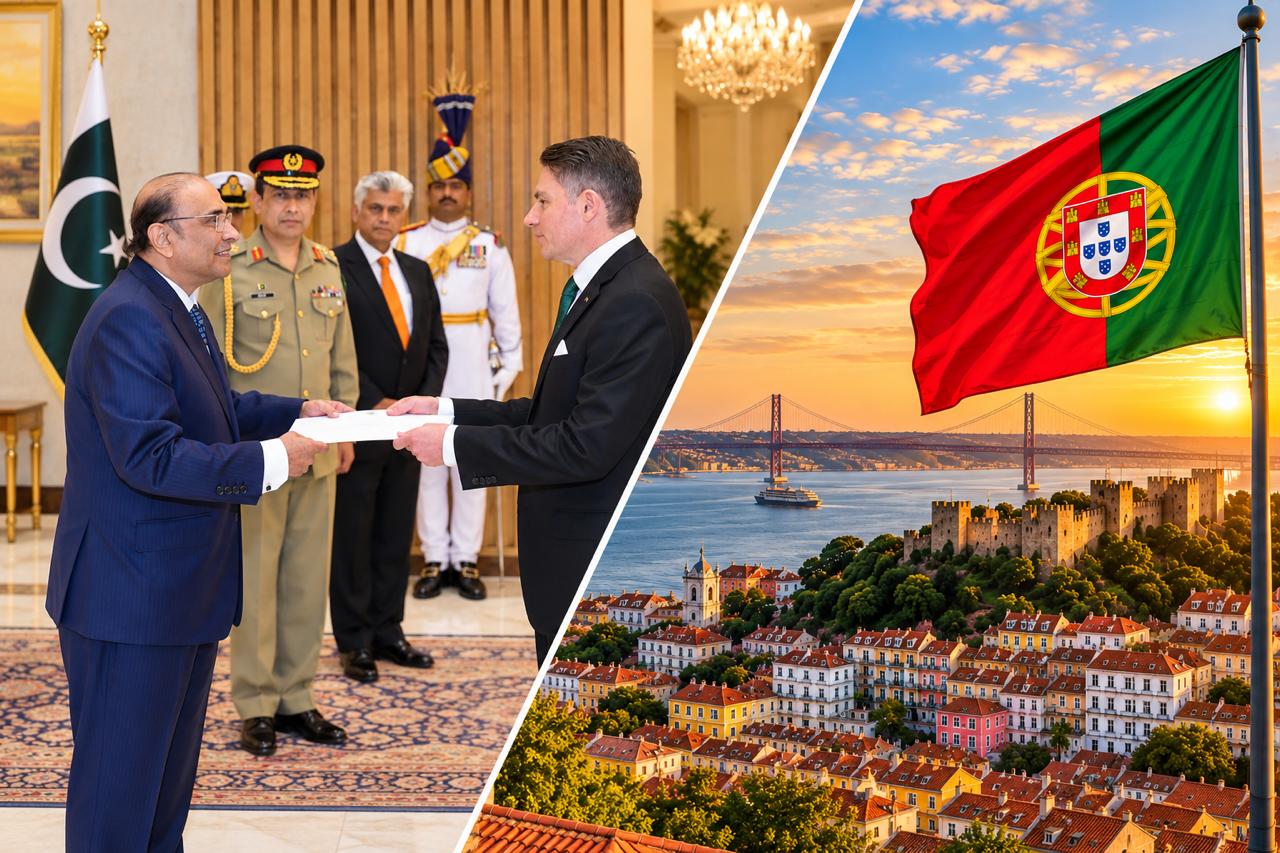

A year of turmoil in the Middle East has produced an unlikely export, capital itself. Dubai has spent two decades building itself into the Gulf’s financial hub, the address where money moving between Doha, Manama and Abu Dhabi came to be managed, multiplied and reinvested, alongside a genuinely international investor base drawn from Britain, India, China, Russia and beyond. That role is now under strain. As this year’s regional flare-up unsettles sentiment across that base, a share of the capital it once concentrated is fanning out toward Europe. Of the countries positioning to receive it, Portugal has moved further and faster than most, and housing is only where its pitch is easiest to see; the incentive architecture behind it reaches into manufacturing, technology, energy equipment and life sciences as well.
The Hub Losing Its Shine
Dubai’s property market is not collapsing, and it would be dishonest to write the piece as though it were. Price growth has simply come back down, from roughly 13 per cent in 2025 to under 2 per cent year on year by the second quarter of 2026, and Fitch Ratings continues to expect a correction of no more than 15 per cent, well short of a crash, with the emirate’s rated developers, Emaar, Damac, Sobha, Omniyat among them, carrying light debt loads and healthy cash positions. What has moved more sharply is sentiment: the stock index of Dubai’s listed developers fell by roughly 30 per cent during this year’s regional flare-up, even as physical property prices held up comparatively well. That resilience, though, is increasingly carried by a different kind of buyer than a year ago. Industry reports this year describe Dubai’s active buyer base as shifting toward long-term residents and end-users, people of many nationalities who have made the emirate their home over years or decades and are treating softer prices as a chance to buy into a market they already live in, rather than a reason to leave it. The layer of capital most visibly heading elsewhere is the more mobile one: overseas investors with no residence or roots in Dubai, for whom a cooling market is one signal among several to look at alternatives. A hub that spent four years being told it only goes up is now being asked, for the first time since the pandemic, to prove it still can. That question lands differently depending on which passport is asking it, and on how deep the roots are behind that passport. A resident investor rides out a correction because Dubai is where they live. A footloose overseas investor weighs it against alternatives closer to home, or against a home government’s own reasons to be wary of Abu Dhabi.
Developer financing is helping keep that resident-driven segment active. Many builders are now offering heavily deferred payment plans, and in some cases arrangements marketed as low or zero-deposit purchases and rent-to-own schemes, letting long-term residents, including first-time buyers who might otherwise have kept renting, secure a unit without the upfront capital a traditional purchase would demand. None of this points to a market in crisis today. But the caution belongs in the supply pipeline rather than in current sentiment: developers have more than 160,000 residential units scheduled for delivery in 2026 alone, against roughly 39,700 completed in 2025 and 30,500 in 2024. Even allowing for the usual gap between what is scheduled and what is actually handed over, a pipeline of that size raises a real question of whether supply will outrun demand within the next year or two, a risk that would look considerably sharper than the mild, sentiment-driven correction underway now.
The base doing that weighing is not one nationality but several, and the scale involved is not small for any of them. Indian investors alone hold an estimated $22 billion in Dubai real estate, the largest foreign stake in the market, anchored by a resident community of roughly 3.5 million and trade ties that crossed $100 billion this year. British buyers, still absorbing the end of the UK’s non-dom tax regime and the wealth exodus it triggered, briefly overtook Indian buyers as Dubai’s top foreign purchasers in early 2026 and held roughly 13.3 per cent of the year’s transactions, with Egyptian, American, Saudi and Australian buyers rounding out the largest blocs. Pakistanis accounted for a comparatively modest 6.9 per cent of this year’s transaction volume on that same count, but their cumulative exposure to the UAE runs considerably deeper than a single year’s purchasing share suggests, and it is that older, larger stock of capital, not this year’s flow, that is now being tested by a bilateral relationship under strain.
Where The Friction Is Sharper Than The Market
Pakistan is the clearest case of that third position. Beyond the general unease unsettling Dubai’s wider investor base, Islamabad’s relationship with Abu Dhabi has visibly cooled this year, and that bilateral friction is doing its own work on where Pakistani capital chooses to sit. It is not the only nationality reassessing its Gulf exposure, but it is the one doing so with an added, country-specific reason layered on top of a regional one. The scale involved is not trivial. The last comprehensive public figure for the full relationship, given by Pakistan’s former ambassador to the UAE, put cumulative Pakistani investment in the Emirates at more than $23 billion, spread across finance, construction, textiles, education, media, machinery and real estate, carried by more than 6,000 registered Pakistani companies. That figure is now close to a decade old, and a narrower, current data point suggests it already understates today’s total: as of April 2026, roughly 17,000 Pakistani nationals owned some 23,000 properties in Dubai alone, worth an estimated $13 billion, real estate being only one of the sectors the original $23 billion figure spanned. Scaling that older, fuller figure by even a conservative multiple for a decade of business expansion, migration and reinvested earnings points to total Pakistani exposure to the UAE now running well above $35 billion, an estimate this publication offers for context, drawn from well-placed sources familiar with the sector rather than any single verified count. Even that figure likely undercounts the true picture, since it is built on passport-based statistics. A substantial share of the wider Pakistani diaspora, including large communities of Pakistani origin in Britain, the United States and parts of continental Europe, holds dual nationality, and their Dubai holdings register in British, American or European buyer figures rather than in any Pakistan-specific tally. Even the original, understated number was enough to be noticed by a country actively courting it; the current one, however it is measured, is harder still to ignore.
The scale extends well beyond individual buyers. Samana Group, the Dubai-based conglomerate founded in 1996 by Imran Farooq, an entrepreneur originally from Pakistan, has built its real-estate arm, Samana Developers, into the emirate’s seventh-largest private developer by units sold, with a project portfolio now valued at roughly AED 16 billion, about $4.4 billion. Companies operating at that scale are not usually a case of capital flight, and there is no public indication that Samana itself is redirecting investment abroad. But the broader direction of travel is visible even at this end of the market: developers of that size are increasingly among those weighing markets outside the Gulf, Portugal included, as a way of diversifying geographically without stepping back from a home market whose fundamentals, for now, remain intact.
Portugal’s Pitch, From Someone Who Knows The System
Paulo Miguel Guedes Domingues has been Portugal’s ambassador to Pakistan and Afghanistan only since March 2026, presenting his credentials in Islamabad the following month. He arrived new to the post, but not new to the file: earlier in his career he served as AICEP’s own coordinator for Asia, Oceania and the Middle East, and later as an adviser to the agency’s board, before moving into the diplomatic track proper.
In a recent conversation, he was direct about both the opportunity and his government’s intent. The essence of what he conveyed, in his own words as relayed rather than a verbatim transcript, was that Portugal is highly viable for foreign investment, offering flexible terms he described as rare among European destinations, and that his government is making every possible effort to facilitate overseas investors, a point he was able to press with more than the usual diplomatic confidence given his own years inside the agency that runs that facilitation. As a Portuguese official serving in Pakistan, he said, he stands ready to offer his own full cooperation to Pakistani investors exploring the market.
The Housing Gap Pakistan Is Positioned To Help Close
The clearest opening is inside Portugal’s own housing shortage. A Morningstar DBRS analysis this year put the country’s accumulated deficit at more than 300,000 homes since 2014, the gap between new households formed and homes actually completed. Portugal currently delivers roughly 20,000 new homes a year against an estimated need closer to 70,000 to close the gap by the end of the decade, a shortfall compounded by a construction sector short an estimated 80,000 skilled workers. That is not a market a passive buyer competes in. It is a market with more demand for builders than it has builders to meet it. Pakistani construction and town-planning expertise already has a track record in the region: Pakistani engineers, planners and labourers have been part of the workforce behind large-scale development in Dubai and elsewhere in the Gulf for decades, a track record Ambassador Domingues and others in this piece argue could translate directly into Portugal’s own building effort. Pakistani developers, on that reading, have a genuine opportunity here, precisely because Portugal is short of the housing it needs and short of the capacity to build it fast enough on its own.
Bringing The Workforce Along With The Capital
Azfar Bukhari, who chairs the Pakistan-Portugal Trade, Investment and Cultural Council (PPTIC), said he has no doubt that Pakistani investment in Portugal will grow substantially over the coming months and years. That kind of interest is not unexpected for a country offering unusually flexible terms to overseas investors, and the opportunity is not limited to capital. Investors and businessmen interested in real estate, agriculture or information technology are, in many cases, positioned to bring their own workforce with them. Bukhari also reiterated that this pairing is intended to address Portugal’s shortage of skilled labour with a supply of Pakistani engineers, agronomists and technology professionals already experienced in those fields. That combination, he argued, is what separates this opportunity from a simple transfer of money: Portugal gains capacity as well as capital, and Pakistani firms gain a foothold in a market they can staff as well as fund.
The volume of inquiries reaching him directly, Mr Bukhari said, is higher than anything he has seen in the last decade, a surge he attributed to Portugal’s investment-friendly environment, its climate, and its geographic position at a moment when investors worldwide are prioritising physical and political safety over marginal yield. That is a serious assessment, made by a person well known both in Pakistan and EU quarters. Hence, its significance is not merely anecdotal; it is well supported by the country’s own numbers: Portugal’s foreign direct investment rebounded to a record €6.7 billion in the year to mid-2026, and subscriptions into its Golden-Visa-eligible investment funds ran at nearly three times the pace of redemptions over the same period. Neither figure isolates Gulf capital specifically, and France and Spain, not any Gulf state, remain the largest individually named sources. But both are consistent with a country experiencing more inbound interest than usual, not less. That distinction matters for how the rest of this piece should be read: what the record inflows and the Fitch upgrade demonstrate is that Portugal is positioned to attract redirected capital, not that any specific volume of Gulf or Pakistani money has already landed. The demonstrable fact is Dubai’s sorting; Portugal’s gain, for now, is a well-supported expectation rather than a booked one.
The Apex Trade Body Is Paying Attention Too
The interest is no longer confined to individual investors and the bilateral council alone. Atif Ikram Sheikh, President of the Federation of Pakistan Chambers of Commerce and Industry, the country’s apex trade body, has also signalled his support. Portugal, he said, is a genuinely good destination not only for Pakistani investors but for Pakistani manufacturers and exporters specifically, looking to deepen bilateral economic cooperation beyond capital alone. He said he also intends to take an FPCCI delegation along to Portugal soon to explore those opportunities directly. Coming from the country’s apex trade body, including a separate bilateral council built around this relationship, that interest reflects the seriousness with which Pakistani industry is now approaching Portugal as a destination in its own right, rather than simply as a stop on a wider European itinerary.
Mr Bukhari, who chairs that bilateral council, brings his own public profile to the effort. The Legislative Assembly in Pakistan unanimously passed a resolution honouring his services rendered to the country, one of the highest recognitions he has received, tied to international recognition of his extraordinary endeavour. That recognition predates his current PPTIC role, but it is the kind of standing a bilateral council draws on when it goes looking for investors to take seriously.
Some of that momentum is simply timing, but by most accounts not all of it. The Portuguese envoy has built a level of visibility and engagement among Pakistan’s business circles unusually quickly for someone so new to the country, a pace more active than is typically seen from newly arrived ambassadors in comparable postings.
AICEP, Portugal’s state investment and export agency, and the very institution Ambassador Domingues once worked inside, has spent the past two years tripling the funding it can offer to land large foreign projects, from €150 million to €500 million annually, on top of a separate €1 billion strategic-sectors incentive scheme launched in late 2024. Its declared priorities run through renewable energy equipment, automotive components and electronics, life sciences and pharmaceuticals, food and beverage, and aerospace, alongside the digital and agricultural sectors Pakistani trade bodies pointed to directly. Housing, agriculture and IT get Pakistani capital and expertise through the door. What Lisbon actually wants behind that door is broader still: the manufacturing, technology and export capacity its own incentive architecture is built to reward.
A Beneficiary That Did Not Have To Ask
Dubai’s international investor base is not fleeing as one. Most of it will absorb a correction the way it has absorbed others. What is happening instead is a sorting, in which the investors with the least reason to stay, because a bilateral relationship has cooled on top of a regional one, are the ones moving first and furthest. Pakistan’s case illustrates that sorting more clearly than most, but it is not the whole of it. Part of what makes Portugal the beneficiary is temperament as much as terms: the country has held a top-ten spot on the Global Peace Index every year since 2015, ranking seventh in the 2026 edition, a distinction few of the countries competing for the same capital can claim.
The financial markets delivered their own verdict this same week. Fitch Ratings upgraded Portugal’s sovereign credit rating to A+ on 4 September 2026, its highest mark since March 2011, citing a declining public-debt trajectory and budget performance stronger than its ratings peers. The upgrade puts Portugal’s creditworthiness above Spain, Japan and Italy, and level with France and Belgium. Fitch made the timing explicit, noting that the improvement lands against a global backdrop still marked by uncertainty and instability. For any investor reading Dubai’s correction alongside Portugal’s trajectory in the same week, the two data points point in opposite directions.
Brussels did not design this, and Lisbon did not lobby for the volatility that made the pitch land. Europe, in this instance, is simply the address capital reaches when the one it was in starts to feel less certain than it used to, and the address happens to have both an ambassador in Islamabad who already knows how to receive it and a reputation for stability that the markets, this week, put a number on. Part of what makes Portugal’s position credible is that its improving numbers predate this story. The fiscal discipline behind the Fitch upgrade, the falling debt trajectory, the years of primary surpluses, none of that was engineered with Gulf capital in mind. Portugal is not benefiting because Dubai is failing; Dubai, on its own numbers, is not failing at all. Portugal is gaining ground because a growing share of global capital is beginning to price safety differently than it did a year ago, and it happens to be one of the few places already positioned, on its own economic merits, to receive that shift when it arrives.
ABOUT THE AUTHOR
Daniel Becker is a Senior Policy Analyst specialising in trade and investment at The European Post. With a focus on international economic relations, cross-border capital flows, and supply chain resilience, he analyzes European trade policy and industrial strategy. His commentary explores global market dynamics, strategic economic autonomy, and foreign direct investment across the EU and partner economies.
