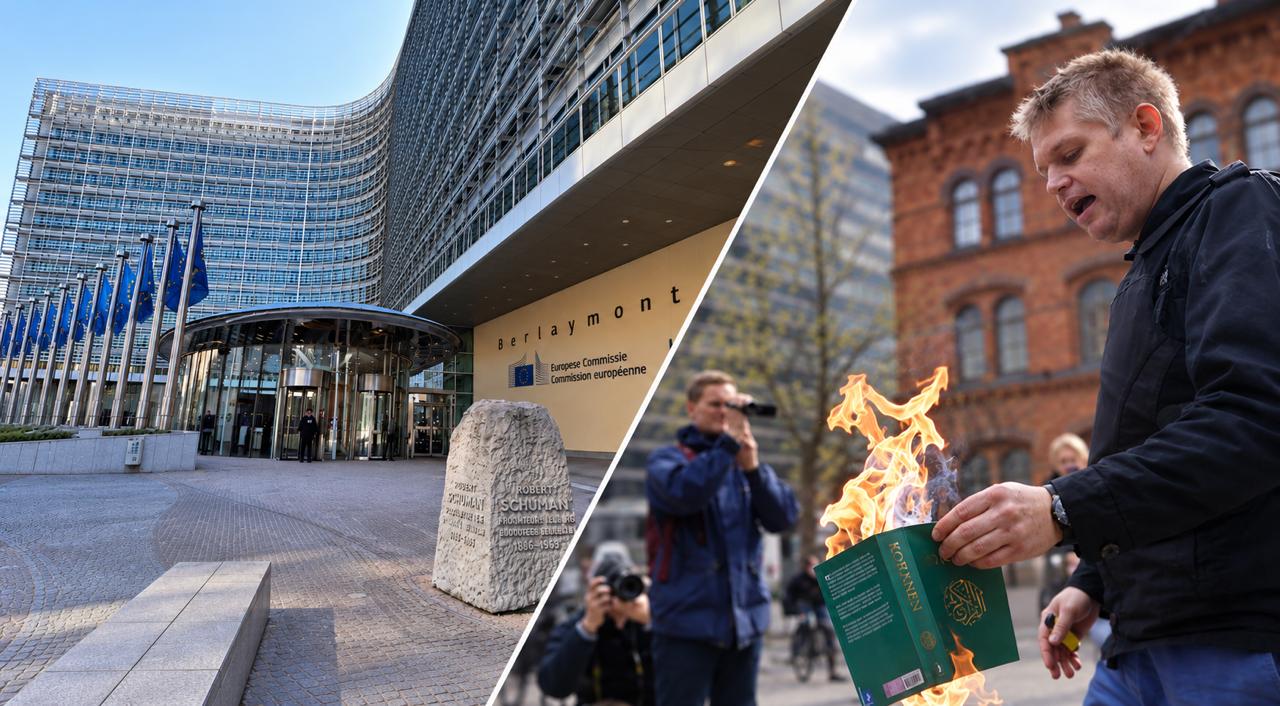

On 11 September, two European towns produced the same story on the same day without either knowing about the other. In Reggio Emilia, a nineteen-year-old activist filmed himself tearing up and burning a copy of the Quran on a public street, captioning the video a defence of Italy against Islamic extremism. In Kaunas, roughly a hundred bikers surrounded a mosque during Friday prayers, revved their engines, played music to drown out the call to worship, and left a pig’s head, an object considered deeply unclean under Islamic law, at the building’s doorstep. Neither man broke new ground. Both followed a script that has now played out, with minor variations, in at least three European Union member states across two consecutive years, and both are the latest expression of a wider European failure that has never been confined to one faith: an unwillingness to treat religious intolerance as an institutional problem until it has already produced a body count. What should worry Brussels is not any single performance of that script. It is that nobody in Brussels has said anything about the fact that it has become one.
Karl Popper’s Warning and Europe’s Recurring Pattern
Karl Popper is not a name TEP reaches for lightly. Born in Vienna in 1902 and forced into exile by the same totalitarian currents he spent his career diagnosing, he became one of the twentieth century’s most influential philosophers of science and politics, a longtime professor at the London School of Economics whose work on open societies shaped how postwar Europe itself came to think about pluralism and its limits. Writing in Vienna before he fled the continent that would soon try to kill him for his ancestry, he gave Europe a formula for exactly this kind of moment. In The Open Society and Its Enemies, he wrote, “Unlimited tolerance must lead to the disappearance of tolerance,” arguing that a society unwilling to defend its own openness against those working to dismantle it would eventually lose that openness altogether, along with everyone who depended on it. Popper was not writing about mosques or Qurans. He was writing about the mechanism by which a pluralist order talks itself out of existence: not through a single dramatic rupture, but through an accumulation of small, camera-ready provocations that each individually seem too minor to justify a response, until the accumulation itself becomes the response nobody made.
Europe has run something close to this experiment before and knows how it ends. Sweden spent 2023 hosting a wave of Quran burnings by the Iraqi refugee Salwan Momika, protests that were approved by Swedish police under free-expression law and that triggered embassy stormings in Baghdad, a diplomatic rupture with several Muslim-majority states, and Sweden’s own terror threat level being raised. Momika was shot dead in his home in January 2025. Nothing about the Reggio Emilia or Kaunas incidents suggests Europe absorbed the lesson that episode should have taught, that a provocation designed to be filmed and shared does not stay contained within the country that hosts it.
The Political Normalization of Religious Intolerance in Europe
This is not a random drift in isolated far-right subcultures. It tracks a specific political shift: parties that once treated anti-Islam messaging as a fringe position now treat it as a growth strategy. Ferenc Venturelli, the Reggio Emilia activist who burned the Quran, had recently moved from the mainstream League party to Roberto Vannacci’s new Futuro Nazionale, a party built substantially around exactly this kind of rhetoric. In Austria, Chancellor Christian Stocker has separately called for a constitutional ban on what he terms political Islam. What was once the language of the extreme fringe is migrating into the platforms of parties that sit in government or within reach of it, and each individual provocation now arrives with a ready-made political audience prepared to treat it as courage rather than incitement.
The local and party-level response to Reggio Emilia is itself instructive about where accountability currently stops. Reggio Emilia’s mayor, Marco Massari, did not settle for a public statement; he sent a formal letter to the city’s Islamic communities condemning Venturelli’s act as outrageous, fanatical, and unconstitutional. Criminal complaints have already been filed against Venturelli, and Futuro Nazionale’s own provincial leadership has left the door open to disciplinary action, including possible expulsion, less than two months after he joined the party. That is accountability functioning at the municipal and party level, which is precisely the point: national and local actors are doing their part. The gap this piece is describing sits one level up, at the institution that has said nothing at all.
What the EU’s Own Discrimination Data Reveals
That mechanism is now visible in the EU’s own data. On 9 September 2025, pig heads appeared outside nine mosques in and around Paris, five of them marked with President Macron’s own name. France’s Interior Ministry had already recorded an 81 percent year-on-year rise in anti-Muslim acts in the first half of that year. On 11 June 2026, arsonists set fire to the entrance of a mosque on Via del Collegio in Cagliari’s Marina district, using a flammable liquid accelerant; residents extinguished the blaze before firefighters arrived, and Italian Carabinieri opened an investigation into what the local imam, resident in the neighbourhood for nearly forty years, called an unprecedented act. In September 2026, Reggio Emilia and Kaunas happened on the same day. Three member states, one pattern, and in each case a response from national authorities that stopped at condemnation, a mayor’s statement, a police investigation, a politician distancing his party from a member acting on his own. Nowhere in that record is there a response from the institution that is supposed to speak for the Union as a whole.
The Union’s own Fundamental Rights Agency has already quantified the wider climate these incidents sit inside. Its 2024 survey of nearly ten thousand Muslims across thirteen member states found that 47 percent had experienced racial discrimination in the previous five years, up sharply from 39 percent in the agency’s 2016 survey, and that 27 percent had experienced racist harassment directly. The highest discrimination rate of any country surveyed was not in a state with a large recent migrant population but in Austria, at 71 percent, the same government now defending its headscarf ban for girls under fourteen as a child-protection measure. This is not a marginal phenomenon the Union lacks the data to see. It is a documented, worsening trend inside the Union’s own research infrastructure, sitting alongside a string of incidents the Union’s own political leadership has declined to address as a pattern.
The Legal Architecture Already in Place: EU Charter and Religious Freedom
This is not a case that requires inventing a new European interest. Article 10 of the EU Charter of Fundamental Rights guarantees freedom of thought, conscience and religion in terms that bind every institution of the Union and every member state acting within the scope of EU law. Article 18 of the UN Universal Declaration of Human Rights, which predates the Charter by half a century and which every EU member state has separately ratified, says the same thing in nearly the same words. Neither document is aspirational language sitting unused in a drawer. The European Court of Human Rights turned the underlying principle into binding jurisprudence more than three decades ago in a case that had nothing to do with Islam at all, a Jehovah’s Witness convicted for proselytising in Greece, ruling in Kokkinakis v. Greece that religious freedom is “one of the foundations of a democratic society,” and that Europe’s pluralism was “dearly won over the centuries.” That the Court’s clearest statement on this right involved a Christian minority sect only underscores that the principle at stake is general, not Muslim-specific; it has simply been Muslim communities absorbing its violation most visibly over the past two years. That sentence has been repeated in nearly every major religious freedom case the Court has decided since. It is, by any reasonable reading, exactly the kind of authority a Commission spokesperson could invoke in a single paragraph after Kaunas or Reggio Emilia. None has.
This is where the argument has to stay disciplined rather than reach for the easiest evidence. Britain has also seen a cluster of serious incidents this year, a stabbing outside Edinburgh’s Broomhouse Mosque that the Prime Minister himself called anti-Muslim hate, an arson attack on a Blackburn prayer room, a firebombing of an imam’s family home in Bolton. But the United Kingdom left the European Union in 2020, and folding its incidents into an argument about Brussels’ institutional silence would be a basic category error: the Commission has no jurisdiction there and no standing to comment on it as an EU matter. What the UK cases do show is that this pattern is not confined to the EU’s own borders. Britain remains a full party to the European Convention on Human Rights, a Council of Europe instrument separate from EU law, and under that convention its record sits inside the same continental pattern this piece is describing, even though it falls outside Brussels’ own remit to address.
The Legislative Question: Incitement If Not Blasphemy
The instinct to reach for legislation here is not unreasonable, and Denmark has already tested it. Its 2023 law criminalizing the public burning or defacement of religious texts passed after Quran burnings had raised the country’s own terror threat level and strained relations with Muslim-majority states; the government’s argument was security, not piety, protecting the public order that systematic provocation was putting at risk. Germany and Austria carry older provisions doing similar work, and the European Court of Human Rights has upheld convictions under them, ruling in 2018 that a state may restrict speech capable of inciting religious intolerance even where the speaker frames it as commentary. There is a real argument, in other words, that what happened in Reggio Emilia and Kaunas fits a definition of blasphemy under national law as it already exists in several member states, deliberate public defilement of a sacred text or object, not private disbelief or academic criticism, but the specific act several European legislatures have already chosen to criminalize. That characterization is not a stretch.
The reason to argue for incitement rather than blasphemy at EU level is not that the blasphemy characterization is wrong. It is that blasphemy as a legal category carries costs this piece should not ask the Union to accept, and that a narrower instrument gets the same practical result without them. Britain abolished its blasphemy offences in 2008, Ireland by a 65 percent referendum in 2018, Malta, the Netherlands, Norway and Iceland all followed within the same decade; the direction of travel in European law has been to retire the category, not expand it. The UN Human Rights Committee holds that laws punishing mere insult to religion, distinct from incitement to violence or hatred, are generally incompatible with the right to free expression, and free-expression bodies have specifically warned that Austria’s approach risks reviving blasphemy prohibitions through a public-order back door. There is also no available legal path to an EU blasphemy law regardless of the merits: criminal restrictions on speech and religion remain a member state competence, and the Union’s one relevant instrument, the 2008 Framework Decision on Racism and Xenophobia, already sets its boundary at incitement to violence or hatred, not desecration or insult as such.
The defensible version of the argument sits inside that existing boundary rather than outside it, and does not require the Union to take a position on blasphemy as a category at all. The Framework Decision could be extended, through the ordinary legislative process, to state explicitly that public, filmed desecration of a religious text or object, carried out with the evident intent to incite hatred against a religious community, falls within the incitement standard the Union already criminalizes. That would not touch private belief, academic criticism of religion, satire, or the kind of blunt public argument European free expression law rightly protects, and it lets member states that already have their own blasphemy-adjacent laws, Denmark, Germany, Austria, keep them undisturbed. It would target the specific, camera-ready act this piece has traced across three member states, at the one level, the EU’s, where no such instrument currently exists, without asking Brussels to adjudicate whether religious sentiment as such deserves protection from insult, a question most of Europe has already answered and moved past.
The Institutional Response This Pattern Requires
None of this requires the Commission to police what a nineteen-year-old posts on Instagram or to intervene in a Lithuanian arson investigation. Policing individual acts is what national authorities are for, and in every case cited here, they have done that part of the job competently. What the Commission has not done is the one thing only it can do: state, once, in its own institutional voice, that a pattern spanning three member states and two years is a pattern, not a coincidence, and that the Charter it wrote obliges it to say so. The narrower legislative step outlined above is a longer-term project for the Council and Parliament; the institutional statement is not, and needs no new law behind it. The Fundamental Rights Agency already tracks the data; it could be tasked with an annual public accounting of anti-Muslim incidents specifically, the way the Union already tracks antisemitic incidents through its own coordinator role, giving Brussels a standing mechanism to respond to a pattern rather than reacting, or not reacting, to each incident as a one-off. Nothing about either ask is radical. It would simply mean treating one religious minority’s safety with the same institutional seriousness already extended to another.
Popper’s point was never that any single act of intolerance would bring down a democratic order by itself. It was that the order fails when its defenders convince themselves that this time, again, silence is the safer choice. Each incident in this piece involved a deliberate bid for visibility, filmed, captioned, timed to Friday prayers, built to travel. An institution’s silence in response does not prevent that visibility; it simply leaves the calculation uncontested, since nothing about the reaction so far has raised the cost of trying again. That is a plausible account of why the trend line moves the way it does, not proof of it, but it is consistent with what the data in this piece shows: rising incidents alongside an absence of legislation that would raise that cost and an absence of any institution willing to name the pattern. Reggio Emilia and Kaunas happening on the same day is one data point, not a verdict. It is, at minimum, a coincidence Brussels has not yet found worth commenting on.
ABOUT THE AUTHOR
Azfar Bukhari is a senior analyst specialising in geopolitics, public diplomacy, migration, international trade, and investment. He is the Vice President (External Relations & Diplomacy) and a regular contributor to The European Post.