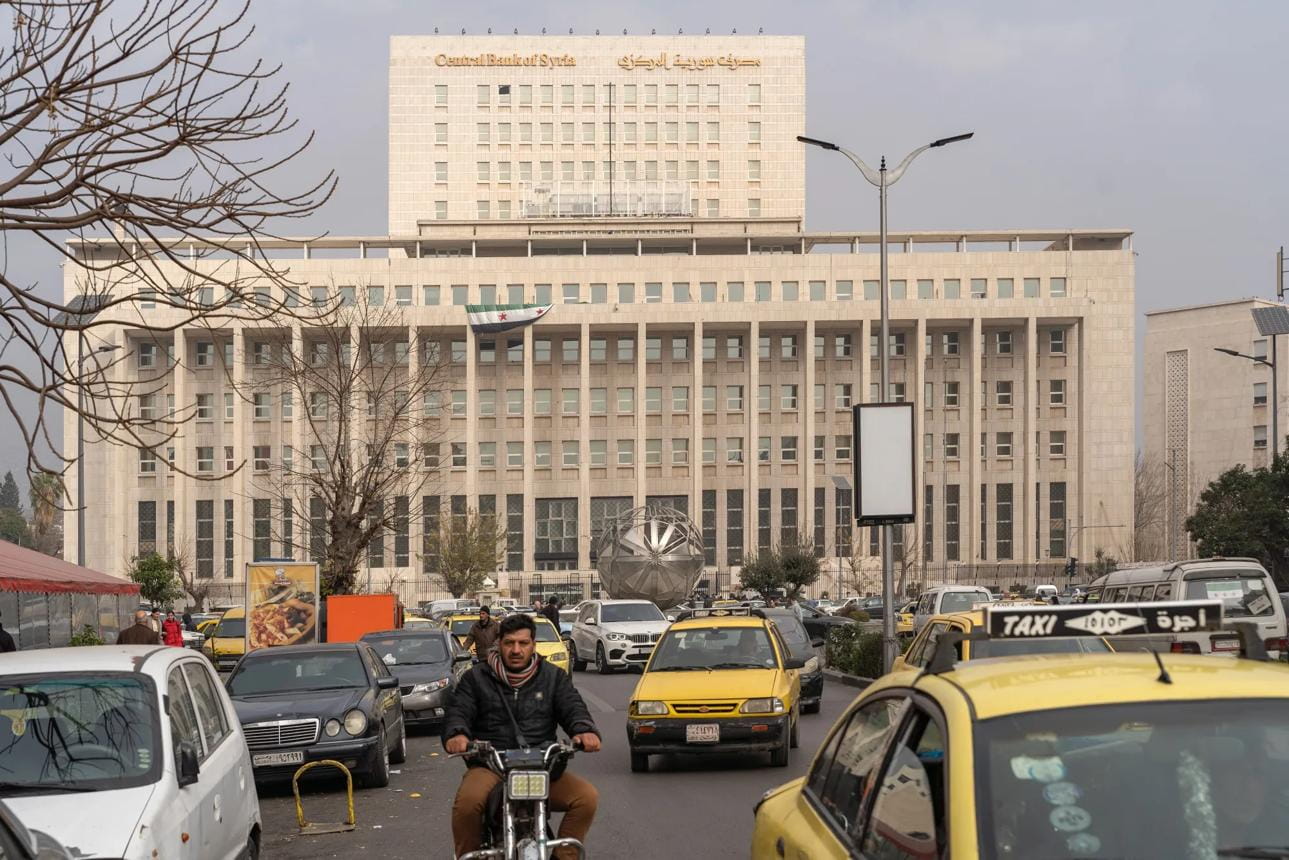
Damascus: Syrian banks can once again send and receive international payment messages, which is not the same thing as being able to make payments. The distinction is the whole of Europe’s current Syria problem, and it is not one that another Council decision can resolve.
The legal scaffolding has been dismantled with unusual speed. The European Union lifted its economic sanctions in May 2025, retaining measures grounded in security concerns. The Commission President travelled to Damascus in January of this year and set out three pillars for the relationship: a political partnership, a trade and economic framework, and roughly 620 million euro in support across 2026 and 2027. In April the Commission proposed restoring the cooperation agreement that had been partially suspended since 2011, and on 11 May the Council terminated that suspension outright. On paper, Syria’s access to the European market is now closer to normal than at any point in fifteen years.
What has not moved at the same pace is the willingness of European banks to carry the risk. Correspondent banking is not a permission granted by governments; it is a commercial decision taken by a compliance department that must justify the relationship to its own supervisor and, in practice, to its dollar-clearing counterparty. Syria has been on the Financial Action Task Force list of jurisdictions under increased monitoring since 2010 and remained there at the June review. A Syrian bank that has spent fifteen years outside the system is behind not only on the rules but on the software, the staffing and the audit trails that European institutions now treat as the minimum evidence of a functioning control environment.
Damascus has begun addressing this. A national strategy against money laundering and terrorist financing was launched in July with United Nations support, translating risk assessment into a reform programme. The work is real. It is also the kind of work whose results are visible only after several assessment cycles, and the incentive structure facing a European compliance officer does not reward early optimism. The cost of declining a Syrian relationship is a lost commission. The cost of accepting one that later goes wrong is a supervisory file.
This asymmetry explains why so much Syrian trade still routes through intermediaries in the Gulf and Turkey, adding cost at every leg and leaving the transaction less transparent, not more. The de-risking dynamic is well documented across the region, and sanctions relief on its own has rarely reversed it. Residual European measures aimed at figures of the former government, at chemical weapons files and at the captagon trade remain in force, and while they are narrowly drawn, they keep Syria inside the screening categories that trigger enhanced due diligence.
The instruments Europe is using are largely instruments of permission. Lifting restrictive measures, restoring trade preferences and disbursing support all remove obstacles the European Union itself erected. None of them changes the balance-sheet arithmetic of a Frankfurt or Milan credit committee. The tools that would are less visible and harder to announce: supervisory twinning with the Syrian central bank, technical assistance on transaction monitoring, and some form of risk-sharing that gives a first-mover institution cover for a relationship its peers are avoiding.
There is a reasonable test of whether European policy toward Syria is working, and it is not the communique issued after the next ministerial. It is whether a mid-sized importer in Aleppo can open a euro letter of credit with a European bank, directly, at a price that reflects Syrian commercial risk rather than Syrian reputational risk. That measure has not yet moved. Until it does, the sanctions have been lifted mainly in the sense that they are no longer the binding constraint.