August 9, 2026
LATEST
New EU Gas Market Rules Take Effect With Consumer SafeguardsDeforestation Regulation Holds Its December Deadline Despite CutsDigital Omnibus Delays Europe’s High-Risk AI Deadline to 2027Europe’s Schools Confront a Widening Basic Skills GapRule of Law Report Finds Progress but Trust Still LagsIRIS2 Gains 66 Satellites as Brussels Signs the Rollout DealNature Restoration Plans Come Due as Member States Race a DeadlineECB Rates Hold at 2.25 Percent as Frankfurt Waits on the DataEU Budget Talks Turn to Cohesion as Ireland Takes OverWildfire Response Stretches Europe’s Emergency Fleet ThinCan Europe’s Quantum Plan Match Its Big Ambitions?Armenia Edges West as Moscow’s Grip Slips AwayEurope Inherits the World’s Aid Bill It Cannot Fully PayAir Passenger Rights Get Their First Overhaul in Two DecadesErasmus Opens a 5 Billion Euro Round for Skills and MobilityCeuta Crisis Pushes the EU Toward Faster Migrant ReturnsBulky Parcels Face a Packaging Crackdown From August 12Can Europe Build Its Drone Wall Before 2030 Arrives?Indonesia’s Trade Deal With Europe Nears Its Final SignatureEurope Leans on Beijing to Keep Climate Talks Alive Before AntalyaNew EU Gas Market Rules Take Effect With Consumer SafeguardsDeforestation Regulation Holds Its December Deadline Despite CutsDigital Omnibus Delays Europe’s High-Risk AI Deadline to 2027Europe’s Schools Confront a Widening Basic Skills GapRule of Law Report Finds Progress but Trust Still LagsIRIS2 Gains 66 Satellites as Brussels Signs the Rollout DealNature Restoration Plans Come Due as Member States Race a DeadlineECB Rates Hold at 2.25 Percent as Frankfurt Waits on the DataEU Budget Talks Turn to Cohesion as Ireland Takes OverWildfire Response Stretches Europe’s Emergency Fleet ThinCan Europe’s Quantum Plan Match Its Big Ambitions?Armenia Edges West as Moscow’s Grip Slips AwayEurope Inherits the World’s Aid Bill It Cannot Fully PayAir Passenger Rights Get Their First Overhaul in Two DecadesErasmus Opens a 5 Billion Euro Round for Skills and MobilityCeuta Crisis Pushes the EU Toward Faster Migrant ReturnsBulky Parcels Face a Packaging Crackdown From August 12Can Europe Build Its Drone Wall Before 2030 Arrives?Indonesia’s Trade Deal With Europe Nears Its Final SignatureEurope Leans on Beijing to Keep Climate Talks Alive Before Antalya
August 9, 2026
LATEST
New EU Gas Market Rules Take Effect With Consumer SafeguardsDeforestation Regulation Holds Its December Deadline Despite CutsDigital Omnibus Delays Europe’s High-Risk AI Deadline to 2027Europe’s Schools Confront a Widening Basic Skills GapRule of Law Report Finds Progress but Trust Still LagsIRIS2 Gains 66 Satellites as Brussels Signs the Rollout DealNature Restoration Plans Come Due as Member States Race a DeadlineECB Rates Hold at 2.25 Percent as Frankfurt Waits on the DataEU Budget Talks Turn to Cohesion as Ireland Takes OverWildfire Response Stretches Europe’s Emergency Fleet ThinCan Europe’s Quantum Plan Match Its Big Ambitions?Armenia Edges West as Moscow’s Grip Slips AwayEurope Inherits the World’s Aid Bill It Cannot Fully PayAir Passenger Rights Get Their First Overhaul in Two DecadesErasmus Opens a 5 Billion Euro Round for Skills and MobilityCeuta Crisis Pushes the EU Toward Faster Migrant ReturnsBulky Parcels Face a Packaging Crackdown From August 12Can Europe Build Its Drone Wall Before 2030 Arrives?Indonesia’s Trade Deal With Europe Nears Its Final SignatureEurope Leans on Beijing to Keep Climate Talks Alive Before AntalyaNew EU Gas Market Rules Take Effect With Consumer SafeguardsDeforestation Regulation Holds Its December Deadline Despite CutsDigital Omnibus Delays Europe’s High-Risk AI Deadline to 2027Europe’s Schools Confront a Widening Basic Skills GapRule of Law Report Finds Progress but Trust Still LagsIRIS2 Gains 66 Satellites as Brussels Signs the Rollout DealNature Restoration Plans Come Due as Member States Race a DeadlineECB Rates Hold at 2.25 Percent as Frankfurt Waits on the DataEU Budget Talks Turn to Cohesion as Ireland Takes OverWildfire Response Stretches Europe’s Emergency Fleet ThinCan Europe’s Quantum Plan Match Its Big Ambitions?Armenia Edges West as Moscow’s Grip Slips AwayEurope Inherits the World’s Aid Bill It Cannot Fully PayAir Passenger Rights Get Their First Overhaul in Two DecadesErasmus Opens a 5 Billion Euro Round for Skills and MobilityCeuta Crisis Pushes the EU Toward Faster Migrant ReturnsBulky Parcels Face a Packaging Crackdown From August 12Can Europe Build Its Drone Wall Before 2030 Arrives?Indonesia’s Trade Deal With Europe Nears Its Final SignatureEurope Leans on Beijing to Keep Climate Talks Alive Before Antalya

Tokyo Doubles Down on Brussels Defence Industry Partnership

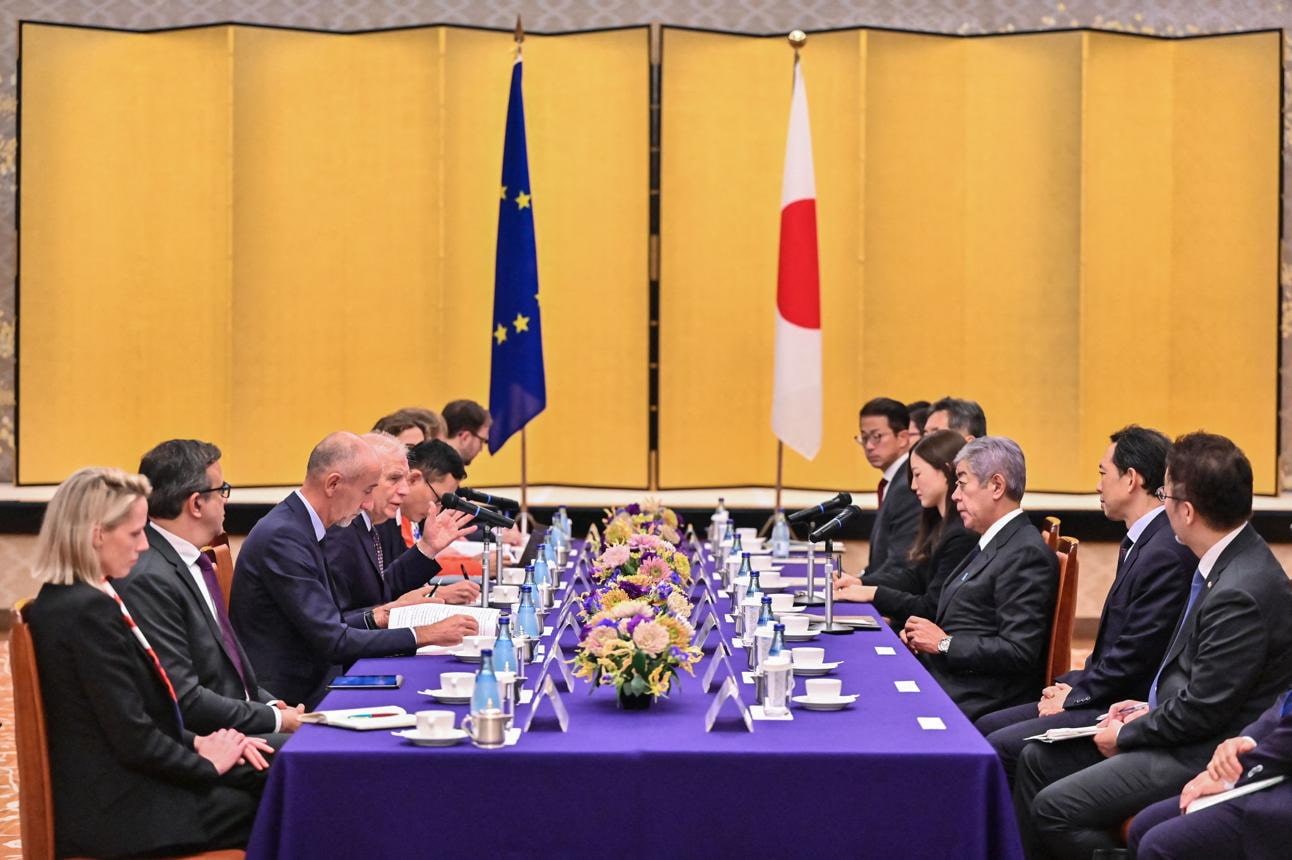
Brussels: Tokyo and Brussels have deepened their security alignment this month as the Seventh EU-Japan High-Level Economic Dialogue ran in parallel with quieter but consequential meetings between defence officials, regulators and industrial policy planners. The conversations build on last summer’s thirtieth EU-Japan Summit, where President António Costa, Commission President Ursula von der Leyen and then Prime Minister Shigeru Ishiba launched a Security and Defence Partnership that has since been operationalised through a series of bilateral workstreams.

The partnership now covers four discrete tracks: cyber resilience, maritime domain awareness, space situational awareness and a Defence Industry Dialogue addressing dual-use technologies. The cyber track has progressed fastest, with a joint table-top exercise scheduled for the autumn focused on coordinated response to critical-infrastructure intrusions. Officials on both sides confirm that the exercise will draw on lessons from previous incidents targeting energy distribution networks in central Europe and undersea cable infrastructure in the western Pacific.

The maritime line of effort intersects directly with the European Union’s evolving Indo-Pacific posture. Japanese officials have welcomed the decisions by France, Germany, Italy and the Netherlands to maintain regular naval deployments through the region. Brussels has expressed interest in deepening interoperability with Japan’s Self-Defence Forces on humanitarian assistance, search and rescue, and freedom-of-navigation operations. The Defence Industry Dialogue has identified satellite communications, unmanned maritime systems and counter-drone capability as the highest-priority cooperation domains, with a joint satellite constellation programme under technical scoping.

The economic security dimension is inseparable from the defence track. Both sides confirmed at the dialogue that work on supply-chain resilience — particularly for advanced semiconductors, rare-earth permanent magnets and battery precursor chemicals — will be integrated into the broader G7 economic security work programme. Tokyo’s METI and the Commission’s DG TRADE have agreed to share early warning information on export-control evasion and coercive economic measures targeting third countries.

The shadow over these conversations is, inevitably, China. European and Japanese officials are careful to avoid framing the partnership in zero-sum language, but the operational priorities tell a coherent story. Both jurisdictions have introduced or expanded outbound-investment screening, both have moved to limit dependence on Chinese inputs for green and digital technologies, and both have intensified scrutiny of foreign subsidies. The convergence is now structural rather than rhetorical.

Industrial questions sit alongside the security dossier. The EU-Japan Economic Partnership Agreement, in force since 2019, remains the deepest trade arrangement either party has concluded, yet its industrial chapters were drafted in a pre-pandemic, pre-Ukraine landscape. Officials in both capitals signalled interest in updating the agreement to reflect new realities around critical minerals, hydrogen and digital trade rules. A possible modernisation track may be opened at the next summit, expected in the second half of 2026.

The defence pillar carries political weight that exceeds its current operational footprint. For the EU, an institutional security relationship with Tokyo demonstrates that the bloc’s Strategic Compass commitments are not confined to its immediate neighbourhood. For Japan, the partnership offers a counterweight against perceptions that Tokyo is over-dependent on a single security guarantor. Neither side speaks of an alliance in formal terms. What is being built, methodically, is something closer to an interoperable network of like-minded democracies — designed less to confront a rival than to absorb the shocks of a destabilised international order.