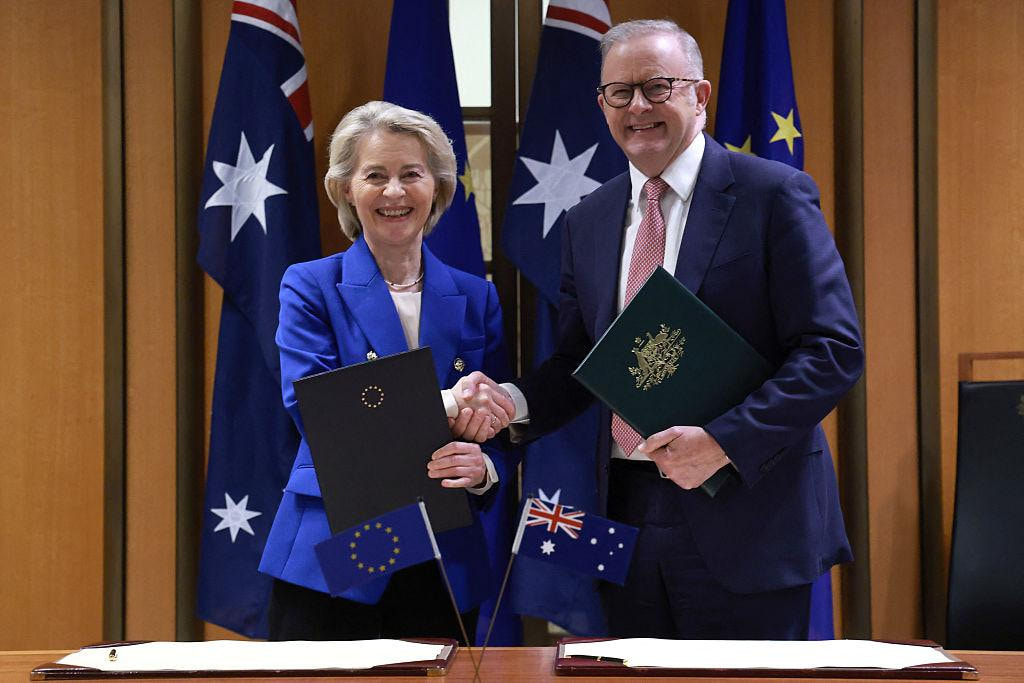
Canberra: The EU Australia trade agreement will be judged less by its tariff headlines than by the safeguards that protect European farmers from import surges. Negotiators concluded the text on 24 March 2026 after almost eight years of talks that began in July 2018, and the deal now moves through legal verification and translation into the EU’s 24 official languages.
The headline numbers are large. The European Commission says the pact removes more than 99 percent of tariffs on EU exports to Australia and could save European exporters up to one billion euros a year in duties. Two-way trade in goods and services already exceeds 89 billion euros annually and supports around 460,000 European jobs, so even modest gains under the EU Australia trade agreement matter for exporters of machinery, chemicals and processed food.
Agriculture is where the EU Australia trade agreement becomes politically delicate. According to an analysis published by New Zealand’s trade ministry, the EU will open a beef quota that reaches 35,000 tonnes by 2034, including 30,600 tonnes of new access phased in over ten years. Sheep meat access reaches 30,581 tonnes, and Australia also receives limited quotas for butter, skim milk powder and whey. Sugar is treated as a sensitive product with restricted access.
Farm lobbies in Ireland, France and Poland will focus on the safeguard clauses. The same analysis reports a bilateral safeguard lasting 15 years for beef, 12 years for sheep meat and eight years for butter, milk powder and milk fats. A general safeguard additionally allows Brussels to act quickly if imports surge. Under the EU Australia trade agreement these instruments only work if the Commission monitors volumes monthly and is willing to trigger them, which is a political decision as much as a technical one.
The EU Australia trade agreement also gives Brussels something beyond tariffs. The agreement protects 165 agricultural and food geographical indications and 231 spirit drinks, and a modernised wine agreement covers more than 1,600 European wine names. Australia will protect feta and prosecco, although existing users of feta may continue and Australian winemakers may keep using prosecco as a grape variety for a transition period. Critical raw materials add a strategic layer, since Australia produces lithium, manganese and aluminium and both sides promise supply chain cooperation.
The timetable remains open. The Commission lists legal revision, a Council decision, signature, European Parliament consent and a final Council decision on conclusion, and New Zealand’s analysis expects signature by the end of 2026 or early 2027 with entry into force around late 2027. Parliament will be the real test.
For European farmers and exporters alike, the EU Australia trade agreement is a bargain whose value depends on enforcement. If the safeguards are credible and the quotas phase in as promised, the deal can diversify trade without hollowing out rural support. If not, Parliament’s consent vote will become a referendum on the agreement.