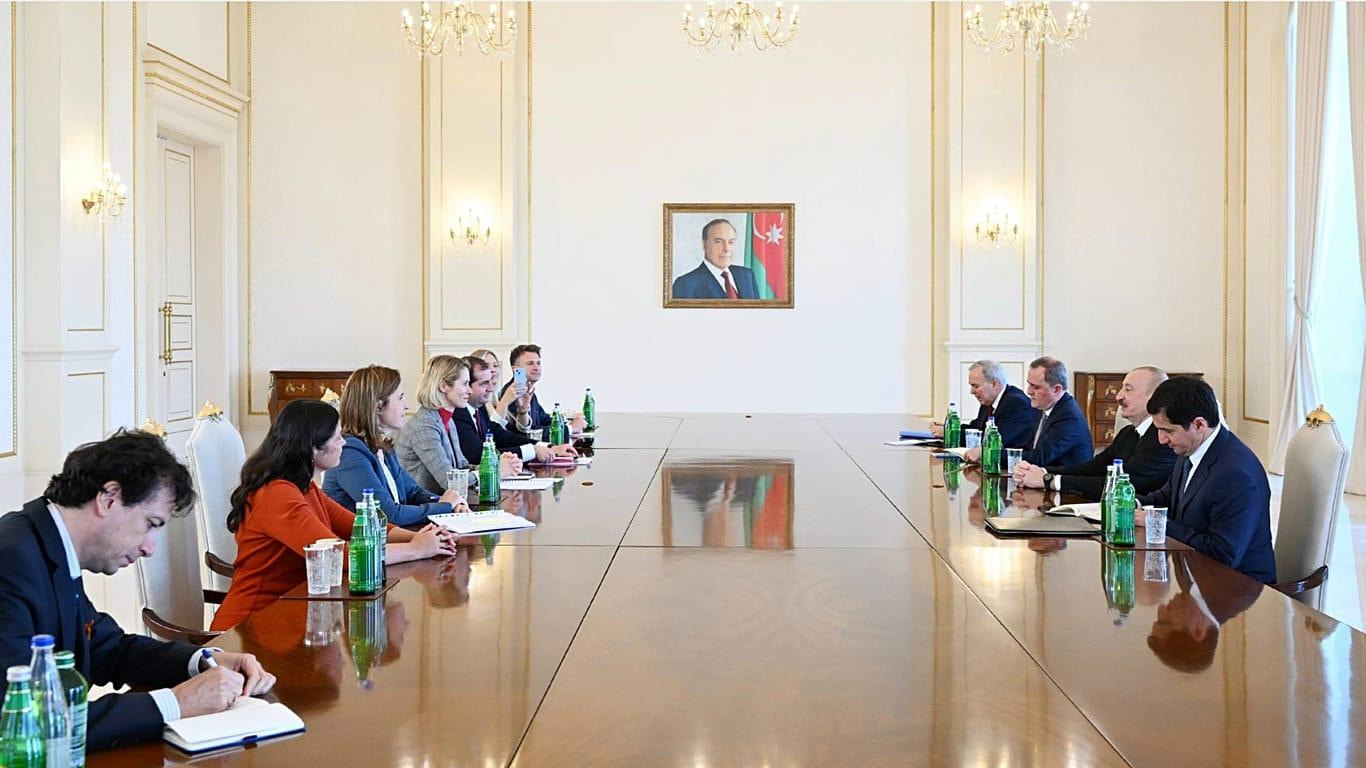
Baku: The Azerbaijan partnership that Brussels describes as a more structured relationship still lacks a name, a text and a date. Since Kaja Kallas visited Baku on 5 May 2026 and met President Ilham Aliyev, European officials have spoken of deeper cooperation, yet the public record I reviewed shows no concluded framework, and the Azerbaijan partnership therefore remains an ambition rather than an agreement.
The visit covered trade, transport, digital cooperation, connectivity and energy. Kallas told her hosts that links between the EU, the South Caucasus and Central Asia serve a shared strategic interest, and that the Union is open to a more structured partnership. Aliyev, for his part, noted that Azerbaijani gas had recently begun reaching Germany and Austria for the first time, a fact that strengthens Baku’s bargaining position.
The existing legal basis is old. The 1999 Partnership and Cooperation Agreement still governs relations, and European Council President Antonio Costa has said Brussels and Baku are working on a new framework covering security, defence, energy, digital policy and transport. Any new Azerbaijan partnership will need to carry that ambitious list without losing sight of the human rights dialogue that the EU’s own statement says remains part of the engagement.
Timing matters because of the wider map. Kallas travelled to Baku after the EU-Armenia summit in Yerevan and one day after Giorgia Meloni’s own visit, which shows how many European capitals now court Azerbaijan for gas and connectivity. At the European Political Community summit in Yerevan, Kallas also argued that the Middle Corridor lets Europe diversify trade routes and avoid dependence on a single passage, particularly while the war in Iran continues.
The peace process between Armenia and Azerbaijan gives the Azerbaijan partnership a second purpose. Kallas called it a historic opportunity and offered EU help with confidence-building measures and demining. European credibility depends on treating both capitals fairly, and a deal with Baku that ignores Yerevan’s security concerns would weaken the Union’s role as an honest broker.
Brussels therefore faces a balancing act with three parts. It must secure energy and transit routes that reduce exposure to Russia and to unstable sea lanes. It must keep its human rights language consistent with what it says elsewhere. And it must avoid creating a hierarchy among South Caucasus partners, given that Georgia’s accession path has stalled while Armenia’s reform agenda advances.
A credible text would set conditions in advance. It could link market access and connectivity funding to measurable steps on the peace process, rule-of-law reform and gas transparency, and it could specify a review clause. Such conditions would give European negotiators leverage, and they would give Azerbaijani officials a clear target.
The next signal will come when the Commission or the Council publishes a negotiating mandate or a joint declaration. Until then, the Azerbaijan partnership stays a promise made in Baku in May, and its value will depend on whether Europe attaches firm commitments to its warm words.