
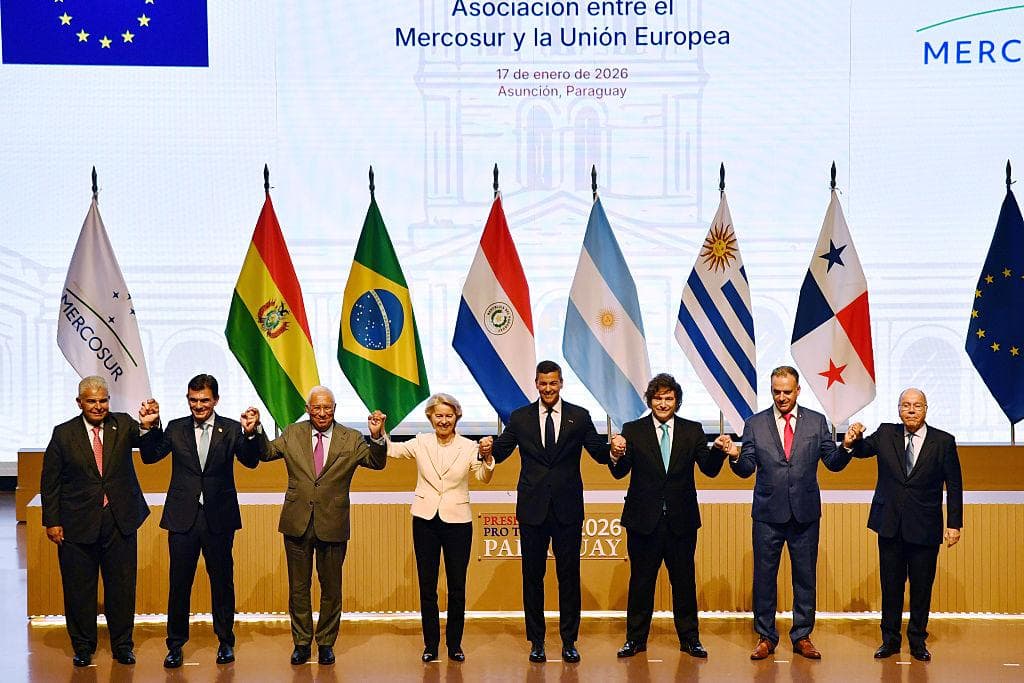
The provisional application of the EU–Mercosur Interim Trade Agreement on 1 May 2026 marks one of the most consequential commercial milestones the Union has produced in a generation, and yet the political language surrounding it has been strikingly subdued. Twenty-six years of negotiation, three substantive rounds of renegotiation, a paragraph-by-paragraph addendum on environmental commitments, and a fragmented ratification path that has split the agreement into trade and political-cooperation tracks have together produced a deal that already binds four South American economies and the bulk of the EU’s external trade architecture. The instrument is now operational, the first tariff cuts are live, and exporters from Stuttgart to São Paulo will spend the rest of 2026 absorbing the price signals it generates. The Union’s response should be more analytical and less defensive than the political debate has so far allowed.
The starting question concerns scale. The agreement covers around 99.7 percent of tariff lines for Mercosur exporters and 91 percent for European ones, a coverage profile that places it among the most ambitious deals the EU has concluded outside its immediate neighbourhood. Day-one cuts on vehicles from 35 to 25 percent for electric and hybrid models, and from 35 to 17.5 percent for internal-combustion exports, will reshape competitive dynamics in regional markets where European manufacturers have steadily lost share to Asian competitors over the past decade. Pharmaceutical and machinery exporters benefit from immediate or accelerated relief. Wine, spirits, and olive oil — sectors disproportionately based in southern member states — receive their first cuts on the agricultural side, with longer phasing on more sensitive products. For European exporters, the agreement reverses a long pattern of being out-priced in Latin American markets by competitors operating under bilateral arrangements with Mercosur. For Mercosur countries, it anchors part of their export economy in rules-based access to the world’s largest consumer market.
The editorial test is not whether Mercosur represents an economic gain. It does, on the order of several billion euros annually in incremental exports once tariff phasing matures, with the heaviest beneficiaries concentrated in capital-goods, vehicle, and pharmaceutical sectors. The test is whether the Union can hold political coherence around the agreement during the period in which costs and benefits distribute unevenly across regions, sectors, and member states. French farm interests have been the loudest critics, and the agricultural carve-outs negotiated into the final text reflect that pressure. Yet the broader fiscal logic — that Europe’s exposure to commodity-import competition from Mercosur agricultural producers is significantly smaller than its exposure to losing industrial export markets in those same economies — has rarely been articulated with the clarity it deserves. The agreement is not a concession to South America; it is, on the European side, an industrial-policy lever dressed in trade-policy clothing.
A second analytical layer concerns geopolitics. Provisional application arrives at a moment when the multilateral trade system continues to fray and the United States has resumed an explicit policy of bilateral tariff coercion. Mercosur’s leadership has been openly weighing alignment options between Beijing, Washington, and Brussels, and the timing of this agreement matters precisely because it offers a credible commitment device on the European side. Each year that the deal operates without significant rollback strengthens the argument that the EU is a stable, predictable partner — a reputational asset that should not be undervalued at a time when American and Chinese partners are both demonstrating, in different ways, that strategic commitments can be withdrawn quickly. The agreement is therefore part of a broader portfolio that includes the recently advanced EU-Australia free trade arrangement, the EU-South Korea trade-and-technology partnership, and the deeper strategic alignment with Japan announced at the Tokyo Summit. Read together, these instruments amount to a quiet redrawing of the EU’s external commercial map.
A third layer concerns environmental and labour conditionality. Critics have argued, with some justification, that the agreement’s environmental provisions remain weaker than the formal commitments embedded in the European Green Deal would suggest. The addendum on Paris-aligned implementation, the deforestation-related provisions, and the joint monitoring committee on sustainable development do not amount to the kind of enforceable conditionality that European civil society demanded during the negotiation. Yet the alternative — refusal to ratify in pursuit of stronger language that the Mercosur side was visibly unwilling to accept — would have produced no agreement at all, leaving Europe with neither commercial benefits nor any leverage over deforestation trajectories in the southern cone. The honest editorial position is that the deal’s environmental architecture is imperfect but real, and the Union’s task is to make it operational rather than to pretend that perfect alternatives existed.
A fourth and least-discussed layer concerns precedent. Provisional application has become the EU’s principal instrument for putting trade deals into operation before full ratification by all national parliaments. Mercosur is the largest agreement to enter this status to date, and its operational performance over the next eighteen months will shape how member states approach the procedure in future deals. If the rollout is administratively smooth — customs authorities aligned, rules-of-origin guidance digested, dispute mechanisms operating predictably — the case for provisional application as a default approach will strengthen. If it falters, expect renewed pressure to subject future deals to slower and more politically costly ratification paths.
For Brussels policymakers, Mercosur should therefore be read as a stress test of three things at once. It tests industrial competitiveness in an era of unequal global tariff regimes. It tests environmental governance under imperfect international conditions. And it tests the Union’s institutional ability to operationalise complex agreements while political ratification continues in parallel. None of those tests will be passed on day one. The first six months will produce administrative frictions; the second six will produce political ones; the third will likely produce both. The Union’s task is to hold its nerve through that sequence, communicate the gains honestly to its publics, and recognise that the comparative advantage of European trade policy in the coming decade will depend less on rhetorical purity and more on the demonstrated capacity to deliver agreements that work.
What this editorial board would urge, against the temptation of triumphalism on one side and reflexive scepticism on the other, is a sober posture of implementation. The Commission should publish quarterly transparent indicators on tariff utilisation, sectoral export performance, and the operation of the sustainable development chapter. Member states should resist the urge to relitigate the agreement through domestic political theatre while the provisional period unfolds. European business federations should be candid about which sectors gain and which adjust, rather than papering over distributional realities with aggregate growth figures. And civil society organisations should treat the joint monitoring mechanism as a forum to be used rather than a fig leaf to be dismissed. The cost of Mercosur is real but bounded; the cost of failing to operationalise it credibly would be larger and more diffuse, eroding the EU’s standing in every subsequent negotiation. The provisional application is not the end of a 26-year argument. It is the first day of a different one, and the Union should approach it accordingly.