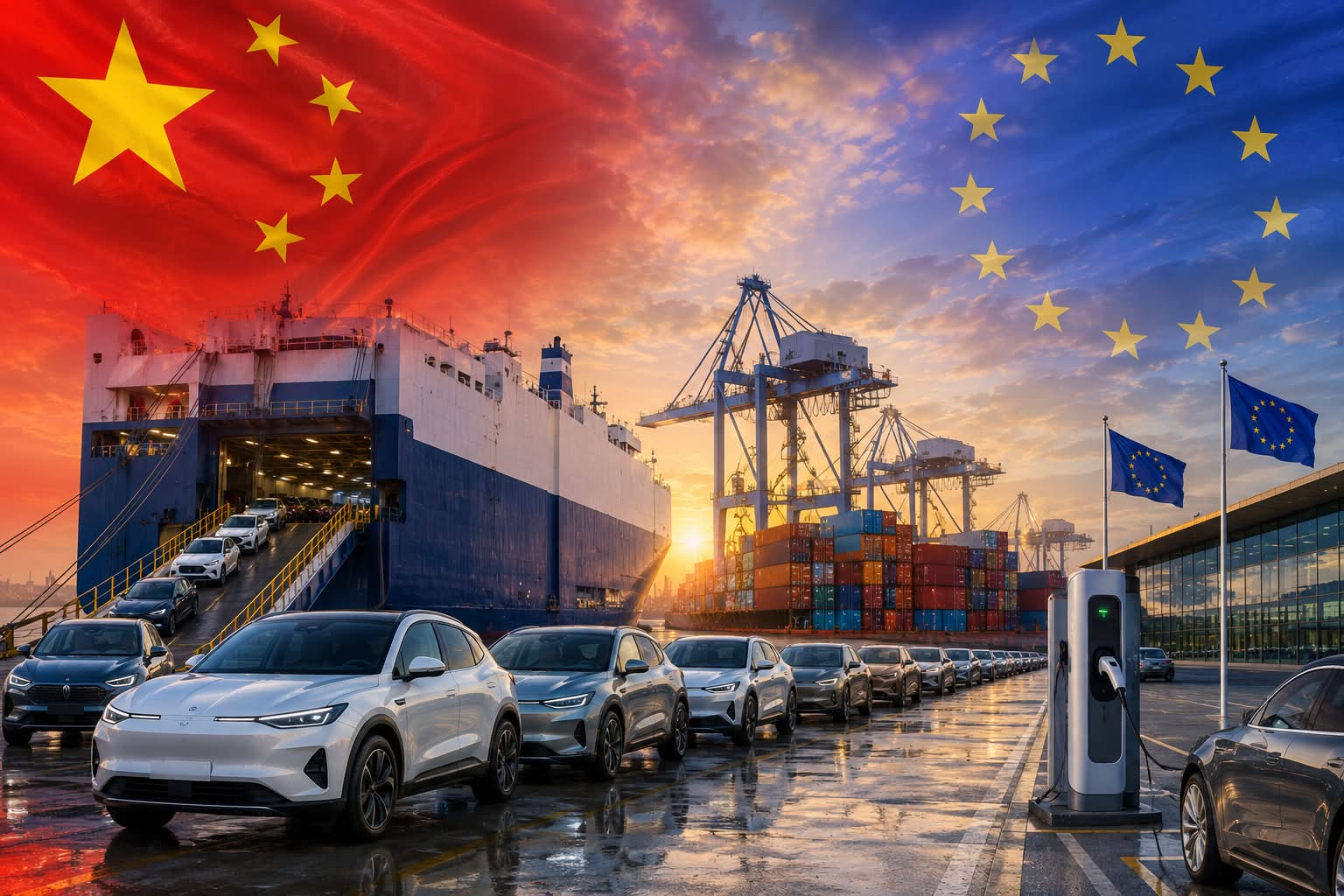
Beijing: The price-undertaking pathway that European trade officials confirmed this month for Chinese electric-vehicle exporters represents one of the most consequential procedural shifts in the EU’s eighteen-month-long countervailing duty saga, and a useful test of whether Brussels can hold an industrial policy line while preserving a working economic relationship with the world’s second-largest economy. Under guidance distributed to Chinese manufacturers, exporters may submit binding model-specific minimum import prices, complemented by volume undertakings and verifiable EU-side investment commitments, in lieu of paying the layered countervailing duties that range from a residual 7.8 percent to a top-band 35.3 percent. The instrument is not new — the EU has used price undertakings in steel, fertiliser and even solar-panel cases — but the scale and political salience of the EV file make it a different beast.
Why now? Three forces converged. The first is European industrial pragmatism. After the 2024 tariff round produced months of legal challenges and a parallel Chinese probe into European pork, brandy and dairy, German automakers in particular pressed for a settlement architecture that could de-risk their China exposure and avoid a fully fledged retaliatory spiral. The second is the slow but visible recovery of Beijing’s incentive to negotiate. Chinese commerce officials have spent the past quarter shopping price-undertaking templates with individual EU member states, and the formal commerce-ministry note welcoming the EU guidance was unusual in its specificity. The third is geometry. With Washington’s tariff posture hardening across categories, the European market matters disproportionately to Chinese EV exporters who can no longer count on a soft landing in North America.
The mechanics matter. A workable undertaking will require model-by-model verification, customs-level price floors and a credible monitoring regime — three things Brussels’ trade defence unit has struggled with in past cases. The Commission has signalled it will lean on the European Anti-Fraud Office and member-state customs authorities to track unit values, and it has hinted that volume ceilings will be tied to investment milestones in EU plants. That last element is the strategic prize: a workable settlement could convert Chinese export volumes into EU greenfield investment, with technology-transfer obligations embedded in plant-level agreements. The Hungarian BYD facility, now nearing operational status, becomes the test case. If the plant runs initially on imported Chinese cells and steel, the political logic of the undertaking weakens; if local sourcing rises on schedule, Brussels can present the architecture as a win for industrial policy.
Risks are concrete. Italian, French and Spanish industry ministries have publicly worried that minimum prices set too low will simply formalise market-share gains without meaningful technology transfer. The European Court of Auditors has already flagged enforcement gaps in past undertaking regimes. And the political optics in Berlin — where the governing coalition has staked its trade rhetoric on a de-risk-not-decouple framing — will be tested if Chinese exports continue to grow under the new floor.
For now, the path forward looks managerial rather than transformational. Brussels has bought time and Beijing has bought market access. Whether the architecture becomes a durable interface between the two industrial systems, or a stop-gap that delays a harder confrontation, will depend on enforcement, investment delivery, and whether the parallel files on rare earths, ports and 5G generate enough goodwill to keep the EV channel open. The next political marker is the autumn EU-China summit, where the upgraded supply mechanism for critical minerals announced earlier this spring is meant to start delivering verifiable export volumes. The summit will, in effect, be a midterm exam on whether the price-undertaking machinery can hold under stress.