August 9, 2026
LATEST
New EU Gas Market Rules Take Effect With Consumer SafeguardsDeforestation Regulation Holds Its December Deadline Despite CutsDigital Omnibus Delays Europe’s High-Risk AI Deadline to 2027Europe’s Schools Confront a Widening Basic Skills GapRule of Law Report Finds Progress but Trust Still LagsIRIS2 Gains 66 Satellites as Brussels Signs the Rollout DealNature Restoration Plans Come Due as Member States Race a DeadlineECB Rates Hold at 2.25 Percent as Frankfurt Waits on the DataEU Budget Talks Turn to Cohesion as Ireland Takes OverWildfire Response Stretches Europe’s Emergency Fleet ThinCan Europe’s Quantum Plan Match Its Big Ambitions?Armenia Edges West as Moscow’s Grip Slips AwayEurope Inherits the World’s Aid Bill It Cannot Fully PayAir Passenger Rights Get Their First Overhaul in Two DecadesErasmus Opens a 5 Billion Euro Round for Skills and MobilityCeuta Crisis Pushes the EU Toward Faster Migrant ReturnsBulky Parcels Face a Packaging Crackdown From August 12Can Europe Build Its Drone Wall Before 2030 Arrives?Indonesia’s Trade Deal With Europe Nears Its Final SignatureEurope Leans on Beijing to Keep Climate Talks Alive Before AntalyaNew EU Gas Market Rules Take Effect With Consumer SafeguardsDeforestation Regulation Holds Its December Deadline Despite CutsDigital Omnibus Delays Europe’s High-Risk AI Deadline to 2027Europe’s Schools Confront a Widening Basic Skills GapRule of Law Report Finds Progress but Trust Still LagsIRIS2 Gains 66 Satellites as Brussels Signs the Rollout DealNature Restoration Plans Come Due as Member States Race a DeadlineECB Rates Hold at 2.25 Percent as Frankfurt Waits on the DataEU Budget Talks Turn to Cohesion as Ireland Takes OverWildfire Response Stretches Europe’s Emergency Fleet ThinCan Europe’s Quantum Plan Match Its Big Ambitions?Armenia Edges West as Moscow’s Grip Slips AwayEurope Inherits the World’s Aid Bill It Cannot Fully PayAir Passenger Rights Get Their First Overhaul in Two DecadesErasmus Opens a 5 Billion Euro Round for Skills and MobilityCeuta Crisis Pushes the EU Toward Faster Migrant ReturnsBulky Parcels Face a Packaging Crackdown From August 12Can Europe Build Its Drone Wall Before 2030 Arrives?Indonesia’s Trade Deal With Europe Nears Its Final SignatureEurope Leans on Beijing to Keep Climate Talks Alive Before Antalya
August 9, 2026
LATEST
New EU Gas Market Rules Take Effect With Consumer SafeguardsDeforestation Regulation Holds Its December Deadline Despite CutsDigital Omnibus Delays Europe’s High-Risk AI Deadline to 2027Europe’s Schools Confront a Widening Basic Skills GapRule of Law Report Finds Progress but Trust Still LagsIRIS2 Gains 66 Satellites as Brussels Signs the Rollout DealNature Restoration Plans Come Due as Member States Race a DeadlineECB Rates Hold at 2.25 Percent as Frankfurt Waits on the DataEU Budget Talks Turn to Cohesion as Ireland Takes OverWildfire Response Stretches Europe’s Emergency Fleet ThinCan Europe’s Quantum Plan Match Its Big Ambitions?Armenia Edges West as Moscow’s Grip Slips AwayEurope Inherits the World’s Aid Bill It Cannot Fully PayAir Passenger Rights Get Their First Overhaul in Two DecadesErasmus Opens a 5 Billion Euro Round for Skills and MobilityCeuta Crisis Pushes the EU Toward Faster Migrant ReturnsBulky Parcels Face a Packaging Crackdown From August 12Can Europe Build Its Drone Wall Before 2030 Arrives?Indonesia’s Trade Deal With Europe Nears Its Final SignatureEurope Leans on Beijing to Keep Climate Talks Alive Before AntalyaNew EU Gas Market Rules Take Effect With Consumer SafeguardsDeforestation Regulation Holds Its December Deadline Despite CutsDigital Omnibus Delays Europe’s High-Risk AI Deadline to 2027Europe’s Schools Confront a Widening Basic Skills GapRule of Law Report Finds Progress but Trust Still LagsIRIS2 Gains 66 Satellites as Brussels Signs the Rollout DealNature Restoration Plans Come Due as Member States Race a DeadlineECB Rates Hold at 2.25 Percent as Frankfurt Waits on the DataEU Budget Talks Turn to Cohesion as Ireland Takes OverWildfire Response Stretches Europe’s Emergency Fleet ThinCan Europe’s Quantum Plan Match Its Big Ambitions?Armenia Edges West as Moscow’s Grip Slips AwayEurope Inherits the World’s Aid Bill It Cannot Fully PayAir Passenger Rights Get Their First Overhaul in Two DecadesErasmus Opens a 5 Billion Euro Round for Skills and MobilityCeuta Crisis Pushes the EU Toward Faster Migrant ReturnsBulky Parcels Face a Packaging Crackdown From August 12Can Europe Build Its Drone Wall Before 2030 Arrives?Indonesia’s Trade Deal With Europe Nears Its Final SignatureEurope Leans on Beijing to Keep Climate Talks Alive Before Antalya

Firefighting Hub At Paphos Switches On Before 2026 Fire Season Hits

Paphos: The first European firefighting hub officially opened at Paphos airport in late April, just weeks ahead of what meteorologists across the south-east Mediterranean are warning could be the harshest wildfire season on record. The inauguration, timed for the informal EU summit hosted by Nicosia on 23 and 24 April, finally locked in a long-discussed plan to centralise rescEU aerial capability in a single Mediterranean location.

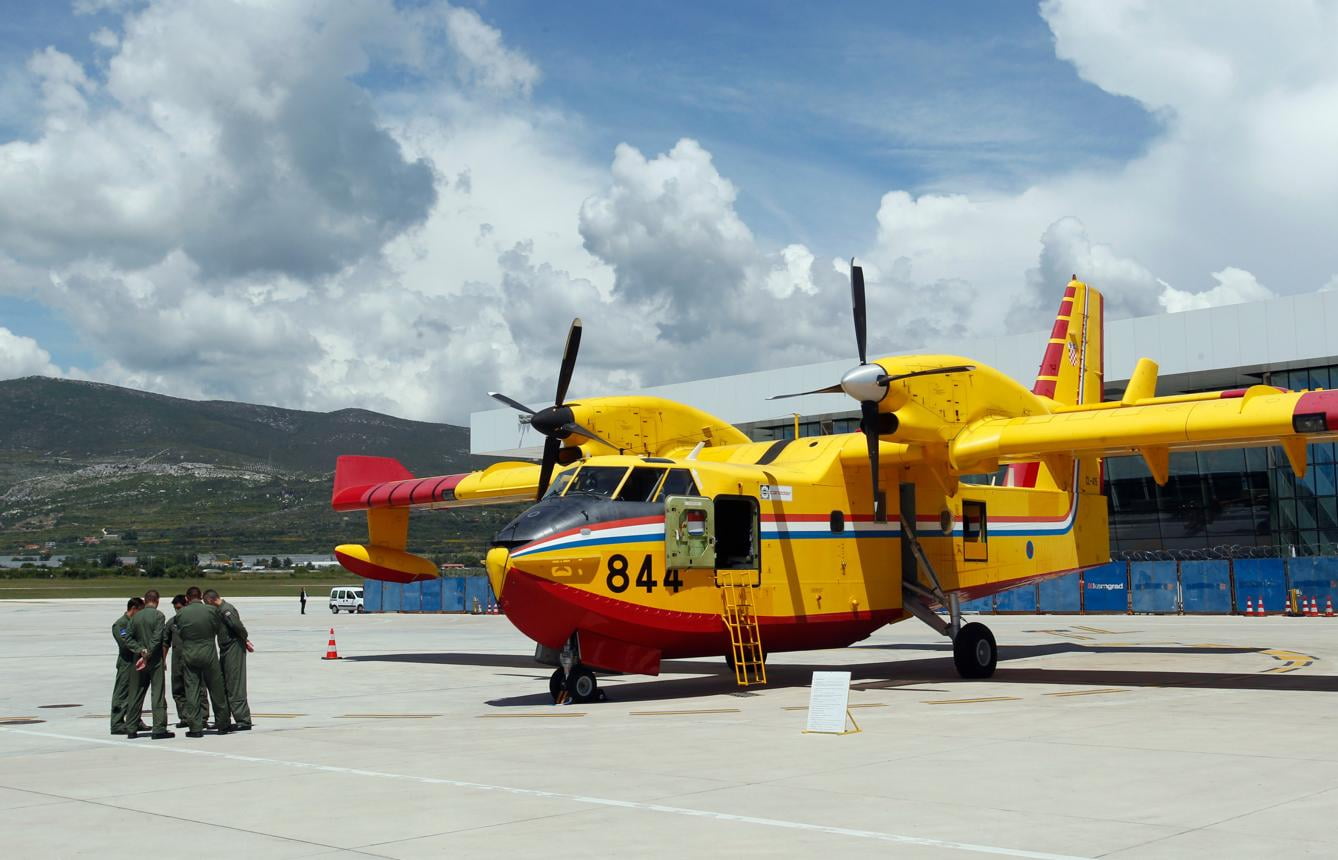
Six firefighting aircraft are already pre-positioned at the airport, a mix of Canadair CL-415s on rotation and Air Tractor AT-802 single-engine planes drawn from the bloc’s expanded fleet. The hub also houses a training and exercise centre that will serve crews from the 24 participating Civil Protection Mechanism states, plus partner countries from the southern Mediterranean. Cyprus carried the infrastructure costs, and the Commission financed the operational layer through the rescEU envelope.

The timing is no accident. The Joint Research Centre’s 2025 wildfire bulletin, published in March, confirmed what regional forest services had been calling the worst year since EFFIS records began in 2006, with nearly 1.08 million hectares burnt across 25 member states, almost double the 2006 to 2024 average. Greece, Spain, Portugal, France and Italy accounted for the largest losses, but smaller member states, Slovenia and Croatia in particular, also reported record-breaking damage relative to their land area.

Commissioner Hadja Lahbib, speaking at the opening, framed the hub as a strategic centre in the region rather than a national asset. The phrasing matters. Member states have historically resisted any framing that suggests rescEU is a permanent supranational fire service, and the Commission has stuck to a strict subsidiarity line. National fleets respond first, rescEU is a top-up. The Cyprus hub does not break that principle, but it does push the centre of gravity of European response capability several hundred kilometres south.

The fleet itself is set to grow. The Commission is in the procurement phase for 12 new firefighting planes and an additional five helicopters, all to be folded into the rescEU strategic reserve. Deliveries are staggered through 2027 to 2029, but the first replacement aircraft are expected to enter service this summer. A separate procurement track covers ground-based modules, including specialised vehicles and command units that can be airlifted into hot zones within 48 hours.

There are still real gaps. The two new EU-procured CL-515s ordered in 2023 will not be ready until 2027, leaving the bloc dependent on ageing CL-415s and rented commercial assets for the next two seasons. The Cyprus hub partly mitigates that by ensuring pre-positioning of available planes, but ECHO’s own internal reviews have warned that the moment the bloc faces three simultaneous Tier 3 fires, a scenario that played out twice in 2025, capacity stretches thin.

Beyond aerial assets, the Commission’s March wildfire strategy is now in the implementation phase. The document set out an integrated risk-management approach combining prevention, preparedness, response and recovery, with prevention funding tied to cohesion envelopes in member states classified as high risk. The next test arrives between June and September. If 2026 mirrors 2025, the Paphos hub will move from inauguration set-piece to operational backbone in a matter of weeks.