
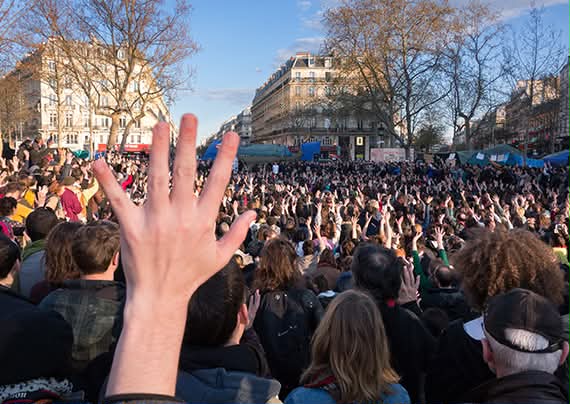
A generation lived under a single proposition: that the world had become a “global village,” in which goods, capital, ideas, and human movement would pass across a planet deliberately reduced in scale. The first three of those promises have held. The fourth, the only one carried in human form, is being revoked in public, by receiving societies that no longer pretend the welcome they once extended was meant to last.
In Johannesburg’s townships, on the streets outside hotels in northern England, around reception centres in Saxony and Calabria, and through neighbourhoods of Dublin & Rotterdam, the same political phenomenon is now visible in different national vocabularies. People who have lived through decades of austerity, deindustrialisation, and rising rents are organising against the foreigners they hold responsible for their condition. The detail varies. The grievance does not. And the response of the political class that produced both the migration and the conditions in which it became combustible has been moral condemnation of the protesters, occasional minor adjustments to asylum policy, and a determined refusal to revisit the proposition on which the entire arrangement was built.
That proposition went, broadly, as follows. The end of the Cold War would inaugurate a more integrated world in which goods, capital, ideas, and eventually people would move with diminishing friction. The phrase “global village,” borrowed from a Canadian theorist of media, became the working metaphor of the political and corporate consensus of the late twentieth century. It was repeated at Davos, written into election manifestos, taught in universities, and embedded in the assumptions of every trade agreement, every climate accord, and every framework on international development. The promise was that the borders mattered less, that the receiving societies would be enriched by what arrived, and that the human movements which followed economic ones were the natural completion of a logic everyone had endorsed.
The goods kept moving. The capital kept moving. The ideas, where convenient, kept moving. The people who took the promise at face value, who left Zimbabwe for Cape Town, Syria for Bavaria, Bangladesh for Manchester, Nigeria for Dublin, are now being told, in the only honest reading of what is happening on the streets and in the polling, that the village was never meant to be populated by them. The contradiction is not that any single voter has become xenophobic. The contradiction is that an entire intellectual and political settlement promised one thing for thirty years and is now delivering its opposite, and the bill is being presented to the people least responsible for the failure.
The political class that sold this version of the world is, with very few exceptions, the same political class still in office, still on the boards, and still on the podiums at the conferences. It produced the trade arrangements that displaced manufacturing from the towns now most visibly in revolt. It signed the financial deregulation that hollowed out the housing markets the protesters cannot afford. It commissioned the public service efficiencies whose absence the same protesters now feel daily. And it spent the same decades reassuring the populations of arrival that the arrivals would be welcome, integrated, and productive, while building almost none of the public infrastructure that welcome would actually have required.
An entire intellectual and political settlement promised one thing for thirty years and is now delivering its opposite. The bill is being presented to the people least responsible for the failure.
A serious account of this moment has to refuse two convenient framings at once. The first, dominant in the editorial pages of the centre-left, treats the protests as a moral lapse of the populations they emerge from, an outbreak of nativism to be condemned and out-organised by the centres of enlightened opinion. That framing absolves the architects of the settlement that produced the underlying conditions, and it has had three decades to work and has worked nowhere. The second, increasingly audible from the populist right, treats migrants themselves as the cause of the dysfunction, an analysis that requires ignoring the actual chronology of deindustrialisation, austerity, and housing collapse, and that delivers the protesters into the hands of opportunists with no interest in solving the problems they exploit.
Honesty would require something neither side has been willing to attempt. It would require an acknowledgement that the global village was either a real proposition, in which case the receiving societies owe their new neighbours the institutional and material follow-through the proposition implied, or it was always rhetorical cover for the freedom of capital and goods, in which case those who sold it owe the public an apology and the architects of the next settlement should not be the same individuals. It would require, in particular, that no government continue to sign new arrangements presupposing the free movement of labour while telling its existing population that those already arrived must somehow be removed, without saying who would do the removing or where the displaced would go.
What this editorial will not concede, under any rhetorical pressure, is that the men, women, and children now living under threat in South African townships, British hotels, German hostels, or Italian reception centres are the proper recipients of the bill for a settlement they did not write. They came on the promise their host societies extended. Many came after considerable suffering. Their continued safety, their access to due process, and their basic standing as human beings are not negotiable in the editorial that follows, and they are not negotiable in any account of European politics that takes itself seriously. The protests reveal a real failure. The protesters are not licensed to direct that failure at those least equipped to absorb it.
The European Post’s position is that the present moment demands an honesty the European political conversation has spent thirty years avoiding. The global village was sold. The bill has arrived. It belongs in the hands of the institutions and individuals who promised something they did not build. Receiving societies require a real account of why their public services thinned, their wages stagnated, and their cities became unaffordable, and that account does not start with the people who arrived from elsewhere. Arriving communities require an account of why the welcome they were offered turned, within a decade, into the hostility they now navigate. Neither account begins with the protests on the streets. Both begin in the rooms where the promise was made, and the rooms where, decade after decade, the resources required to keep it were not voted through. The village can still be built. It cannot be built by pretending that what is happening on the streets is not the verdict that it has not been.
The Editorial represent the considered position of The European Post. They are developed and edited by the Editorial Board, published without individual byline, and offered in the public interest as a contribution to European policy debate.