November 11, 2026
LATEST
Generational Renewal in Farming Moves Up Irish Presidency AgendaOACPS-EU Joint Parliamentary Assembly Presses Brussels on Fair TradeEIB Investment Survey Shows 85% of EU Firms Kept on SpendingExtended EUMAM Ukraine Mandate Adds Kyiv Presence Through 2028DSA Election Guidelines Bring Deepfake Labels to Video FeedsZaharieva Steers EU Research Security Toward Binding Rules In 2026Deported Ukrainian Children Top Parliament Agenda Before Key VoteConnecting Europe Facility Bid Seeks €91 Billion For Rail And GridsLebanon Security Mission Races the Clock as UNIFIL Winds DownMoldova EU Accession Sprint Puts Chisinau Ahead of KyivBlack Sea Maritime Security Hub Gets €50 Million PushInward FDI Data Show US Investors Lead in 14 EU CountriesHorizon Europe 2028-2034 Funding Clash Reaches ParliamentDrone Strategy Review Finds EU Single Market Stuck On PaperNew Canada EU Alliance Pairs Data Rules With Defence LinksSupermarket Cyberattacks Expose EU Gap On Old ControllersStand-Alone European Social Fund Wins €124 Billion Backing From MEPsGreenhouse Gas Emissions Fall 1.6 percent As Nine Capitals Drift Off TrackHumanitarian Action Reform Puts Starvation Warfare in EU SightsSerbia Accession Talks Get a Fresh Start After Vučić Loses PowerGenerational Renewal in Farming Moves Up Irish Presidency AgendaOACPS-EU Joint Parliamentary Assembly Presses Brussels on Fair TradeEIB Investment Survey Shows 85% of EU Firms Kept on SpendingExtended EUMAM Ukraine Mandate Adds Kyiv Presence Through 2028DSA Election Guidelines Bring Deepfake Labels to Video FeedsZaharieva Steers EU Research Security Toward Binding Rules In 2026Deported Ukrainian Children Top Parliament Agenda Before Key VoteConnecting Europe Facility Bid Seeks €91 Billion For Rail And GridsLebanon Security Mission Races the Clock as UNIFIL Winds DownMoldova EU Accession Sprint Puts Chisinau Ahead of KyivBlack Sea Maritime Security Hub Gets €50 Million PushInward FDI Data Show US Investors Lead in 14 EU CountriesHorizon Europe 2028-2034 Funding Clash Reaches ParliamentDrone Strategy Review Finds EU Single Market Stuck On PaperNew Canada EU Alliance Pairs Data Rules With Defence LinksSupermarket Cyberattacks Expose EU Gap On Old ControllersStand-Alone European Social Fund Wins €124 Billion Backing From MEPsGreenhouse Gas Emissions Fall 1.6 percent As Nine Capitals Drift Off TrackHumanitarian Action Reform Puts Starvation Warfare in EU SightsSerbia Accession Talks Get a Fresh Start After Vučić Loses Power

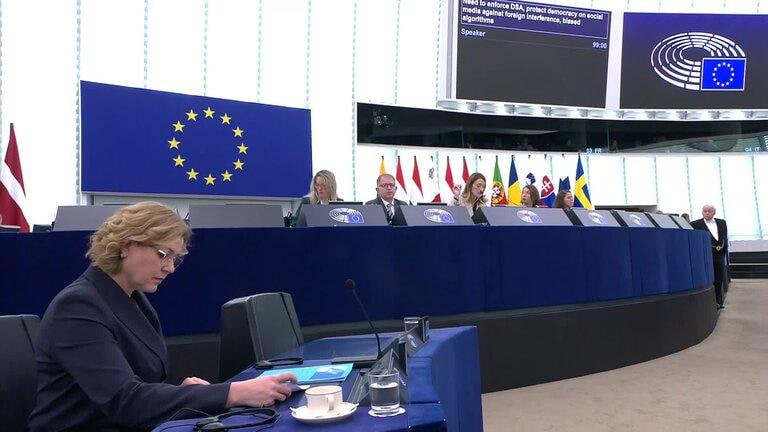
DSA Election Guidelines Bring Deepfake Labels to Video Feeds

The revised DSA election guidelines that the European Commission put out for consultation on 10 November 2026 mark the first serious update of Europe’s rulebook for online platforms during elections since April 2024. Very large online platforms and very large online search engines have until 23 November to comment on a text that focuses squarely on generative AI and information manipulation.

The timing is deliberate. The original DSA election guidelines, adopted under Article 35 of the Digital Services Act before the 2024 European Parliament vote, were written when synthetic video was still a novelty. Two years and dozens of national ballots later, the Commission has a clearer picture of how coordinated networks, recommender systems and cheap AI tools combine to distort a campaign.

The draft asks platforms to detect coordinated inauthentic behaviour early and to dismantle the networks behind it, rather than removing individual posts one by one. That shift matters. Foreign information manipulation and interference rarely depends on a single viral lie; it relies on clusters of fake accounts that amplify each other until an algorithm treats the noise as genuine public interest.

Recommender systems receive the most demanding attention. Under the draft, platforms should spot suspicious trends before they go viral and test their algorithms for manipulation before every national election. They would also keep a record of changes made to those systems in the six months before a vote, which gives regulators an audit trail if a sudden shift in what users see coincides with a polling day.

On AI content, the DSA election guidelines are blunt. Deepfakes should be clearly labelled, and the label should survive when the content is shared across services. Illegal deepfakes of candidates should come down fast. Candidates themselves would get dedicated channels to reach platforms, with threats, harassment and impersonation handled swiftly and applied neutrally to every party and campaign.

Accountability closes the package. Within 30 days of an election, platforms would report to the Commission and national authorities on how they mitigated risks, and they would publish a public version. This post-election reporting turns the DSA election guidelines from a set of good intentions into something closer to a measurable obligation.

The Commission insists the DSA election guidelines are content-neutral and that it does not ask platforms to delete lawful speech. That claim will be tested. Civil liberties groups have long warned that pressure to act quickly before a vote can push companies toward over-removal, while election officials in several member states argue the opposite risk is larger. The draft also builds on the Code of Conduct on Disinformation and its Rapid Response System, so much of the machinery already exists on paper.

The harder question is enforcement. Guidelines under Article 35 are not binding in themselves, yet the Commission can treat a platform’s failure to follow them as evidence that it has not mitigated systemic risks. In practice, that makes the revised DSA election guidelines a benchmark for future DSA investigations, and platforms know it.

For democratic governance in the European Union, the stakes reach beyond any one ballot. Trust in election results depends on voters believing that what they saw online reflected real debate rather than a manufactured wave. The final DSA election guidelines, expected after the consultation closes on 23 November 2026, will show whether Brussels can turn that principle into rules that platforms actually apply.