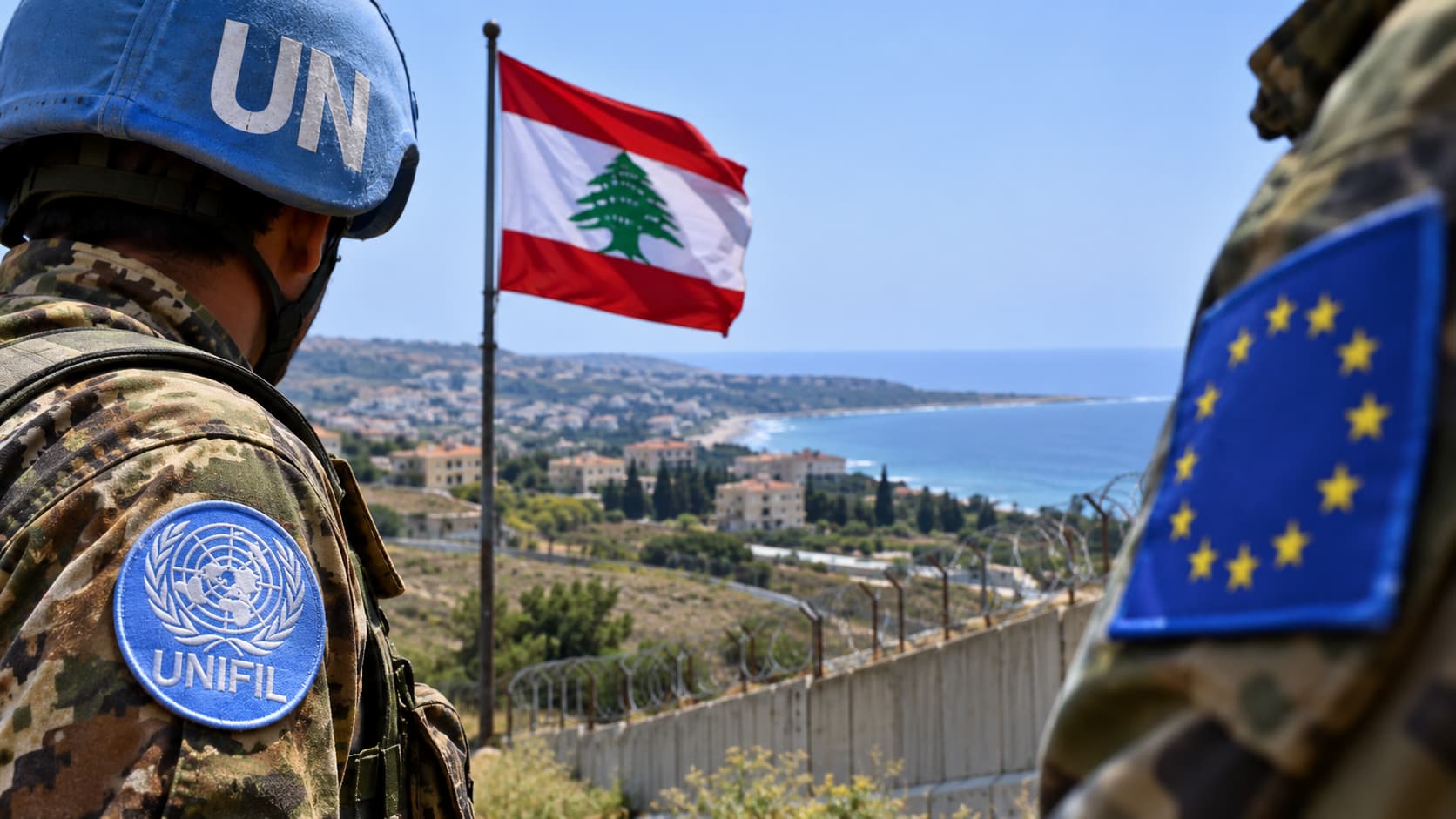
Beirut: The EU’s Lebanon security mission faces a hard deadline, because the UN peacekeeping force that has patrolled the south for decades loses its mandate on 31 December 2026. With seven weeks left, the European Union Support Mission in Lebanon, known as EUSM Lebanon, exists in law but not yet on the ground.
Foreign ministers agreed in Luxembourg on 12 October to create the mission under the Common Security and Defence Policy. It combines a military pillar and a civilian pillar with an initial mandate of up to three years. The Council still has to adopt a separate decision before operations can begin, and staffing and command arrangements remain unsettled.
The design is deliberately modest. Reports suggest Brussels is weighing around 150 personnel, set against roughly 7,500 UNIFIL troops drawn from nearly 50 countries. The Lebanon security mission will advise and train rather than patrol, and it will not deploy in the south where Israel continues its campaign against Hezbollah.
On the military side, Lebanon security mission advisers will help the Lebanese Armed Forces monitor land borders, secure maritime approaches, counter drones and improve intelligence, surveillance and reconnaissance. The civilian team will train the Internal Security Forces in cybercrime and anti-smuggling work and address port security, including at the Port of Beirut.
High Representative Kaja Kallas has framed the effort as a sovereignty project. She argues that stronger Lebanese institutions can restore full state control over territory and borders. She has also warned that leaving no international presence could open a monitoring gap around the US-backed ceasefire arrangements that Israel and Lebanon agreed in June.
That warning exposes the core tension. The Lebanon security mission is not designed to replace UNIFIL, yet it will inevitably be judged against the vacuum UNIFIL leaves. Training programmes pay off over years, while ceasefire violations can unravel in days. Brussels is betting that capacity building is the realistic contribution Europe can make, not a substitute peacekeeping force.
Member state politics will shape how the Lebanon security mission performs. Italy, France, Spain, Ireland, Germany, Austria, Finland and Poland, all UNIFIL contributors, have shown interest in staying engaged. One proposal would rotate command among Italy, France and Spain. Ireland, which holds the Council presidency, has signalled participation mainly on the civilian side.
Coordination is another open question. The mission complements equipment and support financed through the European Peace Facility, and it must fit alongside the coalition that Emmanuel Macron and Giorgia Meloni announced in June. Duplicating effort in a crowded field would waste scarce resources and confuse Lebanese partners.
Beirut, for its part, has asked for UNIFIL’s mandate to be extended, a sign that Lebanese leaders see the EU offer as welcome but insufficient. Kallas has said she hopes the mission can work on the ground within a couple of months, which already implies a gap after 1 January 2027.
The coming weeks will test whether European diplomacy can move at the speed of events. If the Council adopts its launch decision quickly and capitals commit personnel, the Lebanon security mission could become a credible anchor for a fragile state. If it drifts, Europe will have announced a mission and missed the moment it was meant to meet.