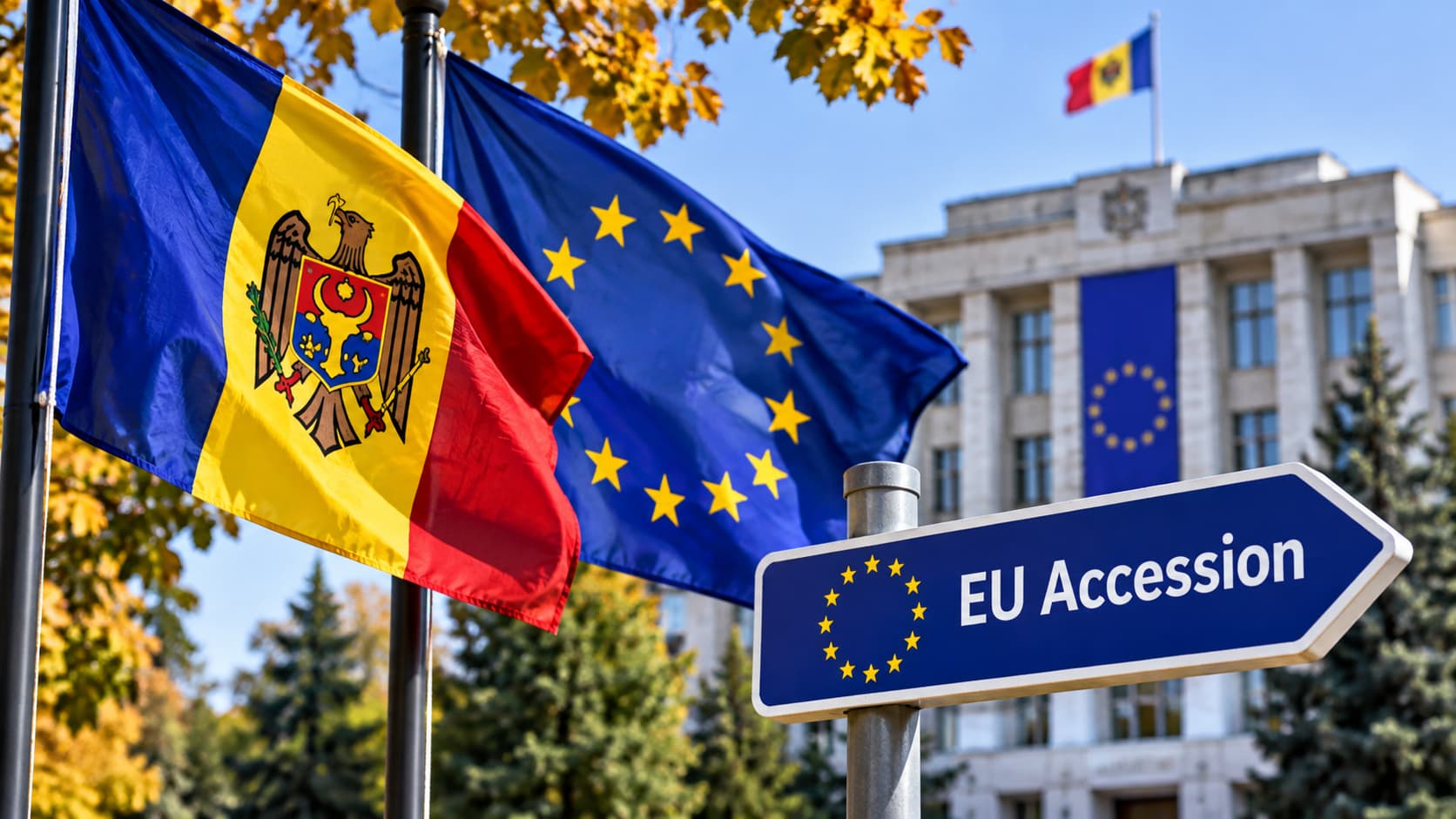
Chisinau: Moldova EU accession has moved from a hopeful slogan to a dated timetable, and the European Commission’s 2026 Enlargement Package published on 4 November makes that shift plain. Brussels now says Moldova has met the conditions to open all remaining negotiating clusters. It calls Chisinau’s goal of closing talks by early 2028 “ambitious but achievable” if reforms keep their current pace.
That verdict matters because Moldova and Ukraine have travelled as a pair since both applied in 2022. The indicative roadmaps released alongside the package break that symmetry. The Commission expects Moldova to close 25 of the 33 chapters during 2027, while Ukraine is projected to close only seven in the same year.
The numbers behind Moldova EU accession tell a story about administrative capacity as much as political will. A small state with a compact legislature can align laws with the acquis faster than a country of tens of millions fighting a war. One senior EU official described Moldova’s alignment rate as “unprecedented”, and the Commission notes that Chisinau launched its rule-of-law task force with the EU in July 2026, three months before Kyiv did.
Yet speed carries its own risk for Moldova EU accession. Commissioner Marta Kos warned that the next phase depends on enforcement, not drafting. She asked for “a solid track record in investigating, prosecuting and sentencing corruption cases”, a test that no amount of legislative copying can pass on paper alone.
The Commission’s 2027 checklist for Moldova EU accession is practical rather than symbolic. It wants Moldova to finish reforming local public administration, reorganise central institutions transparently, tighten fiscal discipline and open its budget to closer scrutiny. Energy security, job creation and growth sit at the top of its economic priorities, reflecting how exposed the country remains to supply shocks.
Kyiv has noticed the gap and dislikes it. After Prime Minister Vasile Tofan visited the Ukrainian capital on 26 October, President Volodymyr Zelensky said both countries “are certainly stronger when we move forward on this track together.” Ukraine hopes to finish talks only by the end of 2028, and the Commission says it must accelerate the pace of reforms to hit even that date.
Decoupling therefore poses a diplomatic dilemma for member states. Rewarding progress on Moldova EU accession honours the principle that each candidate advances on its own record. Holding it back would signal that geopolitics trumps performance, which would undercut the credibility of the whole merit-based method that Brussels defends.
The final two clusters for both candidates are expected to open in December 2026, after which interim rule-of-law benchmarks must be signed off before chapters can close. The Council now has to weigh the Commission’s recommendations and decide the next steps. Whether national capitals accept a Moldova-first sequence will reveal how seriously they take their own rules.
For Chisinau, the opening is real but narrow. Moldova EU accession now depends less on promises from Brussels than on courtrooms, procurement offices and municipal halls delivering visible results before the 2028 window closes. If they do, the smallest candidate in the Eastern Neighbourhood could become the first to cross the line in this enlargement cycle.