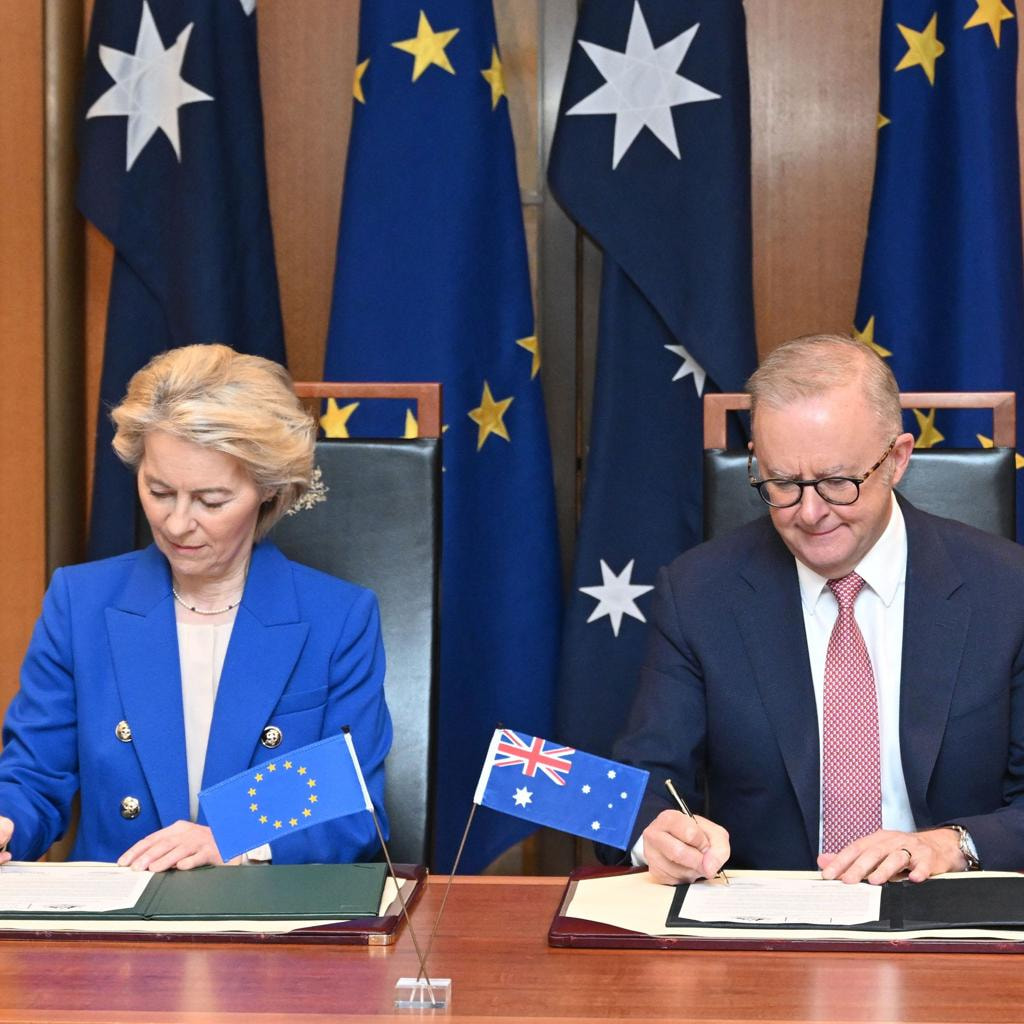
Canberra: After eight years of negotiation that more than once looked terminal, the European Union and Australia finally concluded their free trade agreement in March, and the document has been greeted in both capitals as a landmark for supply-chain resilience. The applause is justified, but it deserves a careful reading. The deal removes almost all bilateral tariffs and, most consequentially, strips duties from the critical minerals that have become the contested terrain of twenty-first-century industrial policy. What it does not do is rewrite the geology of refining, and that distinction is where the real story lives.
The headline numbers are attractive. Brussels secures tariff-free access to Australian lithium, cobalt, manganese, tungsten, antimony and rare earths, eliminating duties that ran from roughly two to five and a half percent across these categories. Canberra gains improved entry to the European market and a formal upgrade of the 2024 Strategic Partnership on Sustainable Critical Minerals, with official estimates suggesting the agreement could add around ten billion Australian dollars to national output once fully implemented. For a European bloc that has watched export controls weaponised against it, an alternative source of the raw inputs behind electric vehicles, wind turbines and defence systems is a genuine prize.
Yet a tariff line is not a supply chain. China controls something close to ninety percent of the world’s rare earth processing, and that bottleneck sits not at the mine but at the refinery. Australia is rich in ore, but much of what it extracts still travels abroad to be turned into the oxides and metals that industry actually consumes. A trade agreement that lowers the cost of shipping Australian rock to Europe does little if Europe lacks the processing capacity to use it, and building that capacity is a matter of years, permits and patient capital rather than signatures. The agreement is best understood as the long game its architects describe, not a switch that diversifies dependence overnight.
This is where the deal’s true value lies, and it is subtler than the communiqué suggests. What Brussels and Canberra have bought is optionality and investor confidence. By binding the two sides into a durable framework, the agreement lowers the political risk that deters the enormous, slow investments refining and downstream manufacturing require. A company weighing a processing plant in South Australia or a magnet factory in Europe can now price in tariff-free movement and a partnership unlikely to evaporate with the next electoral cycle. That predictability, more than the headline duty cuts, is what may eventually shift tonnes through new facilities.
There is also a strategic symmetry that should not be overlooked. Australia gains a customer for downstream products, not merely a buyer of unprocessed ore, which is precisely the upgrade Canberra needs if it is to escape the trap of digging while others refine. Europe gains a supplier whose politics it trusts and whose standards on labour and environment it can defend at home. Both sides are hedging, quite openly, against a world in which trade is increasingly treated as an instrument of pressure rather than a neutral exchange.
The sober conclusion is that the EU–Australia agreement is necessary without being sufficient. It removes a barrier and builds a foundation, but the edifice of genuine mineral independence still has to be constructed plant by plant, and the hardest engineering is metallurgical, not diplomatic. Brussels has bought itself an option on resilience. Whether it exercises that option will depend on industrial policy and capital decisions taken long after the trade ministers have shaken hands.