

Iran struck the passenger terminal at Kuwait International Airport on 3 June, the latest in a campaign that has continued since 28 February. The Gulf Cooperation Council has invoked collective defence three times during those ninety-five days. The question is no longer whether the bloc has the vocabulary of deterrence. The issue is whether it possesses the architecture such declarations have long implied.
The drone strike on Terminal 1 of Kuwait International Airport on the evening of 3 June killed one person, wounded several dozen, and forced the closure of the airfield for a period before flights resumed. The operation belonged to a continuous Iranian campaign that began on 28 February with strikes against all six members of the Gulf Cooperation Council, including Saudi Arabia, the United Arab Emirates, Bahrain, Oman, Qatar, and Kuwait itself, with more than four thousand projectiles launched in the first nineteen days alone according to the International Institute for Strategic Studies.
The war has now extended into its fourth month, and the Council has issued the language of collective defence at three separate ministerial gatherings during that period. Each declaration was clear, each was published on the institutional record, and none was followed by an operational response that would have made the next declaration unnecessary.
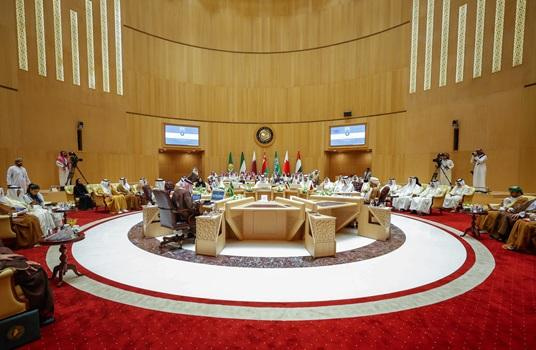
The first of those statements emerged on 1 March, at the 50th Extraordinary Ministerial Council convened in Riyadh the day after Iran began its operations. The text, issued under the chairmanship of the Kuwaiti foreign minister, affirmed that any aggression against one member state constitutes direct aggression against all, in accordance with the GCC Charter and the Joint Defence Agreement.
The same position was reiterated at the GCC-EU joint ministerial held in Brussels on 5 March, co-chaired by the High Representative Kaja Kallas and the Bahraini foreign minister, where the bloc and the Union together recalled the inherent right of the Gulf states, under Article 51 of the United Nations Charter, to defend themselves individually and collectively. The same language was endorsed again at the Gulf summit held in Jeddah on 28 April, where the heads of state reinforced the declaration with explicit calls for accelerated military integration across the six capitals. The collective defence position has therefore been recorded at three institutional altitudes: the Council ministerial, the joint statement with Brussels, and the heads-of-state communiqué at Jeddah. Iran has continued striking through each of those moments.
What has filled the operational gap is not collective response by the Gulf bloc but mediation through Pakistan. Pakistani diplomacy brokered a two-week ceasefire on 8 April between Washington and Tehran, and hosted twenty-one hours of direct talks between the two sides at the Islamabad rounds of 11 and 12 April, which produced no formal agreement but established the back-channel that has since remained the principal off-ramp from the war.
The Pakistani role rests in part on the Strategic Mutual Defence Agreement signed in Riyadh on 17 September 2025 between Prime Minister Shehbaz Sharif and Crown Prince Mohammed bin Salman, which commits the two states to treat any aggression against either as aggression against both. That pact has provided Riyadh with a credible deterrent layer the rest of the Gulf does not possess. It has not, however, been formally invoked in response to the four-month Iranian campaign, and the question of what would constitute its activation has been carefully left unresolved.
The distance between language and structure is therefore institutional rather than accidental. The bloc’s existing instruments anticipate collective response to external aggression and have done so for over forty years. The GCC Charter of May 1981, the Joint Defence Agreement of December 2000, and the Peninsula Shield Force established in 1984 as a standing joint military formation all carry the legal architecture a unified response would require. Peninsula Shield deployments since the 1990-91 Gulf War have been bilateral in practice, scaled to specific moments, and politically constrained in scope.
There has nonetheless been operational progress alongside the dormant instruments. Joint air and missile defence cooperation has expanded since the 2019 Aramco strikes, multilateral exercises with allied partners have built interoperability over a quarter-century, intelligence sharing through the bloc’s military channels has become routine, and successive summit communiqués have endorsed deeper integrated command. The picture overall is one of selective integration rather than absent architecture.
Capability has been built where the political costs were low. Where the costs would have been higher, the language has stood in for the apparatus.
Complications also follow from the political logic the bloc itself has chosen. Each of the six members carries a foreign-policy posture that a strict collective defence regime would constrain. Qatar shares the world’s largest natural-gas field with Tehran and has built a diplomatic identity around mediation between adversaries. Oman has maintained traditional neutrality for over forty years and is currently a quiet channel between Washington and the same capital. The United Arab Emirates retains an independent regional posture and a substantial trade relationship with Iran. The 2017 rupture between Qatar and the Saudi-led group demonstrated, expensively, the price of forced alignment within the council. Flexibility cannot be read solely as institutional deficit. It is also a deliberate choice, one that has preserved the bloc as a forum even when its members have disagreed sharply about the conduct of the region’s external relations.
Comparative regional architectures place the question in further perspective. The North Atlantic Treaty Organisation took decades to build the operational integration that now defines it, and has invoked Article 5 once in over seventy years, after the attacks of 11 September 2001. The Arab League’s Joint Defence Treaty of 1950 has never been formally activated, despite multiple wars in the region during which it might have been. The Collective Security Treaty Organisation in the post-Soviet space has activated only once, briefly, in Kazakhstan in 2022. Collective defence at the regional level is, by historical pattern, declarative more often than operational. The Gulf Cooperation Council is not, by that measure, uniquely deficient in the distance between text and action.
The question facing the bloc, however, is not whether it lags an external benchmark. It is whether the present moment is the one in which the gap stops being tolerable to its own members. Three options are now in front of the six capitals.
The first is to maintain the present pattern, treating collective defence language as diplomatic positioning rather than as security commitment, while the mediation track through Pakistan and Oman continues to manage the conflict in practice. The second is to formally invoke joint defence, with treaty-level mutual obligations modelled on the Pakistan-Saudi instrument, accelerated military integration along the lines the Jeddah summit endorsed in April, and coordinated economic measures against Tehran. The third is to fragment, with Saudi Arabia, the Emirates, Bahrain, and Kuwait taking a harder posture while Qatar and Oman preserve their roles as channels between adversaries. The first option preserves stability at the cost of credibility. The second restores credibility at the cost of mediation. The third ratifies the de facto behaviour of the past four months and ends the pretence that the bloc acts as one on security.
The mediation track is the variable that shapes which option becomes viable. The High Representative said at the Islamabad press conference on 1 June that there was a “tenuous diplomatic opening” to extend the ceasefire and reopen the Strait of Hormuz, and that she expected the first phase of a Pakistan-mediated agreement to be formally signed. The strikes of 2 and 3 June against Kuwait, Bahrain, and a vessel near Hormuz were either Tehran’s signal that the opening was closing or its attempt at leverage before any signature. The bloc’s response to those strikes will determine whether the diplomatic track survives the week. A formal invocation of collective defence in the aftermath of the Kuwait Airport drone strike would likely end the mediation. Continued silence would consolidate the perception that the bloc’s repeated affirmations are now language without consequence.
The European Union has a serious stake in the outcome. The EU-GCC summit in Riyadh this autumn was scheduled on the assumption that Brussels meets a coherent regional interlocutor. If the Council remains in declaratory mode, the gathering becomes a series of bilateral conversations conducted under a shared roof. The Union’s energy security continues to depend on the maintenance of normal flows through the Strait of Hormuz, a corridor Kallas described in Islamabad as one the war was making more expensive by the day. European sovereign capital flows, both incoming Gulf investment in EU strategic sectors and outgoing European investment in Gulf infrastructure, depend on the bloc’s ability to make and keep collective commitments. Brussels has so far treated the Council as a unitary partner. The 3 June attack on Kuwait Airport raises the question of whether that treatment is still warranted.
The Gulf Cooperation Council has issued the language of collective defence three times since the war began. Each declaration was meaningful in its moment, and each remains on the public record. The capability the bloc has built over four decades, in joint exercises, in air and missile defence cooperation, and in selective intelligence sharing, has been real if uneven. None of those measures, however, has been operational at the level the war has now required. The drone strike on Kuwait International Airport two days before this writing raises the question of whether a fourth declaration is in preparation, and whether anyone in Tehran, Washington, Brussels, or Riyadh will read it as anything other than continuation of the pattern.
The architecture the Gulf has promised exists in text. The structure the Gulf has built in practice has operated through bilateral arrangements and through mediation by Pakistan and Oman, neither of which substitutes for the security commitment the bloc itself has repeatedly affirmed in writing. The summit in Riyadh this autumn will meet whichever bloc the six capitals choose to be in the next two weeks. The choice is now in front of them. The world will hear what they decide by what they do, or by what they continue not to do.
Notes:
- The GCC Charter, signed in Abu Dhabi on 25 May 1981 and the founding instrument of the bloc, establishes its six-member composition and consultative architecture. The GCC Joint Defence Agreement, signed by all six heads of state at the December 2000 summit, formalises the principle that an attack on one member is an attack on all and provides the legal foundation for the Peninsula Shield Force. Both texts have been on the institutional record for over two decades and are publicly available through the GCC Secretariat-General.
- The Strategic Mutual Defence Agreement between Pakistan and Saudi Arabia was signed at Al-Yamamah Palace in Riyadh on 17 September 2025, between Prime Minister Shehbaz Sharif and Crown Prince Mohammed bin Salman. Multiple official statements have characterised its central commitment as treating any aggression against either party as aggression against both. The Pakistani defence minister has stated that Saudi Arabia falls within the scope of Pakistan’s nuclear umbrella under the pact, though the official text of the agreement has not been published in full.
- The Peninsula Shield Force was established in 1984 as the standing joint military arm of the Gulf Cooperation Council, headquartered at Hafar al-Batin, Saudi Arabia, and initially configured at brigade strength. Its largest deployment was during the 1990-91 Gulf War, in defensive positions inside Saudi Arabia. Smaller deployments have occurred since, including the 2011 intervention in Bahrain at the request of the Bahraini government during the Pearl Roundabout protests. The force has not been deployed in response to the 2026 Iranian campaign.
- The 50th Extraordinary Ministerial Council statement of 1 March 2026, the GCC-EU joint ministerial statement of 5 March 2026, and the Jeddah summit communiqué of 28 April 2026 each affirmed the indivisibility of Gulf security and the collective character of any response to aggression. The texts are publicly available through the GCC Secretariat-General and the European External Action Service.
AUTHOR’S NOTE:
This article is offered as analysis in good faith, an examination of the Gulf Cooperation Council’s repeated invocations of collective defence during the 2026 Iran war and the institutional gap between those declarations and operational response. Its argument rests on the documented record of the Council’s 50th Extraordinary Ministerial statement of 1 March 2026, the GCC-EU joint ministerial statement of 5 March 2026, the Jeddah summit communiqué of 28 April 2026, the published Pakistan-Saudi Strategic Mutual Defence Agreement of 17 September 2025, the joint press communiqué of the eighth round of the EU-Pakistan Strategic Dialogue held in Islamabad on 1 June 2026, contemporaneous reporting on the Kuwait International Airport drone strike of 3 June 2026, and the published analytical record of the International Institute for Strategic Studies on the scale of the Iranian campaign. It examines the conduct of states and institutions, not the character of any nation or people. The analysis is grounded in established fact, and the views expressed are honestly held.
ABOUT THE AUTHOR
Azfar Bukhari is a senior analyst specialising in geopolitics, public diplomacy, migration, international trade, and investment. He is a regular contributor to The European Post.