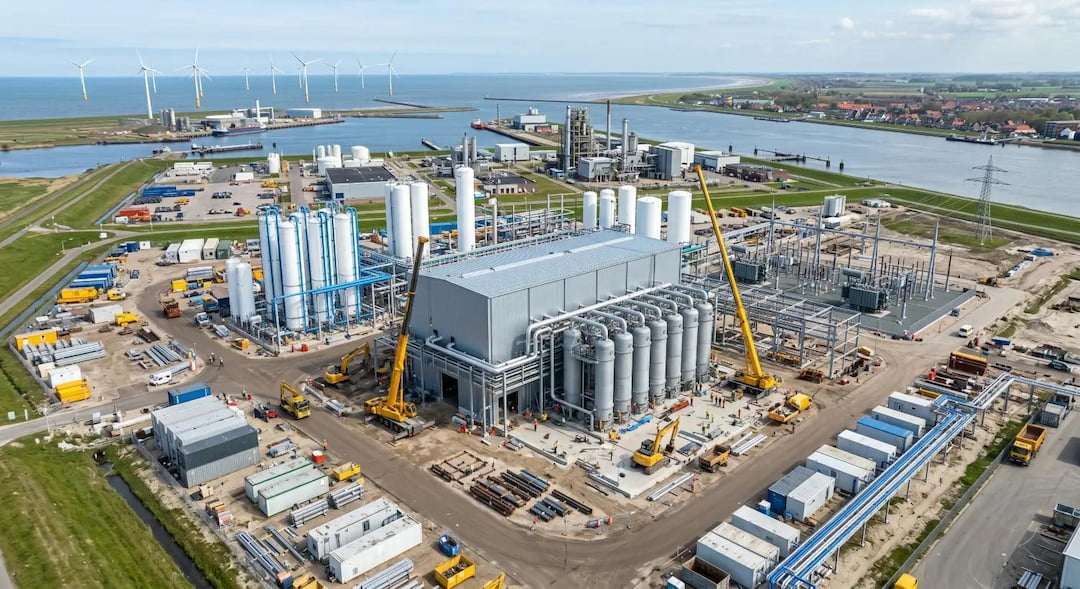
Eemshaven: The Commission has cleared a €780 million Dutch hydrogen state aid scheme that aims to build about 400 megawatts of electrolysis capacity for renewable hydrogen. The approval, announced at the start of October 2026, rests on the Clean Industrial Deal State Aid Framework, which the Commission adopted on 25 June 2025.
Under the scheme, the Netherlands will award support through a competitive bidding process that it plans to finish by the first quarter of 2027. Winners will receive a direct grant in two parts. The first is an upfront investment grant that covers up to 80% of investment costs. The second is a variable premium that runs for between five and 10 years. The Dutch hydrogen state aid therefore backs both the construction of plants and their early operation.
Strict conditions apply to the Dutch hydrogen state aid. Beneficiaries must prove that their hydrogen meets the EU criteria for renewable fuels of non-biological origin, which the delegated acts on renewable hydrogen set out. Projects that cannot document that compliance will not qualify, and the competitive format should push bidders to offer the lowest support per unit of hydrogen.
The Netherlands expects clear results. The electrolysers built with the aid should produce up to 40 kilotonnes of renewable hydrogen per year and avoid roughly 324 kilotonnes of carbon dioxide emissions each year. Those figures are national estimates, and the real outcome will depend on which projects win the auctions and how quickly they reach a final investment decision.
This Dutch hydrogen state aid is the third scheme of its kind. The Commission approved earlier schemes in July 2023 and July 2024, so the latest decision continues a steady pipeline rather than opening a new one. Each round has added public support for electrolysis in the country, and this round ties that support to Clean Industrial Deal goals.
The legal assessment follows a familiar path. The Commission based its decision on Article 107(3)(c) of the Treaty on the Functioning of the European Union, which lets it approve aid that supports the development of certain economic activities. Officials concluded that the measure is necessary and appropriate for producing renewable hydrogen, that it has an incentive effect and that it has a limited impact on competition and trade within the EU. They judged that the positive effects, especially for Clean Industrial Deal objectives, outweigh the possible distortions.
For investors, the Dutch hydrogen state aid decision removes a legal uncertainty, because a scheme without state aid clearance cannot pay out. For rival member states, it sets a benchmark on how much of the capital bill public money can cover and how long a premium can last. Governments designing their own hydrogen support will watch the 80% investment cap and the five to 10 year premium window closely.
The next milestones sit with The Hague. The bidding process must open and close, winners must sign grants and plants must reach operation. Until then, the Dutch hydrogen state aid remains a promise on paper, but a promise that now carries Commission approval and a clear 400 MW goal under the 2026 rulebook.