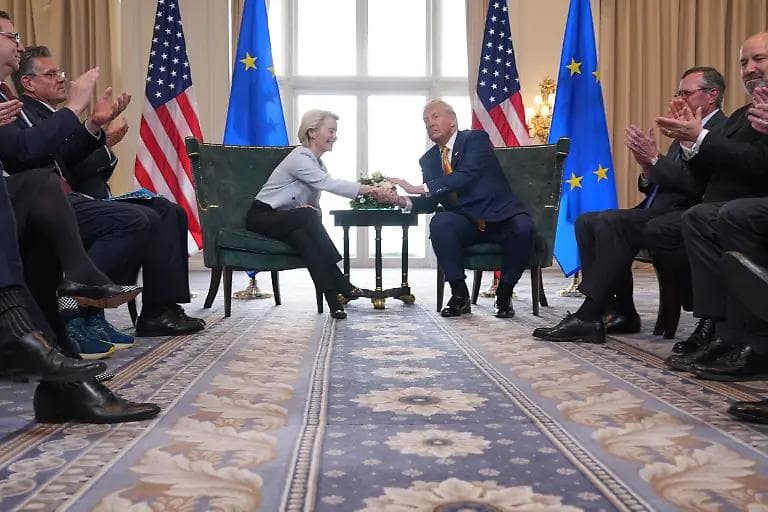
Strasbourg: The European Parliament approved the framework trade agreement with the United States on 16 June by 440 votes to 151, with 50 abstentions, a margin comfortable enough to look decisive and lopsided enough to hide how reluctant much of that majority was. The deal eliminates EU tariffs on most American industrial and agricultural goods while capping US duties on European imports at fifteen percent, codifying the bargain struck by Donald Trump and the Union at his Turnberry golf resort last July. Many of the MEPs who voted yes spent the debate explaining what they disliked about it.
The asymmetry is the obvious grievance. Europe removes its tariffs; Washington merely promises not to raise its own above a ceiling that is still high by any historical standard. A fifteen-percent cap is not free trade, and it locks in a level of friction that would have been unthinkable a decade ago. Lawmakers also complained that safeguards meant to let the EU suspend concessions if the United States breaks the Turnberry terms had been watered down in committee. The legislation expires at the end of 2029, a deliberately short leash, but a sunset clause is cold comfort if the enforcement teeth have already been filed down.
So why did it pass. The honest answer is that the alternative looked worse. Rejecting the deal would have collapsed the only stable framework governing the largest trading relationship on earth and handed Washington a pretext to impose the punitive tariffs it had repeatedly threatened. Faced with a choice between a flawed agreement and open trade conflict with an unpredictable partner, a majority concluded that certainty, even bad certainty, was worth more than principle. The vote was less an endorsement than an act of risk management, a judgement that European exporters could live with a fifteen-percent ceiling but not with the chaos of having none.
That logic deserves scrutiny rather than reflexive applause. Accepting an asymmetric deal under pressure sets a precedent: it signals that European unity can be split and its market opened when the counterpart is willing to threaten hard enough. The next administration, in Washington or elsewhere, will have studied how this was done. Defenders counter that pragmatism is not capitulation, that a predictable fifteen percent is vastly better for supply chains than tariffs that lurch with each social-media post, and that the Union preserved its regulatory autonomy on the standards that matter most, food safety, digital rules, environmental thresholds. On their telling, Europe traded a little tariff dignity for a lot of operational stability, and got the better of the exchange.
Both readings can be true at once, which is what makes the vote interesting. The agreement now passes to the twenty-seven member states for formal endorsement, and that stage is where the abstentions and grudging yeses could harden. Capitals with large agricultural exporters will weigh the gains for their farmers against the optics of validating a deal born of coercion; governments with strong transatlantic instincts will press for swift ratification. Unanimity is not guaranteed, and a single determined holdout can slow the process even if it cannot ultimately block it.
What matters now is implementation and the credibility of the safeguards. If the United States honours the Turnberry ceiling, the deal will quietly become the uncontroversial floor of transatlantic commerce and the debate will be forgotten. If Washington tests the limits, the EU will discover whether its diluted suspension mechanism can actually be triggered, or whether it was always a paper instrument. Parliament has bought four years of relative predictability. Whether it also bought a habit of yielding to pressure is the question that will outlast this agreement, and it is one Europe will face again long before 2029.