August 9, 2026
LATEST
Pension Savings Rules Get a Reset as the EU Scraps the 1% CapMedicine Shortages Move to the Heart of Europe’s Pharma ResetJapan Becomes Europe’s Closest Security Partner in AsiaCan Europe’s New Zealand Deal Anchor It in the Pacific?Chip Research Binds Europe and South Korea CloserMinimum Prices Replace Tariffs in Europe’s China Car DealBrussels and Beijing Keep Talking While the Trade Gap WidensKorean Weapons and EU Loans Now Bankroll Europe’s RearmamentNew EU Gas Market Rules Take Effect With Consumer SafeguardsDeforestation Regulation Holds Its December Deadline Despite CutsDigital Omnibus Delays Europe’s High-Risk AI Deadline to 2027Europe’s Schools Confront a Widening Basic Skills GapRule of Law Report Finds Progress but Trust Still LagsIRIS2 Gains 66 Satellites as Brussels Signs the Rollout DealNature Restoration Plans Come Due as Member States Race a DeadlineECB Rates Hold at 2.25 Percent as Frankfurt Waits on the DataEU Budget Talks Turn to Cohesion as Ireland Takes OverWildfire Response Stretches Europe’s Emergency Fleet ThinCan Europe’s Quantum Plan Match Its Big Ambitions?Armenia Edges West as Moscow’s Grip Slips AwayPension Savings Rules Get a Reset as the EU Scraps the 1% CapMedicine Shortages Move to the Heart of Europe’s Pharma ResetJapan Becomes Europe’s Closest Security Partner in AsiaCan Europe’s New Zealand Deal Anchor It in the Pacific?Chip Research Binds Europe and South Korea CloserMinimum Prices Replace Tariffs in Europe’s China Car DealBrussels and Beijing Keep Talking While the Trade Gap WidensKorean Weapons and EU Loans Now Bankroll Europe’s RearmamentNew EU Gas Market Rules Take Effect With Consumer SafeguardsDeforestation Regulation Holds Its December Deadline Despite CutsDigital Omnibus Delays Europe’s High-Risk AI Deadline to 2027Europe’s Schools Confront a Widening Basic Skills GapRule of Law Report Finds Progress but Trust Still LagsIRIS2 Gains 66 Satellites as Brussels Signs the Rollout DealNature Restoration Plans Come Due as Member States Race a DeadlineECB Rates Hold at 2.25 Percent as Frankfurt Waits on the DataEU Budget Talks Turn to Cohesion as Ireland Takes OverWildfire Response Stretches Europe’s Emergency Fleet ThinCan Europe’s Quantum Plan Match Its Big Ambitions?Armenia Edges West as Moscow’s Grip Slips Away
August 9, 2026
LATEST
Pension Savings Rules Get a Reset as the EU Scraps the 1% CapMedicine Shortages Move to the Heart of Europe’s Pharma ResetJapan Becomes Europe’s Closest Security Partner in AsiaCan Europe’s New Zealand Deal Anchor It in the Pacific?Chip Research Binds Europe and South Korea CloserMinimum Prices Replace Tariffs in Europe’s China Car DealBrussels and Beijing Keep Talking While the Trade Gap WidensKorean Weapons and EU Loans Now Bankroll Europe’s RearmamentNew EU Gas Market Rules Take Effect With Consumer SafeguardsDeforestation Regulation Holds Its December Deadline Despite CutsDigital Omnibus Delays Europe’s High-Risk AI Deadline to 2027Europe’s Schools Confront a Widening Basic Skills GapRule of Law Report Finds Progress but Trust Still LagsIRIS2 Gains 66 Satellites as Brussels Signs the Rollout DealNature Restoration Plans Come Due as Member States Race a DeadlineECB Rates Hold at 2.25 Percent as Frankfurt Waits on the DataEU Budget Talks Turn to Cohesion as Ireland Takes OverWildfire Response Stretches Europe’s Emergency Fleet ThinCan Europe’s Quantum Plan Match Its Big Ambitions?Armenia Edges West as Moscow’s Grip Slips AwayPension Savings Rules Get a Reset as the EU Scraps the 1% CapMedicine Shortages Move to the Heart of Europe’s Pharma ResetJapan Becomes Europe’s Closest Security Partner in AsiaCan Europe’s New Zealand Deal Anchor It in the Pacific?Chip Research Binds Europe and South Korea CloserMinimum Prices Replace Tariffs in Europe’s China Car DealBrussels and Beijing Keep Talking While the Trade Gap WidensKorean Weapons and EU Loans Now Bankroll Europe’s RearmamentNew EU Gas Market Rules Take Effect With Consumer SafeguardsDeforestation Regulation Holds Its December Deadline Despite CutsDigital Omnibus Delays Europe’s High-Risk AI Deadline to 2027Europe’s Schools Confront a Widening Basic Skills GapRule of Law Report Finds Progress but Trust Still LagsIRIS2 Gains 66 Satellites as Brussels Signs the Rollout DealNature Restoration Plans Come Due as Member States Race a DeadlineECB Rates Hold at 2.25 Percent as Frankfurt Waits on the DataEU Budget Talks Turn to Cohesion as Ireland Takes OverWildfire Response Stretches Europe’s Emergency Fleet ThinCan Europe’s Quantum Plan Match Its Big Ambitions?Armenia Edges West as Moscow’s Grip Slips Away

A Digital Trade Pact Binds Europe and South Korea Closer

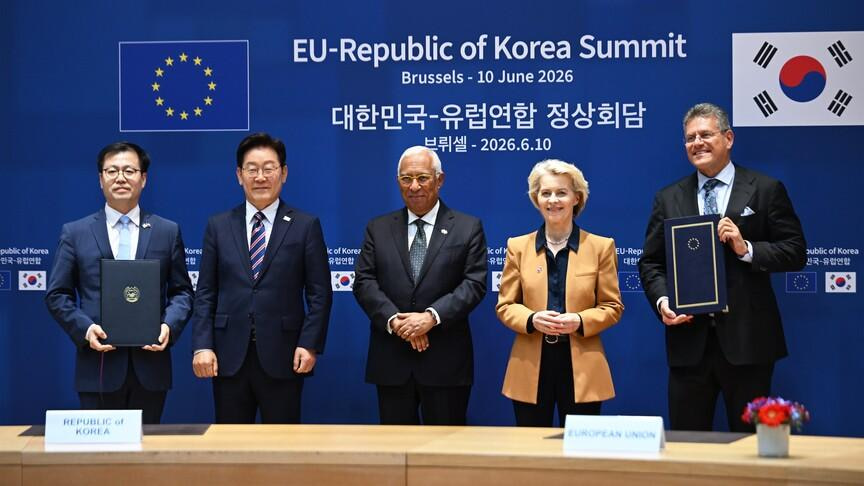
Seoul: The summit that brought European and South Korean leaders together in Brussels on 10 June 2026, their first in three years, produced more than the usual communique. Its centrepiece was a landmark Digital Trade Agreement, signed by trade chief Maros Sefcovic, that tries to write rules for a part of the economy where rules have lagged badly behind reality.

The substance is technical but consequential. The agreement is designed to ease cross-border data flows, give legal recognition to electronic contracts and signatures, strengthen consumer protection online and cut compliance costs for firms operating in both markets. Crucially, it prohibits governments from demanding the transfer of source code as a condition of market access, a safeguard that matters intensely to software and hardware companies wary of forced technology handovers. In an era when data is treated as strategic infrastructure, agreeing that it can move freely between two advanced democracies is a deliberate statement about which model of digital governance they prefer.

The economic backdrop explains the urgency. Trade in goods between the two sides exceeded 124 billion euros in 2025, making South Korea the EU’s eighth-largest trading partner and one of its most technologically complementary. Europe wants reliable access to Korean batteries, semiconductors and shipbuilding; Korea wants a stable, rules-based counterweight as trade with both China and the United States grows more turbulent. The leaders paired the digital pact with a new competitiveness partnership and a high-level economic dialogue, signalling that the relationship is being upgraded from transactional to structural.

It would be easy to overstate what a digital agreement delivers. Data-flow commitments are only as strong as their enforcement, and divergent privacy regimes, Europe’s stringent data-protection rules chief among them, could still generate friction the text papers over. Nor does the pact resolve the thornier questions of artificial intelligence governance, where Brussels and Seoul are still feeling their way toward compatible standards. Critics will note that summits are good at producing frameworks and less good at producing measurable change in how companies actually operate.

Yet the direction matters. By choosing to deepen ties precisely when the global trading order is fracturing, the two partners are betting that predictability has become a competitive advantage in its own right. The summit also expanded their security and defence cooperation, extending coordination on cybersecurity, hybrid threats, foreign information manipulation, maritime security and space, a reminder that digital and security policy are increasingly inseparable.

What to watch now is implementation. Ratification timelines, the first disputes over data adequacy, and whether the competitiveness partnership translates into concrete investment will reveal whether June’s signatures amounted to genuine integration or diplomatic theatre. For Europe, the deal is a template for how it wants to engage like-minded economies in Asia without the leverage of a full free-trade renegotiation. For South Korea, it is insurance against a world in which its two largest trading relationships have both become sources of risk rather than reassurance.