August 9, 2026
LATEST
New EU Gas Market Rules Take Effect With Consumer SafeguardsDeforestation Regulation Holds Its December Deadline Despite CutsDigital Omnibus Delays Europe’s High-Risk AI Deadline to 2027Europe’s Schools Confront a Widening Basic Skills GapRule of Law Report Finds Progress but Trust Still LagsIRIS2 Gains 66 Satellites as Brussels Signs the Rollout DealNature Restoration Plans Come Due as Member States Race a DeadlineECB Rates Hold at 2.25 Percent as Frankfurt Waits on the DataEU Budget Talks Turn to Cohesion as Ireland Takes OverWildfire Response Stretches Europe’s Emergency Fleet ThinCan Europe’s Quantum Plan Match Its Big Ambitions?Armenia Edges West as Moscow’s Grip Slips AwayEurope Inherits the World’s Aid Bill It Cannot Fully PayAir Passenger Rights Get Their First Overhaul in Two DecadesErasmus Opens a 5 Billion Euro Round for Skills and MobilityCeuta Crisis Pushes the EU Toward Faster Migrant ReturnsBulky Parcels Face a Packaging Crackdown From August 12Can Europe Build Its Drone Wall Before 2030 Arrives?Indonesia’s Trade Deal With Europe Nears Its Final SignatureEurope Leans on Beijing to Keep Climate Talks Alive Before AntalyaNew EU Gas Market Rules Take Effect With Consumer SafeguardsDeforestation Regulation Holds Its December Deadline Despite CutsDigital Omnibus Delays Europe’s High-Risk AI Deadline to 2027Europe’s Schools Confront a Widening Basic Skills GapRule of Law Report Finds Progress but Trust Still LagsIRIS2 Gains 66 Satellites as Brussels Signs the Rollout DealNature Restoration Plans Come Due as Member States Race a DeadlineECB Rates Hold at 2.25 Percent as Frankfurt Waits on the DataEU Budget Talks Turn to Cohesion as Ireland Takes OverWildfire Response Stretches Europe’s Emergency Fleet ThinCan Europe’s Quantum Plan Match Its Big Ambitions?Armenia Edges West as Moscow’s Grip Slips AwayEurope Inherits the World’s Aid Bill It Cannot Fully PayAir Passenger Rights Get Their First Overhaul in Two DecadesErasmus Opens a 5 Billion Euro Round for Skills and MobilityCeuta Crisis Pushes the EU Toward Faster Migrant ReturnsBulky Parcels Face a Packaging Crackdown From August 12Can Europe Build Its Drone Wall Before 2030 Arrives?Indonesia’s Trade Deal With Europe Nears Its Final SignatureEurope Leans on Beijing to Keep Climate Talks Alive Before Antalya
August 9, 2026
LATEST
New EU Gas Market Rules Take Effect With Consumer SafeguardsDeforestation Regulation Holds Its December Deadline Despite CutsDigital Omnibus Delays Europe’s High-Risk AI Deadline to 2027Europe’s Schools Confront a Widening Basic Skills GapRule of Law Report Finds Progress but Trust Still LagsIRIS2 Gains 66 Satellites as Brussels Signs the Rollout DealNature Restoration Plans Come Due as Member States Race a DeadlineECB Rates Hold at 2.25 Percent as Frankfurt Waits on the DataEU Budget Talks Turn to Cohesion as Ireland Takes OverWildfire Response Stretches Europe’s Emergency Fleet ThinCan Europe’s Quantum Plan Match Its Big Ambitions?Armenia Edges West as Moscow’s Grip Slips AwayEurope Inherits the World’s Aid Bill It Cannot Fully PayAir Passenger Rights Get Their First Overhaul in Two DecadesErasmus Opens a 5 Billion Euro Round for Skills and MobilityCeuta Crisis Pushes the EU Toward Faster Migrant ReturnsBulky Parcels Face a Packaging Crackdown From August 12Can Europe Build Its Drone Wall Before 2030 Arrives?Indonesia’s Trade Deal With Europe Nears Its Final SignatureEurope Leans on Beijing to Keep Climate Talks Alive Before AntalyaNew EU Gas Market Rules Take Effect With Consumer SafeguardsDeforestation Regulation Holds Its December Deadline Despite CutsDigital Omnibus Delays Europe’s High-Risk AI Deadline to 2027Europe’s Schools Confront a Widening Basic Skills GapRule of Law Report Finds Progress but Trust Still LagsIRIS2 Gains 66 Satellites as Brussels Signs the Rollout DealNature Restoration Plans Come Due as Member States Race a DeadlineECB Rates Hold at 2.25 Percent as Frankfurt Waits on the DataEU Budget Talks Turn to Cohesion as Ireland Takes OverWildfire Response Stretches Europe’s Emergency Fleet ThinCan Europe’s Quantum Plan Match Its Big Ambitions?Armenia Edges West as Moscow’s Grip Slips AwayEurope Inherits the World’s Aid Bill It Cannot Fully PayAir Passenger Rights Get Their First Overhaul in Two DecadesErasmus Opens a 5 Billion Euro Round for Skills and MobilityCeuta Crisis Pushes the EU Toward Faster Migrant ReturnsBulky Parcels Face a Packaging Crackdown From August 12Can Europe Build Its Drone Wall Before 2030 Arrives?Indonesia’s Trade Deal With Europe Nears Its Final SignatureEurope Leans on Beijing to Keep Climate Talks Alive Before Antalya

Europe Lines Up AWS and Azure for Gatekeeper Rules

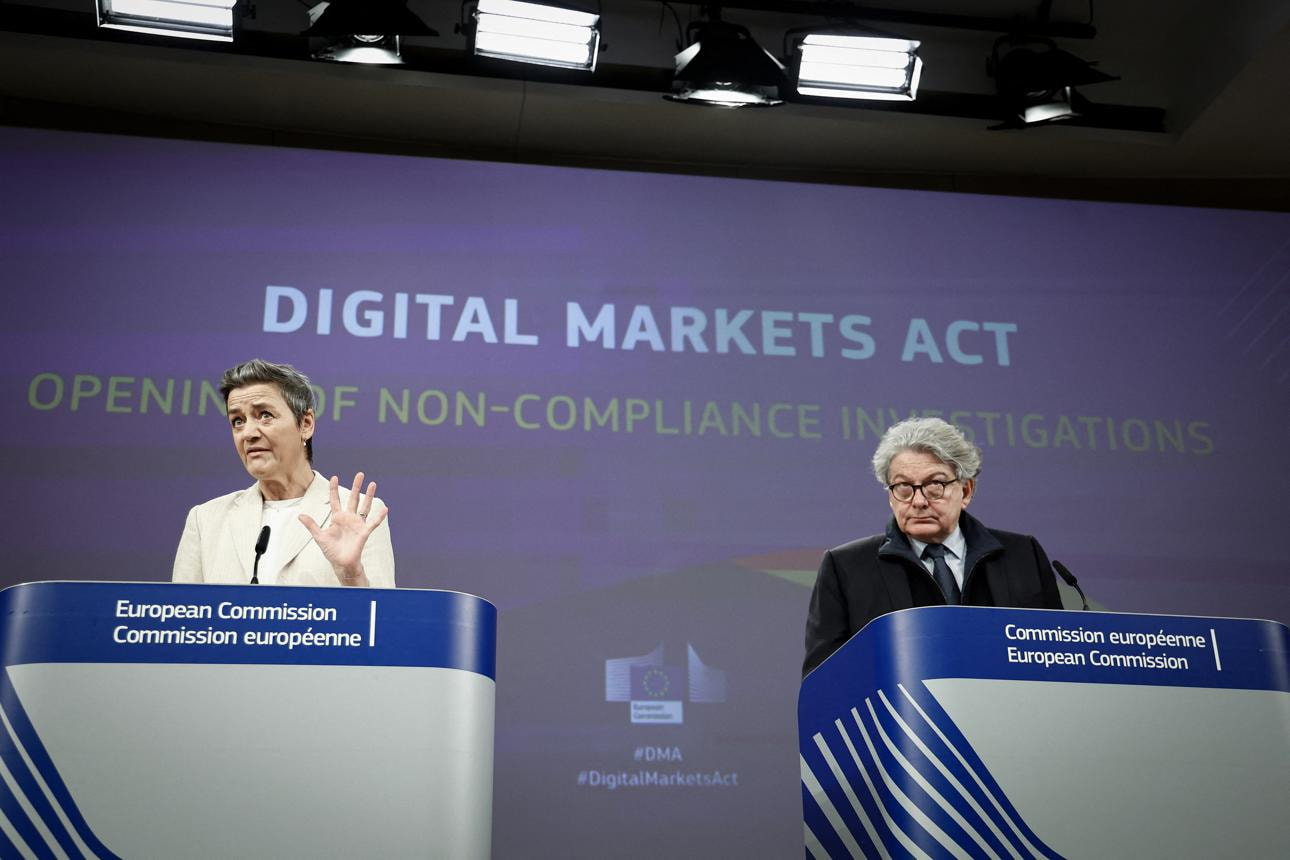
The European Commission’s preliminary finding that Amazon Web Services and Microsoft Azure should be designated as gatekeepers under the Digital Markets Act is less a surprise than a confirmation. For much of the past two years, regulators had signalled discomfort with a cloud market where the two largest providers set the terms on which almost every European business now runs. What changed on 25 June was that the discomfort acquired legal form.

Under the Commission’s reasoning, AWS and Azure — the largest and second-largest cloud services in the bloc — function as an important gateway between businesses and their customers. That is the phrase that matters. The Digital Markets Act was written to catch platforms whose position is so entrenched that ordinary competition cannot dislodge it, and the Commission’s market investigation, wrapped up earlier this year, concluded that switching between clouds remains artificially difficult. The culprits, in its telling, are the absence of common standards and a reluctance to fully support open container and interface specifications. In plainer terms, once a company’s systems live inside one provider, moving them out is expensive enough to keep most firms where they are.

If the designation is confirmed, the obligations that follow are substantive rather than symbolic. Gatekeepers face limits on self-preferencing, requirements to make their services interoperable, and mandates to let customers move their data out. For cloud, interoperability and portability are the crux, because they attack the switching costs directly. The prospect of genuinely being able to lift workloads from one provider to another, without rebuilding them, would change the negotiating leverage of every European company that depends on cloud infrastructure — which is now most of them.

The two firms have thirty days to respond with counterarguments, and a final decision, after an advisory committee and a possible hearing, is not expected before the end of the year. Neither company will concede quietly. Both are likely to argue that the cloud market is intensely competitive, that customers routinely run several providers at once, and that the switching frictions the Commission describes reflect the complexity of enterprise technology rather than any deliberate lock-in. Those arguments are not frivolous, and they will test whether the Commission’s evidence is robust enough to survive the scrutiny that a decision of this magnitude invites.

The stakes are large enough to explain the caution. Non-compliance with the Digital Markets Act can trigger fines of up to ten percent of global annual turnover, which for either firm runs into the billions. But the more consequential effect is structural. Designating cloud infrastructure, rather than a consumer-facing app or search engine, extends the Act into the plumbing of the digital economy. It signals that Brussels sees the fight over Europe’s technological autonomy being decided not only at the level of AI models and social platforms but in the data centres beneath them.

There is a transatlantic dimension that will not stay quiet either. Aggressive enforcement against two American technology champions arrives amid recurring threats of tariff retaliation against EU tech measures, and the cloud designation gives that dispute a fresh and expensive front. The Commission will insist, rightly, that the Act applies to conduct rather than nationality, and that European providers would face identical obligations at the same scale. Whether that distinction survives contact with a trade negotiation is another matter.

For European businesses and governments increasingly anxious about depending on infrastructure they do not control, the move will be read as overdue. For the companies concerned, it is the opening of a long and costly argument. Either way, the preliminary finding marks the point where the Digital Markets Act stopped being a tool aimed at the visible surface of the internet and started reaching for the foundations. How that reach is resisted, and how far it ultimately extends, will shape the European cloud market for the rest of the decade.