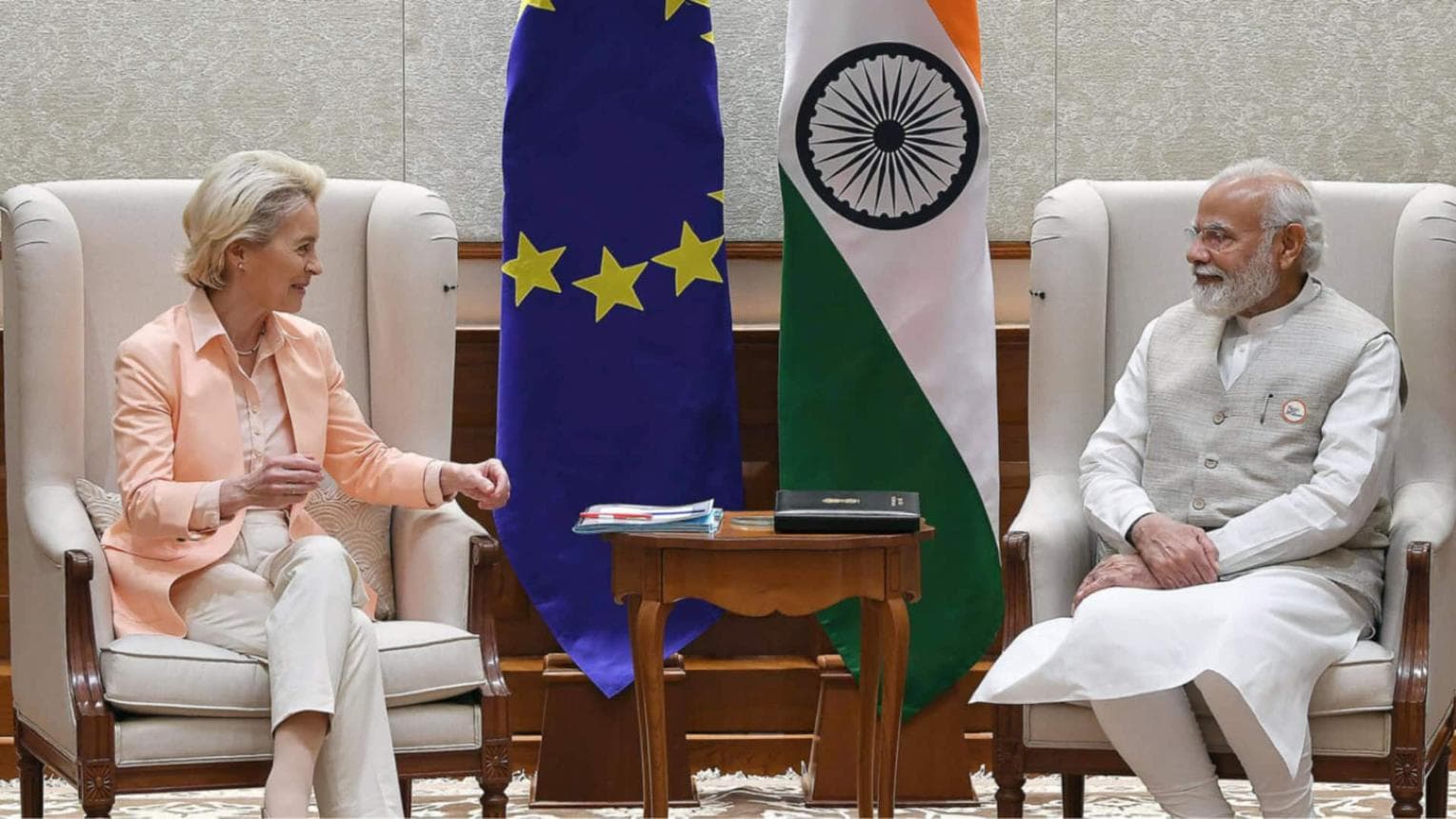
New Delhi: A negotiation that began when smartphones barely existed has finally ended. On 27 January, India and the European Union announced they had concluded a free trade agreement, a trade pact almost two decades in the making, closing a file that had stayed open, on and off, for a generation.
The scale is hard to overstate. The two economies together hold roughly two billion people and account for close to a quarter of global output. The agreement creates the largest free trade zone either side has ever entered, and by some distance the biggest deal Brussels has struck.
For European exporters the prize is access. The pact removes or lowers tariffs on more than 96 percent of EU goods sold to India, a market that has long shielded its industries behind some of the highest duties in the world. European wine, cars and machinery should grow cheaper for Indian buyers, and the Commission expects EU goods exports to India to roughly double by 2032.
India gains in return. Around 93 percent of its exports will enter the European market duty-free, a boost for its textile, leather and engineering firms and for the services companies that already earn heavily in Europe. For a government that has staked its credibility on manufacturing and jobs, the timing could hardly be better.
The deal did not come cheap in political terms, and one dispute still smoulders. Europe refused to drop its carbon border levy, which will charge Indian steel and aluminium for the emissions embedded in them. New Delhi calls the mechanism unfair to a developing economy. Brussels softened the blow with a promise of financial help to cut emissions, but the underlying quarrel over who pays for climate policy remains unresolved.
Geometry explains much of the urgency on both sides. Europe wants to spread its trade beyond a China it no longer trusts and a United States that has grown unpredictable on tariffs. India wants partners who will invest, share technology and treat it as a pillar of the global economy rather than a junior member. Each found in the other a hedge against a narrowing world.
Caution is warranted before anyone celebrates. Concluding a negotiation is not the same as living with its consequences. The two sides intend to sign the text by December, with the agreement taking effect in early 2027, and ratification across the Union’s parliaments can move slowly. Sensitive sectors, from Indian farmers to European dairy producers, will test how far each government is willing to open.
Even so, the achievement stands. After twenty years of false starts, two of the world’s largest markets have chosen to bind their fortunes a little more tightly together. In a decade defined by walls going up, that marks a rare bet on openness, and both sides will spend the coming years discovering whether it pays.