August 9, 2026
LATEST
New EU Gas Market Rules Take Effect With Consumer SafeguardsDeforestation Regulation Holds Its December Deadline Despite CutsDigital Omnibus Delays Europe’s High-Risk AI Deadline to 2027Europe’s Schools Confront a Widening Basic Skills GapRule of Law Report Finds Progress but Trust Still LagsIRIS2 Gains 66 Satellites as Brussels Signs the Rollout DealNature Restoration Plans Come Due as Member States Race a DeadlineECB Rates Hold at 2.25 Percent as Frankfurt Waits on the DataEU Budget Talks Turn to Cohesion as Ireland Takes OverWildfire Response Stretches Europe’s Emergency Fleet ThinCan Europe’s Quantum Plan Match Its Big Ambitions?Armenia Edges West as Moscow’s Grip Slips AwayEurope Inherits the World’s Aid Bill It Cannot Fully PayAir Passenger Rights Get Their First Overhaul in Two DecadesErasmus Opens a 5 Billion Euro Round for Skills and MobilityCeuta Crisis Pushes the EU Toward Faster Migrant ReturnsBulky Parcels Face a Packaging Crackdown From August 12Can Europe Build Its Drone Wall Before 2030 Arrives?Indonesia’s Trade Deal With Europe Nears Its Final SignatureEurope Leans on Beijing to Keep Climate Talks Alive Before AntalyaNew EU Gas Market Rules Take Effect With Consumer SafeguardsDeforestation Regulation Holds Its December Deadline Despite CutsDigital Omnibus Delays Europe’s High-Risk AI Deadline to 2027Europe’s Schools Confront a Widening Basic Skills GapRule of Law Report Finds Progress but Trust Still LagsIRIS2 Gains 66 Satellites as Brussels Signs the Rollout DealNature Restoration Plans Come Due as Member States Race a DeadlineECB Rates Hold at 2.25 Percent as Frankfurt Waits on the DataEU Budget Talks Turn to Cohesion as Ireland Takes OverWildfire Response Stretches Europe’s Emergency Fleet ThinCan Europe’s Quantum Plan Match Its Big Ambitions?Armenia Edges West as Moscow’s Grip Slips AwayEurope Inherits the World’s Aid Bill It Cannot Fully PayAir Passenger Rights Get Their First Overhaul in Two DecadesErasmus Opens a 5 Billion Euro Round for Skills and MobilityCeuta Crisis Pushes the EU Toward Faster Migrant ReturnsBulky Parcels Face a Packaging Crackdown From August 12Can Europe Build Its Drone Wall Before 2030 Arrives?Indonesia’s Trade Deal With Europe Nears Its Final SignatureEurope Leans on Beijing to Keep Climate Talks Alive Before Antalya
August 9, 2026
LATEST
New EU Gas Market Rules Take Effect With Consumer SafeguardsDeforestation Regulation Holds Its December Deadline Despite CutsDigital Omnibus Delays Europe’s High-Risk AI Deadline to 2027Europe’s Schools Confront a Widening Basic Skills GapRule of Law Report Finds Progress but Trust Still LagsIRIS2 Gains 66 Satellites as Brussels Signs the Rollout DealNature Restoration Plans Come Due as Member States Race a DeadlineECB Rates Hold at 2.25 Percent as Frankfurt Waits on the DataEU Budget Talks Turn to Cohesion as Ireland Takes OverWildfire Response Stretches Europe’s Emergency Fleet ThinCan Europe’s Quantum Plan Match Its Big Ambitions?Armenia Edges West as Moscow’s Grip Slips AwayEurope Inherits the World’s Aid Bill It Cannot Fully PayAir Passenger Rights Get Their First Overhaul in Two DecadesErasmus Opens a 5 Billion Euro Round for Skills and MobilityCeuta Crisis Pushes the EU Toward Faster Migrant ReturnsBulky Parcels Face a Packaging Crackdown From August 12Can Europe Build Its Drone Wall Before 2030 Arrives?Indonesia’s Trade Deal With Europe Nears Its Final SignatureEurope Leans on Beijing to Keep Climate Talks Alive Before AntalyaNew EU Gas Market Rules Take Effect With Consumer SafeguardsDeforestation Regulation Holds Its December Deadline Despite CutsDigital Omnibus Delays Europe’s High-Risk AI Deadline to 2027Europe’s Schools Confront a Widening Basic Skills GapRule of Law Report Finds Progress but Trust Still LagsIRIS2 Gains 66 Satellites as Brussels Signs the Rollout DealNature Restoration Plans Come Due as Member States Race a DeadlineECB Rates Hold at 2.25 Percent as Frankfurt Waits on the DataEU Budget Talks Turn to Cohesion as Ireland Takes OverWildfire Response Stretches Europe’s Emergency Fleet ThinCan Europe’s Quantum Plan Match Its Big Ambitions?Armenia Edges West as Moscow’s Grip Slips AwayEurope Inherits the World’s Aid Bill It Cannot Fully PayAir Passenger Rights Get Their First Overhaul in Two DecadesErasmus Opens a 5 Billion Euro Round for Skills and MobilityCeuta Crisis Pushes the EU Toward Faster Migrant ReturnsBulky Parcels Face a Packaging Crackdown From August 12Can Europe Build Its Drone Wall Before 2030 Arrives?Indonesia’s Trade Deal With Europe Nears Its Final SignatureEurope Leans on Beijing to Keep Climate Talks Alive Before Antalya

Can the EU Space Act Tame a Crowded Orbit

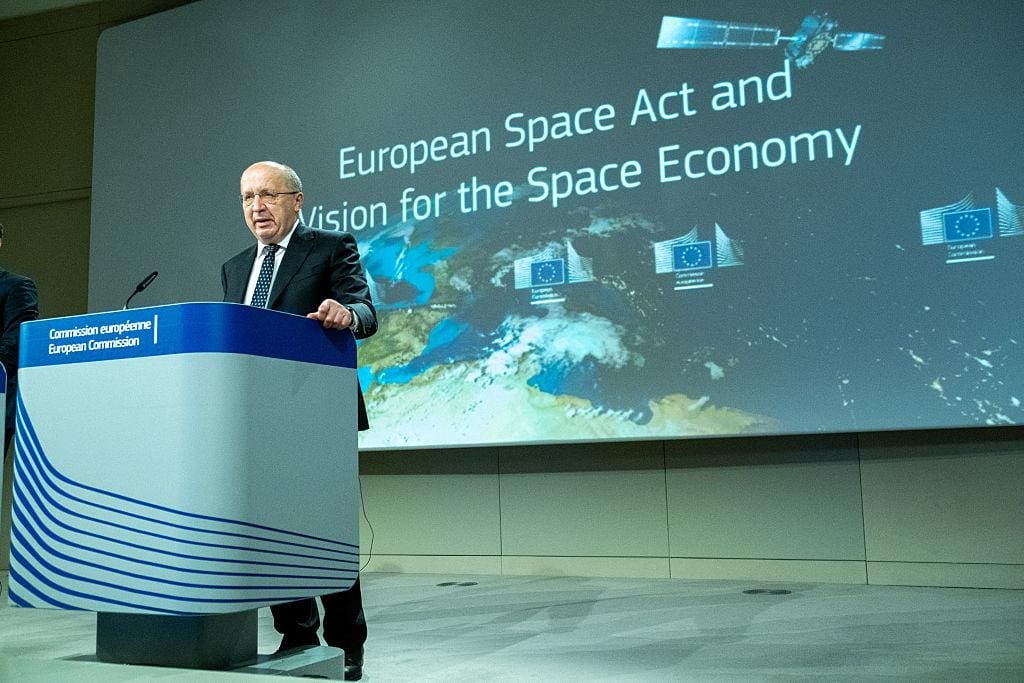
Brussels: Europe wants to write rules for a domain that has never had many. The proposed EU Space Act would replace a scattered patchwork of national licensing regimes with a single rulebook for satellites, launches and the increasingly congested orbits above the continent. Its ambition is large, and so is the resistance it has already provoked.

The Commission tabled the EU Space Act in June 2025 and built it around three pillars: safety, resilience and environmental sustainability. Safety measures target collision risk, demanding that spacecraft can manoeuvre and follow traffic rules. Resilience rules impose tailored cybersecurity obligations on space infrastructure. Sustainability provisions push standardised procedures to limit debris, the invisible shrapnel that now threatens every mission in low orbit.

Why the timing feels overdue

The context is a sky filling faster than anyone anticipated. Mega-constellations now place thousands of satellites into low Earth orbit, and each addition raises the odds of a cascade in which one collision spawns debris that triggers the next. Europe’s own strategic assets, from navigation to secure communications, share that space. A single careless operator can endanger the lot.

Fragmentation compounds the danger. Today a company faces different licensing rules in every member state that runs a space programme, a barrier that favours incumbents and frustrates the start-ups the Commission says it wants to nurture. A single market for space activities would let firms operate across borders under one authorisation, lowering the cost of entry for smaller players.

That single-market logic carries the Act’s strongest argument. If Europe hopes to field competitive launch providers and constellation operators against far larger American and Chinese rivals, it cannot ask them to clear twenty separate regulators first. Harmonisation is as much industrial policy as it is safety policy.

Where the coalition strains

Agreement on the diagnosis has not produced agreement on the cure. The Parliament’s rapporteur draft and the Council presidency compromise text, both circulated by March 2026, exposed material gaps on three fronts: how demanding the cybersecurity requirements should be, how the rules treat market access, and how they apply to operators based outside the Union.

The third question stings hardest. Non-EU operators that serve European customers would fall under the Act, and firms in the United States and elsewhere warn that duplicative or divergent obligations could raise costs and slow service. Legal analysts flag the extraterritorial reach as the provision most likely to draw diplomatic friction, echoing the disputes that greeted Europe’s digital rulebooks.

A national security clause has drawn its own criticism. It would let member states carve out activities they deem sensitive, and academic observers warn that a broad exemption could hollow out the very harmonisation the Act promises, letting capitals reclaim through security language what they conceded on paper. Draw the carve-out too widely and the single market fractures again along national lines.

Smaller operators voice a quieter worry. Compliance carries a fixed cost that weighs more heavily on a start-up than on a prime contractor, and the Act’s supporters will need to show that its debris and cybersecurity duties do not entrench the incumbents it claims to challenge. The Commission insists proportionality is built in; industry wants to see the detail.

The stakes reach beyond Europe. Whoever writes the first comprehensive rulebook for orbital behaviour sets a template others may copy or resist, much as earlier European laws shaped global norms on data and chemicals. If the Union lands a credible standard, it exports influence along with it. If negotiators water the text down to bridge their divisions, they risk a rulebook too soft to matter. The orbit will keep filling either way, which is precisely why the negotiation cannot drift.