August 29, 2026
LATEST
Data Rules Agreed With Seoul Now Wait on Parliament’s ConsentChina Listed Fourteen European Firms and November Ends the TruceWhy Australia’s Finished Trade Deal Still Has No Signature DateLate Application Leaves Tokyo Outside the Defence Loan QueueCyber Resilience Rules Give Makers 24 Hours From SeptemberWinter Stocks Test Europe’s New Gas Storage Flexibility RulesInnovation Theory Meets Merger Control in a New Commission StudyMercosur Tariffs Fell in May and the Court Has Not Ruled YetBilaterals III Now Turns on Which Referendum Switzerland PicksDark Patterns Face the EU Digital Fairness ActFifteen Chapters Stand Between Montenegro and 2028Who Blinks First in the FP10 Research Budget FightCustoms Reform Landed in March and Its Data Hub Opens in 2028Victims Rights Gain an EU Helpline and Capitals Have Two YearsIreland Must Move the EU Budget Box Before the October SummitFertiliser Prices Sit 71 Percent Above Their 2024 Average LevelState Aid Exemptions Face a Rewrite With Four Months to SpareIrregular Crossings Fell 37 Percent and Spain Is the ExceptionSpring Growth Went to Ireland and Skipped Belgium EntirelyEurope’s Drought Pushed Four Great Rivers to Record LowsData Rules Agreed With Seoul Now Wait on Parliament’s ConsentChina Listed Fourteen European Firms and November Ends the TruceWhy Australia’s Finished Trade Deal Still Has No Signature DateLate Application Leaves Tokyo Outside the Defence Loan QueueCyber Resilience Rules Give Makers 24 Hours From SeptemberWinter Stocks Test Europe’s New Gas Storage Flexibility RulesInnovation Theory Meets Merger Control in a New Commission StudyMercosur Tariffs Fell in May and the Court Has Not Ruled YetBilaterals III Now Turns on Which Referendum Switzerland PicksDark Patterns Face the EU Digital Fairness ActFifteen Chapters Stand Between Montenegro and 2028Who Blinks First in the FP10 Research Budget FightCustoms Reform Landed in March and Its Data Hub Opens in 2028Victims Rights Gain an EU Helpline and Capitals Have Two YearsIreland Must Move the EU Budget Box Before the October SummitFertiliser Prices Sit 71 Percent Above Their 2024 Average LevelState Aid Exemptions Face a Rewrite With Four Months to SpareIrregular Crossings Fell 37 Percent and Spain Is the ExceptionSpring Growth Went to Ireland and Skipped Belgium EntirelyEurope’s Drought Pushed Four Great Rivers to Record Lows
August 29, 2026
LATEST
Data Rules Agreed With Seoul Now Wait on Parliament’s ConsentChina Listed Fourteen European Firms and November Ends the TruceWhy Australia’s Finished Trade Deal Still Has No Signature DateLate Application Leaves Tokyo Outside the Defence Loan QueueCyber Resilience Rules Give Makers 24 Hours From SeptemberWinter Stocks Test Europe’s New Gas Storage Flexibility RulesInnovation Theory Meets Merger Control in a New Commission StudyMercosur Tariffs Fell in May and the Court Has Not Ruled YetBilaterals III Now Turns on Which Referendum Switzerland PicksDark Patterns Face the EU Digital Fairness ActFifteen Chapters Stand Between Montenegro and 2028Who Blinks First in the FP10 Research Budget FightCustoms Reform Landed in March and Its Data Hub Opens in 2028Victims Rights Gain an EU Helpline and Capitals Have Two YearsIreland Must Move the EU Budget Box Before the October SummitFertiliser Prices Sit 71 Percent Above Their 2024 Average LevelState Aid Exemptions Face a Rewrite With Four Months to SpareIrregular Crossings Fell 37 Percent and Spain Is the ExceptionSpring Growth Went to Ireland and Skipped Belgium EntirelyEurope’s Drought Pushed Four Great Rivers to Record LowsData Rules Agreed With Seoul Now Wait on Parliament’s ConsentChina Listed Fourteen European Firms and November Ends the TruceWhy Australia’s Finished Trade Deal Still Has No Signature DateLate Application Leaves Tokyo Outside the Defence Loan QueueCyber Resilience Rules Give Makers 24 Hours From SeptemberWinter Stocks Test Europe’s New Gas Storage Flexibility RulesInnovation Theory Meets Merger Control in a New Commission StudyMercosur Tariffs Fell in May and the Court Has Not Ruled YetBilaterals III Now Turns on Which Referendum Switzerland PicksDark Patterns Face the EU Digital Fairness ActFifteen Chapters Stand Between Montenegro and 2028Who Blinks First in the FP10 Research Budget FightCustoms Reform Landed in March and Its Data Hub Opens in 2028Victims Rights Gain an EU Helpline and Capitals Have Two YearsIreland Must Move the EU Budget Box Before the October SummitFertiliser Prices Sit 71 Percent Above Their 2024 Average LevelState Aid Exemptions Face a Rewrite With Four Months to SpareIrregular Crossings Fell 37 Percent and Spain Is the ExceptionSpring Growth Went to Ireland and Skipped Belgium EntirelyEurope’s Drought Pushed Four Great Rivers to Record Lows

What Japan and Europe Built With a Competitiveness Alliance

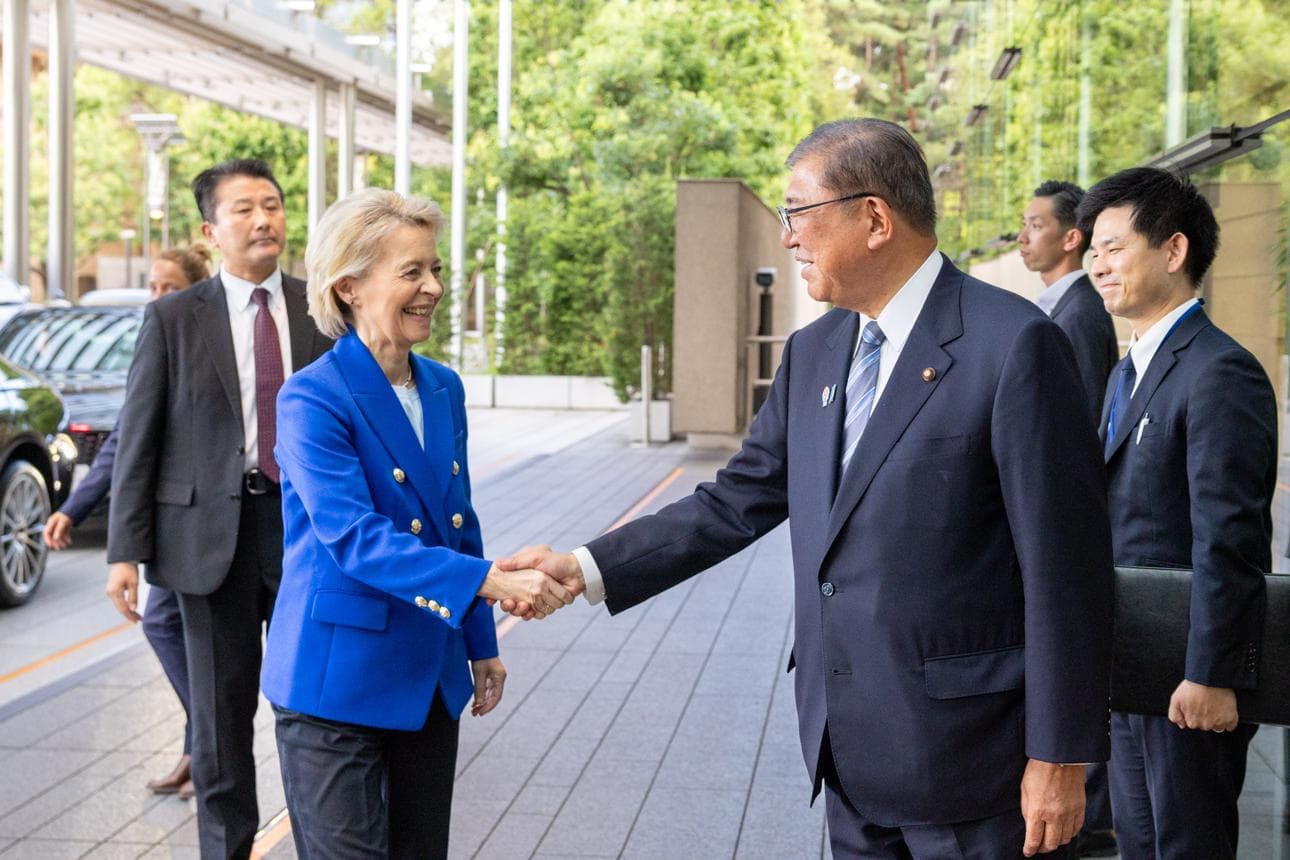
Tokyo: European and Japanese leaders met here for their thirtieth bilateral summit in July 2025 and left with a phrase rather than a treaty. The Competitiveness Alliance commits both sides to work together on trade, economic security, innovation and the twin transition. A year on, the useful question is whether the phrase has acquired any machinery.

The answer is partly yes. The Alliance now organises workstreams on data flows, cybersecurity, artificial intelligence, connectivity, quantum technologies, supply-chain resilience and joint scientific research. Energy security sits alongside them, with liquefied natural gas and clean hydrogen named explicitly. A separate strand covers critical minerals. The list reads like an inventory of everything two advanced economies worry about, which is both its strength and its weakness.

Japan and the European Union already trade under an Economic Partnership Agreement that has governed the relationship since February 2019, and a later amendment secured free flows of personal and industrial data. The Alliance therefore builds on plumbing that exists. Officials on both sides describe the seventh High-Level Economic Dialogue as the body that turns summit language into workplans, and its agenda this year covered multilateral trade rules, supply-chain resilience and industrial competitiveness.

What the Alliance lacks is money and obligation. It creates no fund, no joint procurement vehicle and no binding commitment that either side must honour when domestic politics pull the other way. Compare that with the way Brussels structures its internal industrial policy, where cash and legal deadlines do the work. Dialogue produces alignment. It does not produce factories.

Officials counter that alignment is precisely the scarce good. When Washington raises tariffs and Beijing restricts exports, two economies that publish compatible screening rules, recognise each other’s standards and share early warning on supply disruptions gain real optionality. That case holds. It holds better if the two sides actually converge on outbound investment screening, where their approaches still differ in scope and timing.

Japanese business federations have pushed hardest on regulatory predictability rather than market access, because tariffs between the two economies already sit low. Their complaint concerns divergent sustainability reporting, chemical registration and cyber-certification regimes that force duplicate compliance. The Alliance names these problems. It has not yet solved one.

The strategic logic is nonetheless sound. Europe wants partners in the Indo-Pacific who will not force a choice between security and commerce. Japan wants a second pillar beyond its American alliance. Neither expects the other to supply hard power. Both gain from demonstrating that middle-sized democracies can coordinate industrial policy without forming a bloc.

The measure of success arrives in the next twelve months, and it is unglamorous. If the two sides publish mutual recognition in even one certification area, the Alliance will have earned its name. If the next summit produces another list, it becomes the thing officials quietly call a dialogue about dialogues. The launch statement sits with the European Commission, and the summit record with the Council.