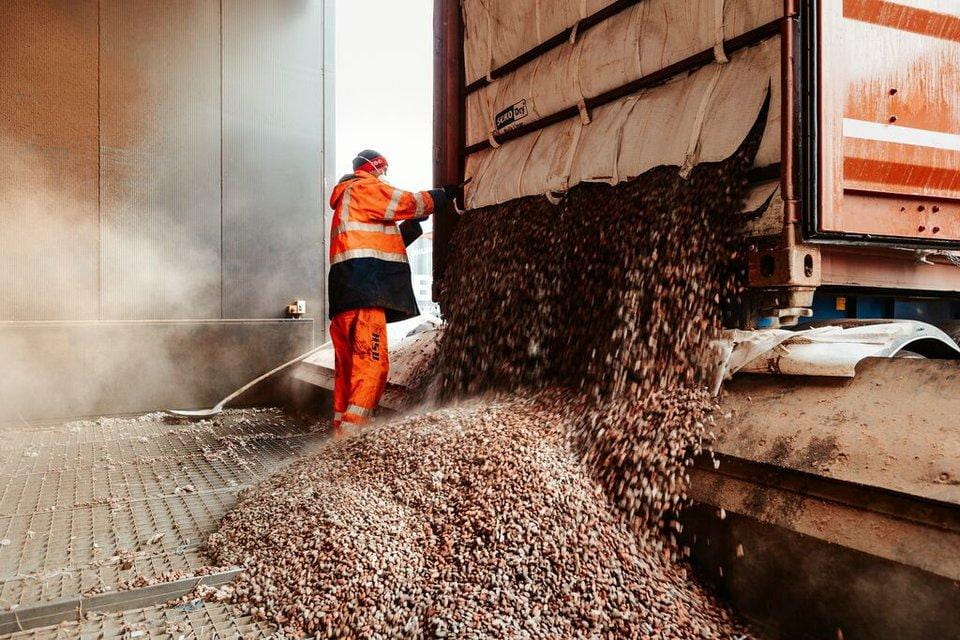
Rotterdam: Cocoa arriving on the Maas has a legal appointment on 30 December. From that date, large and medium operators placing cattle, cocoa, coffee, palm oil, rubber, soya or wood on the Union market must show that the land behind each consignment was not deforested after the end of 2020, and must supply geolocation coordinates to prove it.
The date has moved twice, and importers were entitled to wonder whether it would move again. It has not. The Commission confirmed the December 2026 application date when it published a simplification package, and paired that confirmation with a set of changes it says cuts compliance costs by around three quarters against the original design.
Both halves of that message deserve scrutiny, because a regulation that keeps its start date while shedding most of its administrative weight is a different instrument from the one traders spent three years preparing for.
What the Simplification Actually Removes
The targeted revision agreed by the Council and Parliament in December 2025 attacks repetition rather than substance. Operators who have already filed a due diligence statement for a given consignment no longer need to reproduce it at every subsequent step. A new downstream operator category lets firms further along the chain rely on statements filed upstream, referencing the identifier rather than rebuilding the file.
Large companies may submit one annual declaration covering their imports instead of a statement per shipment. Micro and small primary operators gain a simplified declaration route and an extra six months, running to 30 June 2027, before their own obligations begin. A draft delegated act narrows the product scope, stripping out goods where the deforestation link is remote, and the Commission has upgraded the information system that everyone must register with through TRACES.
None of this touches the core prohibition. The deforestation rules still require geolocation data, still require a risk assessment, and still require mitigation where risk is not negligible. What changes is how many times a firm must say the same thing, and to whom.
The Enforcement Question Nobody Simplified
Cost reduction shifts the pressure point rather than removing it. The binding constraint was never only paperwork volume. It was whether a European chocolate manufacturer can obtain reliable plot coordinates from a supply chain that runs through hundreds of thousands of smallholders in West Africa, and whether the competent authority in the importing member state can check what arrives.
National authorities must inspect a defined percentage of operators each year, with the share rising for suppliers from countries the Commission ranks as high risk. Those authorities are the same understaffed customs and forestry inspectorates that already handle timber legality work under the old regime, and the simplification package does not add inspectors. A system that logs more declarations but verifies a similar number of them changes the compliance calculus for anyone tempted to file optimistically.
The country benchmarking exercise carries its own tension. Most producer states received standard or low risk classifications, which sets inspection rates at modest levels and reduces the friction that made trading partners threaten retaliation. It also means the regulation leans heavily on operator self-declaration in exactly the geographies where satellite evidence of forest loss remains contested.
Traders who invested early in traceability systems now watch competitors reach compliance with substantially less spending. That is the awkward arithmetic of a simplification arriving four months before application. Firms that built plot-level mapping and third-party verification into their contracts hold an asset the revised rules no longer demand, and some of them argue the Commission has quietly rewarded delay.
The decisive test will come in 2027, when the first enforcement actions either arrive or do not. A regulation that survived two postponements and a substantial rewrite still promises to close the Union market to commodities grown on cleared forest. Whether that promise binds depends less on the number of declarations filed in December than on what happens to the first operator whose coordinates point at land the satellites say was forest in 2021.