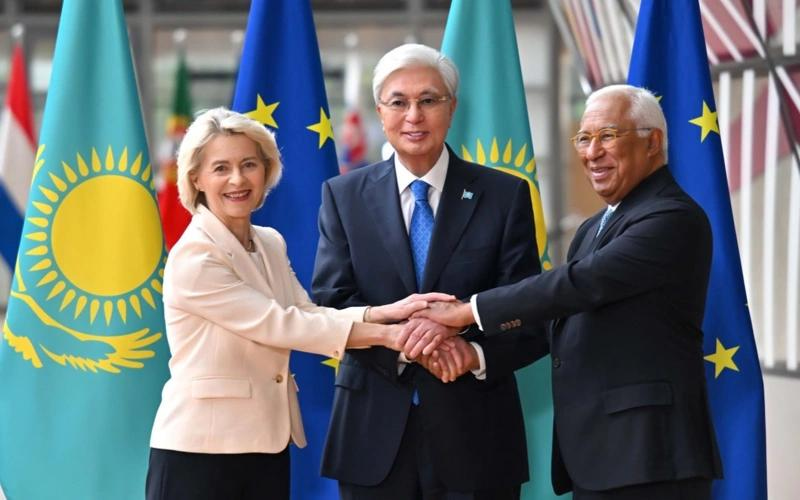
Brussels: The EU-Kazakhstan partnership gained commercial substance in June 2026, when President Kassym-Jomart Tokayev met European Council President António Costa and Commission President Ursula von der Leyen in the Belgian capital. The talks covered trade, energy, connectivity and critical raw materials, and they produced several concrete deliverables rather than general declarations.
The most tangible was a €150 million financing package from the European Investment Bank for transport connectivity. Brussels framed it under Global Gateway, the EU’s strategy for investment in partner countries, as part of the EU-Kazakhstan partnership, and it points to the Trans-Caspian Transport Corridor, which links Central Asia to Europe through the Caspian Sea and the South Caucasus.
A Horizontal Aviation Agreement was also signed. Such agreements allow member states’ air service arrangements with a third country to be brought into line with EU law, which gives airlines legal certainty and can open the way to more routes. In parallel, Air Astana and Airbus announced a deal for up to 50 A320neo and A321neo aircraft, valued at around €7.1 billion.
That order shows how trade policy and industrial interests overlap. A European manufacturer wins a large export contract, a Kazakh carrier secures modern aircraft, and the aviation agreement supplies the regulatory framework. For the EU-Kazakhstan partnership, these linked outcomes are the kind of mutual benefit Brussels likes to present as proof that partnerships need not be one-sided.
Energy and raw materials sit behind the headline. Kazakhstan is an important supplier of oil and uranium to Europe, and the two sides discussed renewable energy and civil nuclear cooperation. Critical raw materials are the other prize, since the EU wants to diversify away from concentrated suppliers and Kazakhstan holds deposits that European industry increasingly needs.
Mobility was on the agenda as well, with visa facilitation and readmission arrangements discussed together. Pairing the two is a familiar EU technique, trading easier travel for cooperation on returns. How far Astana accepts that bargain in the EU-Kazakhstan partnership will indicate how much political capital it is willing to spend on the relationship.
The strategic backdrop of the EU-Kazakhstan partnership is obvious. Central Asian states are courted by several large powers, and the Trans-Caspian route offers an alternative to northern land links that many European planners regard as unreliable. Choosing that route for investment is a commercial judgement and a geopolitical one at the same time.
The risks are practical. Corridors need ports, rolling stock, customs coordination and predictable tariffs along their whole length, and a single weak link can undo the benefit of a well-funded segment. The EU-Kazakhstan partnership will be judged less by the 2026 announcements than by whether cargo volumes, flight connections and raw-material contracts show measurable growth in the years ahead.