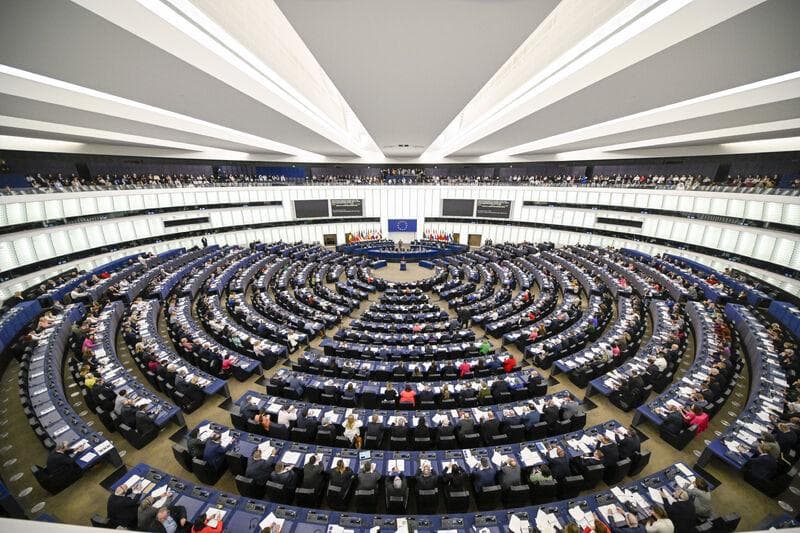
The EU long-term budget for 2028 to 2034 reached a decisive stage this week, after Ireland’s presidency of the Council tabled a negotiating box that trims €141 billion from the Commission’s original proposal. The paper sets the overall volume at €1,622 billion in 2025 prices, which is 8 percent below what the Commission asked for and 30 percent above the current seven-year framework. In current prices the figure comes to roughly €1,825 billion. Thomas Byrne, Ireland’s minister of state for European affairs, says the text brings governments closer to resolving what diplomats call the budgetary trilemma.
The cuts fall unevenly across the main headings. Cohesion, agriculture and fisheries lose the least, with a 3 percent reduction to €914 billion. Competitiveness, research and defence drop 13 percent to €456 billion, administration falls 8.8 percent to €95 billion, and Global Europe, the heading for cooperation with third countries, shrinks 17 percent to €157 billion. The Irish presidency put the box before ambassadors on Sunday, ahead of a General Affairs Council on 13 October and the European Council on 15 and 16 October.
The revenue side of the EU long-term budget matters as much as the spending side. The box proposes a new package of EU-level levies worth about €55 billion a year. It raises the call rate on the Carbon Border Adjustment Mechanism from 75 percent to 90 percent, phases in an emissions trading own resource for member states supported by the Modernisation Fund, and keeps the Commission’s proposals on tobacco excise, a corporate resource, an electronic waste levy and EU retention of 90 percent of customs duties. Three levies the European Parliament wanted, on digital services, online gambling and crypto assets, which could have raised up to €32 billion a year, are left out. Byrne has set three tests for any new own resource: unanimity, substantial funds and readiness by 1 January 2028. He concedes that the last two are not certain to be met.
Politics will shape the EU long-term budget more than arithmetic will. Six frugal countries led by Germany want cuts of several hundred billion euros, and Sweden’s EU minister, Jessica Rosencrantz, called the box unreasonable and said the overall volume must come down significantly. On the other side, Italy’s Giorgia Meloni leads the 17-strong Friends of Cohesion group, which defends farm and regional funding. Ireland’s 8 percent cut sits between the 2 percent proposed by the Cypriot presidency in June, worth €32.8 billion, and the deeper reductions that the frugals demand.
The calendar leaves little slack. Leaders hope to reach political agreement on the EU long-term budget by the end of 2026, before elections in 2027 that could harden national positions. Spain’s prime minister Pedro Sánchez has already called a snap election for 29 November, regional gains for the Alternative for Germany are expected to stiffen Berlin’s stance, and a Eurosceptic candidate is reported as favourite for the French presidency. Diplomats will watch the October summit for any sign of which heading governments are willing to sacrifice first.
For regions, farmers and researchers, the outcome will define funding rules until 2034. The EU long-term budget now moves from technical drafting to political bargaining, and the next few weeks will show whether the Irish box becomes a landing zone or simply the opening bid.