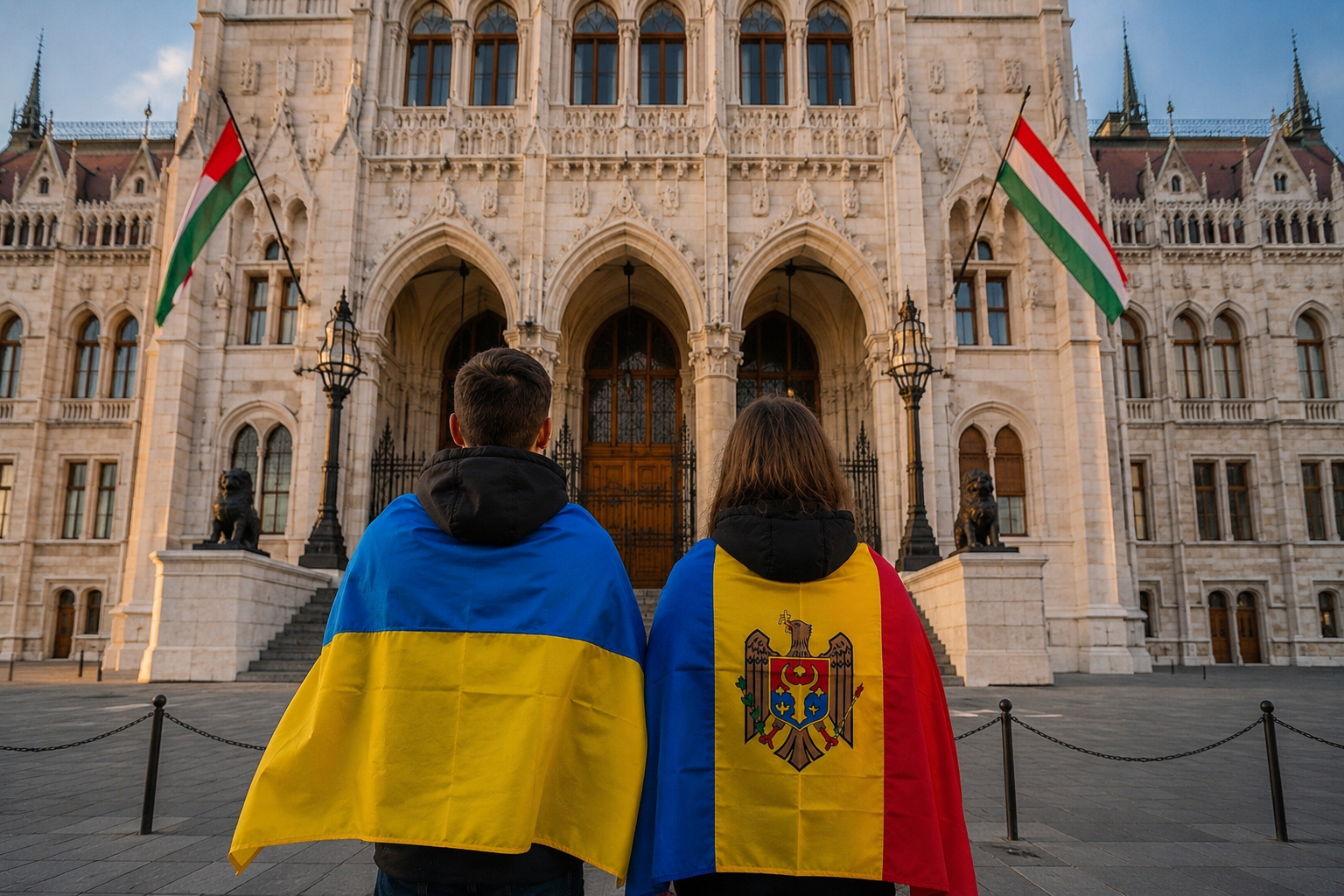
Brussels: A political earthquake in Budapest has reopened a question that European capitals had quietly written off for the better part of two years. Peter Magyar’s installation as Hungarian prime minister in early May has, almost overnight, transformed the calculus of EU enlargement by removing the single largest obstacle to opening accession chapters with Ukraine and Moldova. Officials at the Berlaymont, who had spent eighteen months managing a slow-motion stalemate, are now scrambling to convert political opportunity into procedural progress before the Cypriot presidency hands over the Council baton at the end of June.
The structural picture is unusual. Both Ukraine and Moldova hold candidate status, have formally opened negotiations and have completed the screening phase, the technical exercise by which the Commission maps each country’s legislation against the EU acquis. Ukraine concluded screening in September 2025, Moldova shortly thereafter. In the conventional choreography of enlargement, screening completion is the trigger for opening the substantive chapters of the acquis, beginning with the so-called fundamentals cluster covering rule of law, judiciary and fundamental rights. That step, however, requires unanimity in the Council, and Hungary’s previous government had withheld consent.
The European Council scheduled for 18-19 June now becomes the operational hinge. Officials expect leaders to take, at minimum, a political decision to authorise the opening of the fundamentals cluster for both candidates, with the formal accession-conference modalities to follow in the second half of the year under the next Council presidency. There is also pressure from the Baltic states and from a group of like-minded northern members to compress the cadence of subsequent chapter openings rather than relapse into the leisurely pace that characterised earlier enlargement rounds in the Western Balkans.
The Ukrainian government has set a target of provisionally closing negotiations by the end of 2028, an ambition the Commission considers achievable only with a substantial acceleration of domestic reforms. Moldova has aligned itself with the same 2028 horizon. Both timetables would imply moving through the negotiating clusters at a rate of roughly one substantive opening per quarter, a tempo that has no precedent in modern enlargement practice and that will test the Commission’s screening and benchmarking capacity as much as the candidates’ reform delivery.
Several political risks remain visible. First, the new Hungarian government’s posture on enlargement is supportive in principle but has yet to be tested against the politically sensitive chapters covering agriculture, regional policy and the EU budget, where Hungarian domestic interests are most directly engaged. Second, public opinion in several existing member states, including the Netherlands and Austria, has cooled on enlargement as a project, and national parliaments retain ratification leverage at later stages. Third, the war in Ukraine continues, and any accession trajectory must be reconciled with the ongoing conflict and with the bloc’s evolving security posture.
For the Commission, the immediate task is operational. Drafting common negotiating positions across twenty-seven member states for the fundamentals cluster is laborious work, and the institution will want to present the June European Council with text that has already cleared most coordination hurdles. For the candidates, the imperative is to demonstrate continuous reform delivery, particularly on judicial independence and anti-corruption frameworks, which remain the most politically scrutinised dimensions of the accession process. Enlargement has rarely been a story of speed. It may now, for the first time in a generation, be a story of urgency.