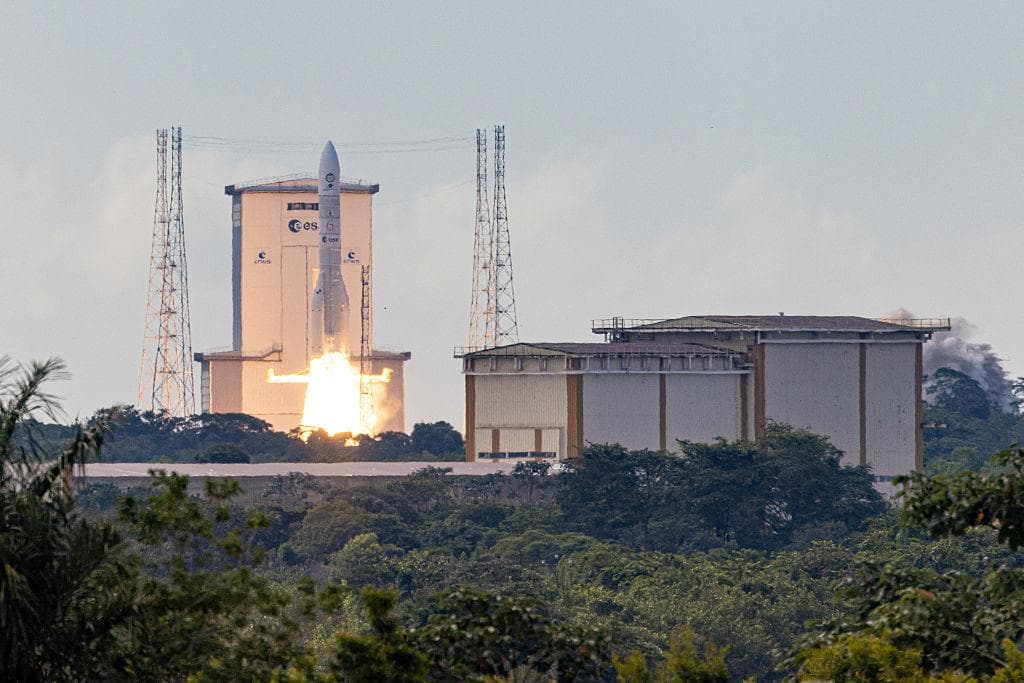
Kourou: Europe has decided that the way to guarantee its place in space is to spend its way out of dependence, and the bill is now visible. The IRIS2 secure-connectivity constellation, signed off as a 10.55 billion euro, twelve-year concession with a consortium led by SES, Eutelsat and Hispasat, is the most ambitious space commitment the Union has made, and its defining condition is simple, every satellite must fly on a European rocket. That clause is where ambition meets uncomfortable reality.
The strategic rationale is sound and, after the past few years, almost self-evident. A sovereign, encrypted satellite network gives European governments communications they do not have to rent from American or Chinese providers, an asset whose value has been underlined by the war in Ukraine and the visible leverage that private constellation operators now hold over national militaries. IRIS2 is meant to be the answer, a system whose governmental capacity Brussels controls and whose supply chain stays inside the bloc. Demanding European launch is the logical extension of that sovereignty argument, because a secure constellation lofted on foreign rockets would be sovereign in name only.
The difficulty is that Europe’s independent access to space is precisely the capability that has been most fragile. The retirement of the workhorse Ariane 5 left a gap that the long-delayed Ariane 6 was supposed to fill, and the smaller Vega line has had its own troubles, leaving European institutions at one point reliant on the very foreign launches that sovereignty doctrine is meant to eliminate. Arianespace has set out a ramp toward higher flight rates, with the cadence rising year on year, but turning a planned manifest into a reliable, high-tempo industrial line is a different order of challenge, and IRIS2’s own first launch is not expected before 2029 with full deployment around 2030.
That timeline exposes the central tension in European space policy, the collision between industrial protection and operational urgency. Reserving launches for European rockets sustains ArianeGroup, the spaceport at Kourou and thousands of skilled jobs, and it builds the domestic capacity that a credible space power requires. But it also ties a flagship connectivity project to a launch system that has yet to prove it can deliver at the necessary rhythm, at a moment when commercial rivals are flying constellations at a pace and price that Europe cannot match. Sovereignty, in other words, is being bought at the cost of speed, and in a fast-moving orbital market speed is not a trivial sacrifice.
There is a deeper question about whether the Union is funding capacity or merely subsidising incumbency. The European launch sector has historically been organised around guaranteed institutional demand rather than competitive pressure, an arrangement that produced reliable but expensive rockets ill-suited to the reusable, high-volume economics that have reshaped the global market. A bridge programme drawing on existing national satellites has been brought into service to cover the gap until IRIS2 arrives, which is prudent, but it also underlines how far the operational reality lags the political ambition. Pouring billions into the established prime contractors guarantees continuity, yet it risks entrenching the very cost structure that left Europe uncompetitive in the first place.
The more promising reading is that scale and certainty are exactly what a maturing industry needs. A guaranteed pipeline of institutional launches gives European manufacturers the demand visibility to invest, and a new generation of smaller launch start-ups across the continent is emerging precisely because public money is signalling that the market will exist. If IRIS2 functions as an anchor customer that pulls a competitive ecosystem into being, rather than as a permanent subsidy to a single champion, the ten-billion bet will look prescient. The distinction between those two outcomes is not technological but governance, whether Brussels rewards performance or merely preserves the status quo.
For now Europe has made its choice and committed the funds, accepting slower deployment and higher cost as the price of not depending on anyone else for its most sensitive communications. It is a defensible wager in a world where access to orbit has become a strategic vulnerability rather than a commercial convenience. Whether it pays off will be decided not in the signing of contracts but in the unglamorous business of launching on schedule, and that is the test European space policy has repeatedly found hardest to pass.