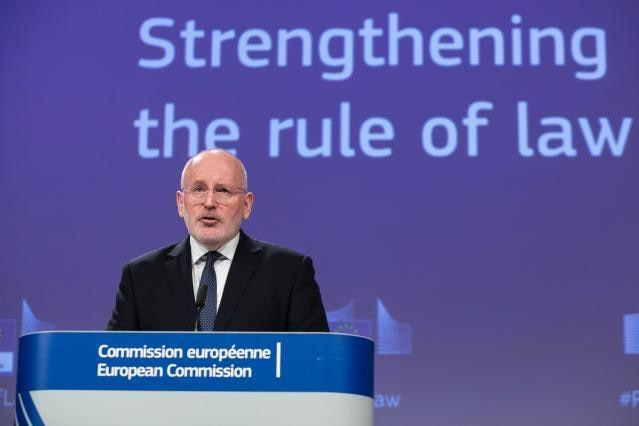
The Commission’s annual rule-of-law cycle is entering its 2026 round under conditions that even its harshest critics in civil society now describe as terminal for the post-2020 monitoring framework. Feedback from member states, NGOs and bar associations closed on 23 January and country chapters are being finalised by the College, but two parallel publications, namely the Liberties Rule of Law Report 2026 released on 30 March and the European Parliament’s resolution sounding the alarm on Hungary in November 2025, have already crowded the political space. Together they make clear that the soft-law architecture built around peer review, dialogue and recommendations is failing to halt regression in the most-affected capitals.
The Liberties report identifies five governments, namely Bulgaria, Croatia, Hungary, Italy and Slovakia, as “dismantlers” that are actively eroding judicial independence, anti-corruption capacity and media plurality rather than merely failing to advance. Four of those five showed no measurable change compared with the previous edition, suggesting that the country chapters’ recommendations have lost their leverage. Hungary remains an outlier even within this group. A new bill before the National Assembly would empower a state body to blacklist civil society organisations and media outlets, freeze their funding and ultimately dissolve them, replicating in EU territory tactics familiar from Moscow’s “foreign agents” law. The Commission already opened an infringement procedure against the implementation gaps in the European Media Freedom Act, with a letter of formal notice dispatched on 7 May 2025 still without a substantive response.
What sharpens the political stakes this cycle is the broadening list. Italy’s security decree, adopted in early 2025, criminalised non-violent road blockades and other forms of protest while expanding presumptions of police lawfulness, a measure that civil society groups argue narrows democratic space in a founding member of the Union. Slovakia under Robert Fico has reorganised the public prosecution service, dissolved the special prosecutor’s office and overhauled the public broadcaster, drawing infringement attention but no Article 7 movement. Bulgaria’s chronic stalling on judicial reforms and Croatia’s anti-corruption deficits are now grouped alongside these cases in independent monitoring, a development Commission officials privately concede is uncomfortable because it dilutes the optics of focusing pressure on Budapest alone.
The conditionality toolbox is meanwhile stretched. The Rule of Law Conditionality Regulation has frozen roughly EUR 18 billion in Hungarian cohesion and recovery funds, but disbursements have continued under partial unblocking arrangements that critics describe as politically expedient. Article 7 procedures on Hungary and Poland remain stalled in the Council, with no qualified majority in sight for moving to determinations of serious and persistent breach. Commission infringement actions, although technically robust, deliver outcomes years after democratic harm has crystallised, a tempo mismatch that the Court of Justice cannot fix through urgent procedures alone.
That is why attention is turning to procedural innovations the 2026 cycle may road-test. Officials in the directorate-general for justice are floating clearer benchmarks tied to disbursement cycles, more frequent monitoring missions and a stronger link between country chapters and the next multiannual financial framework, where rule-of-law conditionality is expected to be hard-wired into all policy strands. Parliament’s lead rapporteurs are also pushing for binding follow-up recommendations rather than the current advisory format, a change that would require Council buy-in unlikely before the new MFF negotiating box opens.
For the worst offenders, however, the calculation is now openly political rather than legal. Each member state’s autocratic drift produces a domestic dividend that outweighs the marginal cost of Brussels’ procedural displeasure, particularly when conditionality unblocking can be traded for cooperation on enlargement, defence or Ukraine. Unless the 2026 cycle reframes those incentives, the report risks becoming a careful chronicle of failures rather than a tool that prevents them.