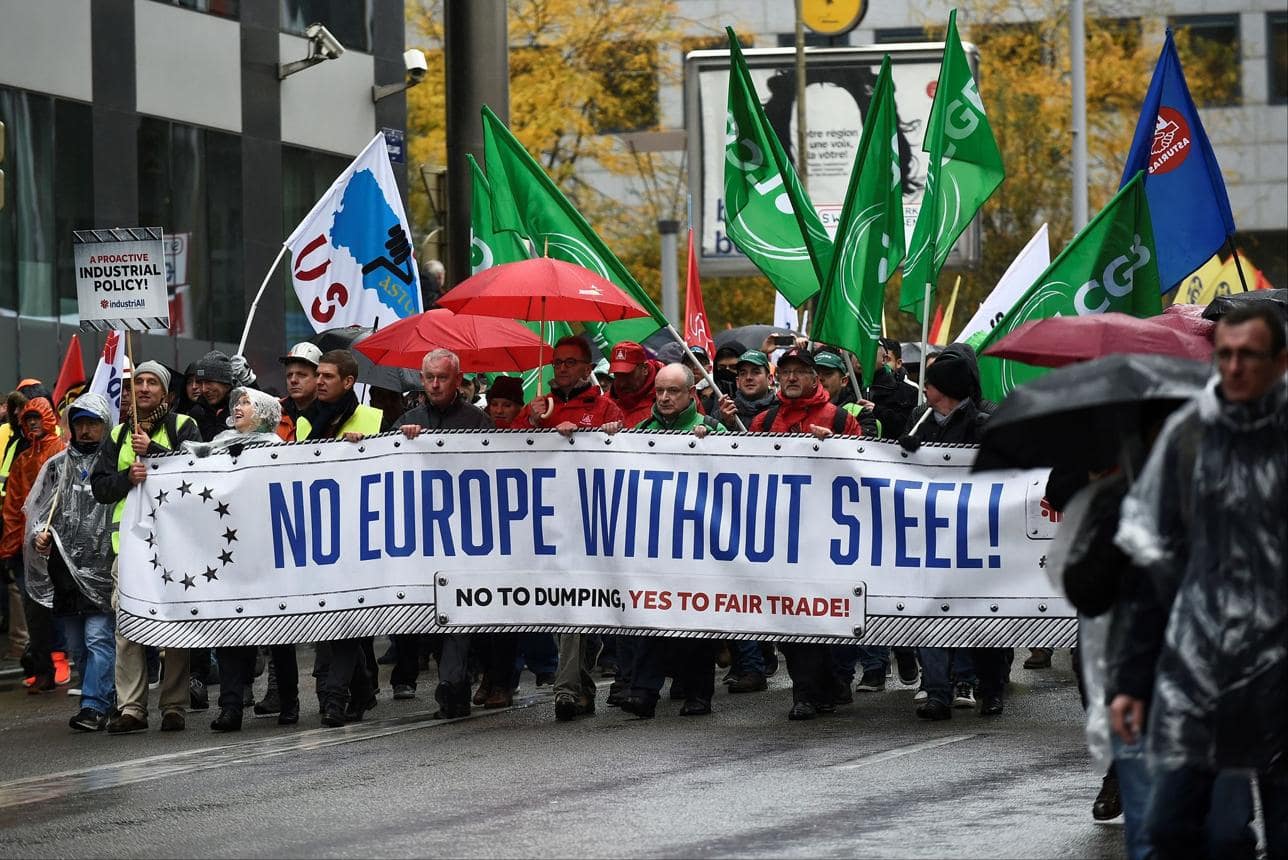
Ten symbolic coffins will travel down Rue de la Loi on Monday morning, carried by companies that turn imported metal into machines, fasteners, radiators and vehicle parts. The European Convoy for Industrial Competitiveness gathers at the Robert Schuman roundabout at 10:30 on 7 September, holds a press conference at 11:00 and stages a funeral procession to the Berlaymont before sounding truck horns at noon. The message reads: Keep Manufacturing in Europe.
The grievance behind the theatre is arithmetical. Since 1 July 2026, Regulation 2026/1384 has governed steel entering the Union, cutting tariff-rate quota volumes by roughly 47 percent against the 2024 baseline to about 18.3 million tonnes a year and raising the out-of-quota duty to 50 percent. Melt-and-pour rules tighten origin tracing. The regulation replaced the old safeguard that expired on 30 June, and European steelmakers had asked for exactly this.
Steel users got the bill. A German fastener plant or an Italian machinery firm buys its input inside the Union at a price shaped by a 50 percent wall, then competes on the shelf against a finished product assembled outside the Union from cheaper metal. Nothing at the customs post distinguishes the two. EUROMETAL calls this a regulatory gap, and downstream federations have grown loud enough about it to hire trucks.
Europe’s carbon border rules widen the same crack. The Carbon Border Adjustment Mechanism entered full financial operation on 1 January 2026 and prices embedded emissions in imported iron, steel, aluminium, cement, fertiliser, hydrogen and electricity. It largely stops at the raw material. An importer bringing in steel coil pays. An importer bringing in a steel cabinet made from the same coil abroad generally does not.
The Council recognised the problem and moved on 12 June 2026, agreeing a general approach that extends the mechanism to roughly 180 downstream steel- and aluminium-intensive products from 1 January 2028. Parliament and Council must still finish the file. Even if they conclude this autumn, manufacturers face at least fifteen months during which their inputs carry a carbon price their competitors’ finished goods avoid.
Eurofer, which represents the producers rather than the users, argues the Council text still falls short on circumvention, on downstream coverage and on exports. That last point rarely gets attention. A European manufacturer selling a steel-intensive product into Asia carries the full carbon cost of the input and receives no adjustment at the border it crosses outward. The mechanism was built to protect the Union market, not Union exporters.
Monday’s demonstration will not change a legislative timetable, and the organisers know it. The convoy is aimed at the political mood around the State of the Union address on 16 September, when the Commission president sets the year’s industrial narrative. Downstream users want an anti-circumvention clause, an export solution and a faster start date, and they calculate that coffins outside the Berlaymont buy more attention than a position paper.
The deeper tension will outlast the trucks. Protecting primary steel production and protecting the manufacturers who consume steel pull in opposite directions, and the Union has now written the first objective into law while leaving the second to a file that arrives in 2028. Each instrument works. Together they leave a two-year window in which European industry pays twice.