August 9, 2026
LATEST
New EU Gas Market Rules Take Effect With Consumer SafeguardsDeforestation Regulation Holds Its December Deadline Despite CutsDigital Omnibus Delays Europe’s High-Risk AI Deadline to 2027Europe’s Schools Confront a Widening Basic Skills GapRule of Law Report Finds Progress but Trust Still LagsIRIS2 Gains 66 Satellites as Brussels Signs the Rollout DealNature Restoration Plans Come Due as Member States Race a DeadlineECB Rates Hold at 2.25 Percent as Frankfurt Waits on the DataEU Budget Talks Turn to Cohesion as Ireland Takes OverWildfire Response Stretches Europe’s Emergency Fleet ThinCan Europe’s Quantum Plan Match Its Big Ambitions?Armenia Edges West as Moscow’s Grip Slips AwayEurope Inherits the World’s Aid Bill It Cannot Fully PayAir Passenger Rights Get Their First Overhaul in Two DecadesErasmus Opens a 5 Billion Euro Round for Skills and MobilityCeuta Crisis Pushes the EU Toward Faster Migrant ReturnsBulky Parcels Face a Packaging Crackdown From August 12Can Europe Build Its Drone Wall Before 2030 Arrives?Indonesia’s Trade Deal With Europe Nears Its Final SignatureEurope Leans on Beijing to Keep Climate Talks Alive Before AntalyaNew EU Gas Market Rules Take Effect With Consumer SafeguardsDeforestation Regulation Holds Its December Deadline Despite CutsDigital Omnibus Delays Europe’s High-Risk AI Deadline to 2027Europe’s Schools Confront a Widening Basic Skills GapRule of Law Report Finds Progress but Trust Still LagsIRIS2 Gains 66 Satellites as Brussels Signs the Rollout DealNature Restoration Plans Come Due as Member States Race a DeadlineECB Rates Hold at 2.25 Percent as Frankfurt Waits on the DataEU Budget Talks Turn to Cohesion as Ireland Takes OverWildfire Response Stretches Europe’s Emergency Fleet ThinCan Europe’s Quantum Plan Match Its Big Ambitions?Armenia Edges West as Moscow’s Grip Slips AwayEurope Inherits the World’s Aid Bill It Cannot Fully PayAir Passenger Rights Get Their First Overhaul in Two DecadesErasmus Opens a 5 Billion Euro Round for Skills and MobilityCeuta Crisis Pushes the EU Toward Faster Migrant ReturnsBulky Parcels Face a Packaging Crackdown From August 12Can Europe Build Its Drone Wall Before 2030 Arrives?Indonesia’s Trade Deal With Europe Nears Its Final SignatureEurope Leans on Beijing to Keep Climate Talks Alive Before Antalya
August 9, 2026
LATEST
New EU Gas Market Rules Take Effect With Consumer SafeguardsDeforestation Regulation Holds Its December Deadline Despite CutsDigital Omnibus Delays Europe’s High-Risk AI Deadline to 2027Europe’s Schools Confront a Widening Basic Skills GapRule of Law Report Finds Progress but Trust Still LagsIRIS2 Gains 66 Satellites as Brussels Signs the Rollout DealNature Restoration Plans Come Due as Member States Race a DeadlineECB Rates Hold at 2.25 Percent as Frankfurt Waits on the DataEU Budget Talks Turn to Cohesion as Ireland Takes OverWildfire Response Stretches Europe’s Emergency Fleet ThinCan Europe’s Quantum Plan Match Its Big Ambitions?Armenia Edges West as Moscow’s Grip Slips AwayEurope Inherits the World’s Aid Bill It Cannot Fully PayAir Passenger Rights Get Their First Overhaul in Two DecadesErasmus Opens a 5 Billion Euro Round for Skills and MobilityCeuta Crisis Pushes the EU Toward Faster Migrant ReturnsBulky Parcels Face a Packaging Crackdown From August 12Can Europe Build Its Drone Wall Before 2030 Arrives?Indonesia’s Trade Deal With Europe Nears Its Final SignatureEurope Leans on Beijing to Keep Climate Talks Alive Before AntalyaNew EU Gas Market Rules Take Effect With Consumer SafeguardsDeforestation Regulation Holds Its December Deadline Despite CutsDigital Omnibus Delays Europe’s High-Risk AI Deadline to 2027Europe’s Schools Confront a Widening Basic Skills GapRule of Law Report Finds Progress but Trust Still LagsIRIS2 Gains 66 Satellites as Brussels Signs the Rollout DealNature Restoration Plans Come Due as Member States Race a DeadlineECB Rates Hold at 2.25 Percent as Frankfurt Waits on the DataEU Budget Talks Turn to Cohesion as Ireland Takes OverWildfire Response Stretches Europe’s Emergency Fleet ThinCan Europe’s Quantum Plan Match Its Big Ambitions?Armenia Edges West as Moscow’s Grip Slips AwayEurope Inherits the World’s Aid Bill It Cannot Fully PayAir Passenger Rights Get Their First Overhaul in Two DecadesErasmus Opens a 5 Billion Euro Round for Skills and MobilityCeuta Crisis Pushes the EU Toward Faster Migrant ReturnsBulky Parcels Face a Packaging Crackdown From August 12Can Europe Build Its Drone Wall Before 2030 Arrives?Indonesia’s Trade Deal With Europe Nears Its Final SignatureEurope Leans on Beijing to Keep Climate Talks Alive Before Antalya

Galileo’s Next Generation Books A Second Ariane 6 Launch

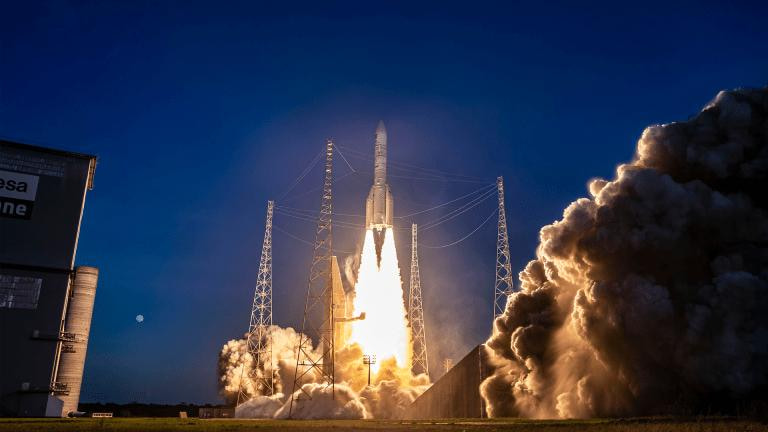
Europe’s drive to modernise its satellite-navigation network has taken another concrete step. The European Union Agency for the Space Programme, known as EUSPA, has signed a fresh launch contract with Arianespace to carry the second pair of Galileo Second Generation satellites into orbit aboard an Ariane 6 rocket. The mission, designated Galileo L18, builds directly on a first launch agreement struck in 2024 and signals that the long-promised upgrade of the constellation is shifting from drawing board to launch pad.

The contract lands at a moment of renewed confidence in Europe’s independent access to space. Ariane 6, the continent’s new heavy-lift launcher, completed its first Galileo mission on 17 December 2025, placing two satellites known as Galileo L14 into orbit. That flight mattered for reasons beyond a single deployment. For years European navigation satellites depended on foreign rockets after delays to Ariane 6 and the retirement of its predecessor left an awkward gap. Restoring a sovereign launch capability for critical infrastructure has become a strategic priority, and each successful Galileo mission on a European vehicle reinforces the case that the bloc can manage its own space programme without leaning on outside providers.

What sets the Second Generation apart is not just newer hardware but a meaningful jump in capability. The incoming satellites will use electric propulsion, allowing more efficient manoeuvring once in orbit, and carry a more powerful navigation antenna. They will host additional and more accurate atomic clocks, the components that underpin the precision of every position fix, alongside fully digital payloads that can be reconfigured in flight to meet evolving needs. Taken together, these features promise sharper accuracy, stronger resistance to jamming and interference, and a constellation that can adapt to new services rather than remaining frozen in the configuration it launched with.

The reach of that improvement is easy to underestimate. Galileo already supplies positioning data to billions of devices worldwide, feeding smartphones, vehicle navigation, aviation, maritime traffic, precision agriculture and emergency response. As economies grow more dependent on accurate timing and location signals, the resilience of the system becomes a question of public infrastructure rather than convenience. A more robust constellation guards against both accidental disruption and deliberate interference, threats that have grown more visible amid heightened geopolitical tension across Europe’s eastern and southern flanks.

EUSPA, acting under delegation from the European Commission, oversees the exploitation of Galileo and the security accreditation of the wider EU space programme, while the European Space Agency manages the technical development of the satellites. The first Second Generation spacecraft are expected to begin joining the constellation during 2026, ushering in a phased transition that will run for years as new units gradually supplement and eventually replace the current fleet. Booking a second Ariane 6 flight so soon after the first underlines an intent to keep that cadence steady rather than let it stall.

For a programme that has weathered cost overruns, technical setbacks and launch-vehicle headaches over its lifetime, the steady drumbeat of confirmed missions offers reassurance. Europe set out to build a civilian navigation system under civilian control, free of dependence on systems run by other powers. With each contract signed and each satellite delivered to orbit on a European rocket, that ambition looks less like aspiration and more like established fact.