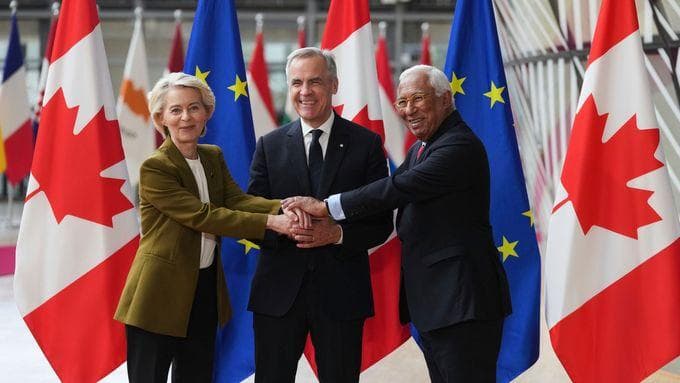
The EU’s SAFE defence loans have crossed a line few expected this early: a country outside Europe is now inside the scheme. On 14 February 2026 Canada signed an agreement to take part in the EUR 150 billion instrument, the first non-European nation to do so. What began as a tool for internal rearmament is starting to look like a transatlantic procurement club.
## How the SAFE defence loans work
Security Action for Europe, adopted in May 2025, offers member states up to EUR 150 billion in long-maturity, competitively priced loans for defence investment. Repayment terms stretch as far as 45 years with a 10-year grace period, and the loans are cheaper than most capitals could secure alone thanks to the EU’s top credit rating.
The catch is that the money is tied to joint procurement of priority capabilities, not national wish lists. Brussels wants the spending to build shared European industrial capacity, not 27 separate supply chains.
## Why Canada’s entry matters
Canada will be the first third country to gain structured access, following the EU-Canada Security and Defence Partnership signed at their June 2025 summit. Under the deal, Canadian firms receive treatment equivalent to European companies for SAFE-financed contracts.
That widens the supplier pool at a moment when every EU capital is trying to buy more, faster. It also signals that Brussels is willing to trade some “buy European” purity for industrial reach and political alignment.
Canada’s defence base, strong in aerospace, shipbuilding and Arctic systems, fills gaps that European industry cannot close overnight. For Ottawa, the prize is non-discriminatory access to a continent-wide rearmament drive worth tens of billions, at a time when its own procurement has leaned heavily on North American suppliers.
## Which member states have lined up
Demand has been heavy. Nineteen member states have requested assistance, and the Commission has approved plans in waves:
– First wave (January 2026): Belgium, Bulgaria, Denmark, Spain, Croatia, Cyprus, Portugal and Romania, worth around EUR 38 billion.
– Second wave (February 2026): Estonia, Greece, Italy, Latvia, Lithuania, Poland, Slovakia and Finland, worth roughly EUR 74 billion, half the envelope.
Czechia, France and Hungary are still waiting on approval, a sign of how fast the instrument has been absorbed.
## The strings attached to Canada
Access is not free. Canada will pay a participation fee equal to 15 percent of the Canadian content in any SAFE procurement where European content falls below 65 percent of a contract’s value. The formula is designed to keep the centre of gravity European while letting allies plug in at the margins.
It is a careful balance: open enough to attract partners, closed enough to keep the industrial dividend at home.
## What happens next
The remaining national plans should clear in the coming months, and attention will shift from approvals to delivery, including whether shared procurement actually lowers costs. Other partners are watching Canada’s terms closely, and the participation formula may become the template for any future non-EU entrant. For a bloc that spent decades treating defence as a national reserve, SAFE is normalising something new: collective European borrowing for arms.