
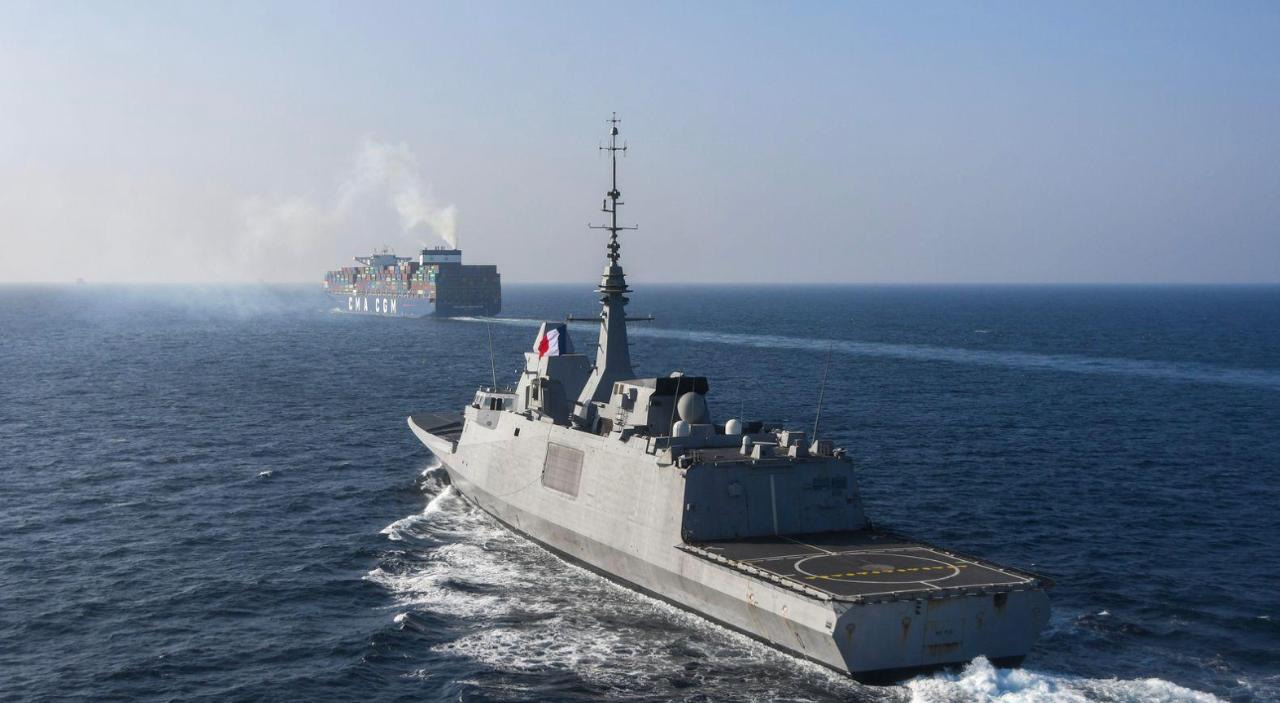
European leaders condemned the Houthi strikes on Saudi Arabia and called for their Red Sea naval operation to be reinforced. The threat that postponed the Riyadh summit lies beyond the reach of any naval mandate.
On 16 October, the leaders of the European Union condemned “the Houthis’ continued military escalation in Yemen and their strikes against Saudi Arabia” and expressed solidarity with the Kingdom. In the same European Council conclusions, they recalled the role of EUNAVFOR Aspides, the Union’s defensive naval operation in the Red Sea, and called for its reinforcement “in line with its mandate”. A day earlier, the second EU-GCC summit, due in Riyadh on 24 October, had been postponed because the city’s main airport was under fire.
Taken together, the two decisions reveal a mismatch that Gulf capitals will notice. The postponement of the EU-GCC summit is a matter of timing; the mismatch is a matter of capability. The attacks that cancelled the meeting came through the air, against an airport and energy installations on Saudi soil. The instrument European leaders have asked to see reinforced operates at sea, under a mandate written for the protection of merchant shipping. So far, Europe has answered an air threat with a maritime tool, and the qualifying phrase in its own conclusions suggests the tool is not meant to be stretched to fit.
What Postponed the EU-GCC Summit
The strikes inflicted heavy civilian losses. According to Saudi Arabia’s General Authority of Civil Aviation, the attack on King Khalid International Airport on 10 October killed twelve people, Saudis and foreign nationals from eight other countries, and injured 309. An Indian national died of his wounds the next day, the Indian Embassy said, bringing the toll to thirteen. The aviation authority’s report did not name the perpetrators. The Houthis claimed the attack, and the airport was struck again on 11 October. Other Saudi airports and energy facilities were targeted in the same week.
The two blocs then announced the postponement in different terms. The GCC Secretariat cited continued Houthi attacks, the extended closure of King Khalid International Airport, and the safety of the delegations. The EU’s notice gave no reason and promised a new date in due course. No date has yet been set. The UN Security Council, for its part, affirmed Saudi Arabia’s inherent right to self-defence.
The Case for Reinforcing Aspides
The European response deserves a fair hearing before it is judged. Brussels did not stay silent: on 11 October, the Commission President, Ursula von der Leyen, described the strikes as attacks by “Iran’s proxies” that were “pushing the region into a spiral of violence”. Aspides is the Union’s main operational asset in the Red Sea. It has escorted merchant vessels through the Red Sea and adjacent waters since February 2024, and under a Council decision of February 2025 it also collects information on arms trafficking and shadow fleets. Reinforcing an existing operation is quicker than designing a new one, and it requires no fresh legal basis.
The call also responds to a request from Riyadh. Arriving at the Foreign Affairs Council on 12 October, the High Representative, Kaja Kallas, reported that Saudi Arabia had asked the Union to strengthen Aspides so that it would work hand in hand with the Saudi-led international force, keeping the Bab el-Mandeb open to shipping. On this reading, European leaders gave the Kingdom what it asked for, through the instrument best suited to deliver it quickly.
Where the Mandate Stops
That defence holds for the sea lanes and fails for the airport. Saudi Arabia’s request concerned the Bab el-Mandeb, and on that front the reinforcement is a fair reply. The difficulty is that the request and the crisis are not the same thing. The Aspides mandate is defensive and maritime. It protects vessels, maintains situational awareness at sea, and collects intelligence on illicit maritime traffic. It does not intercept ballistic missiles aimed at a capital city, and it has no role in protecting terminals, runways, or refineries. The words “in line with its mandate” indicate that any reinforcement will take place within that maritime remit. The conclusions do not rule out wider security cooperation with the Gulf; they simply propose none. Even within that remit, reinforcement depends on warships that member states must volunteer, and Kallas acknowledged in September that the operation was designed to need at least ten.
The intelligence it gathers is the most useful thing Aspides can offer Riyadh. Information on arms trafficking bears directly on how the Houthis obtain weapons in breach of the targeted UN arms embargo. Yet the conclusions frame the operation as a maritime security measure, and nothing in them connects that intelligence to the threat against Saudi airports. Nor do they mention the Gulf Cooperation Council, the postponed summit, or the partnership the summit was meant to advance. Brussels condemned the strikes in one text, postponed the meeting in another, and offered a naval instrument in a third, without drawing the three together.
What the Partnership Has Promised
The gap matters because of what Europe has claimed for itself in the Gulf. The 2022 Joint Communication on a strategic partnership with the Gulf, adopted by the Commission and the High Representative, described the Union as an important security actor in the region. The economic stakes are considerable. According to the Council’s own figures, trade between the two blocs reached €165.6 billion in 2025, Gulf investment stock in the Union stood at €189.8 billion in 2024, and fuels account for more than three quarters of what Europe imports from GCC states. Those figures were published to frame the EU-GCC summit itself.
Other actors have moved faster. On 11 October, Iran’s foreign minister, Abbas Araghchi, told Prince Faisal bin Farhan by telephone that Tehran was ready to help initiate dialogue between Saudi Arabia and Yemen. Whatever one makes of the offer, it presents Iran as a possible mediator. The Union has kept in contact with Riyadh through the High Representative and has now spoken at leaders’ level, but it has announced no initiative addressed to the threat that cancelled the EU-GCC summit.
What the Union Should Do Before Year End
Three steps would give the conclusions practical content, and none requires treaty change.
First, the Council should specify what reinforcement means. A formal decision setting out structured coordination between Aspides and the Saudi-led maritime force, including the regular sharing of arms-trafficking intelligence gathered under the existing mandate, would turn a sentence in the conclusions into an operational commitment. It would also be honest about scope: a stronger naval escort, with an intelligence product that Riyadh can use against the supply chain behind the missiles.
Second, the Union should offer a separate track for the threat Aspides cannot reach. The Union does not command a standing air-defence force of its own. The relevant capabilities remain primarily with member states, which decide nationally whether to deploy them, sell them, or train others in their use. Through its common security and defence policy, the Union can convene and coordinate. It could therefore propose a dedicated EU-GCC dialogue on the protection of civilian aviation and energy infrastructure, in which member states with relevant capabilities act bilaterally and the Union provides the framework. That would match the instrument to the threat rather than the reverse, and the rescheduled EU-GCC summit would be the natural place to launch it.
Third, the EU-GCC summit should be rescheduled before the Irish presidency ends on 31 December. Riyadh’s airport reopened on 18 October, but several European carriers have suspended service to the city for weeks, Lufthansa until mid-November. The venue should therefore be agreed with the GCC on security advice rather than on the airport’s status alone. The security of civilian infrastructure should be on its agenda, so that the meeting addresses the reason it was delayed.
The Measure of a Security Partner
European leaders did the expected things in October. They condemned the attacks, expressed solidarity, and pointed to the operational instrument already at their disposal. In doing so, they treated the EU-GCC summit as a scheduling matter and the Houthi campaign as a maritime one. What they have not yet done is acknowledge that the instrument and the threat belong to different domains.
Gulf governments understand the distinction well. They will judge the Union less by the strength of its condemnation than by whether its offer reaches the danger they face. If the rescheduled EU-GCC summit brings a precise maritime commitment and a credible answer on the air threat, October will be remembered as a delay. If it brings only a reinforced escort, the Union’s claim to be a security actor in the Gulf will look less like a strategy and more like an inventory of what it already had.
The Weekly Editorial
This is the editorial position of The European Post, published weekly on matters of European and international strategic significance. It represents the view of the Editorial Board.