
Washington has set the terms of Gulf fuel-cycle governance until 2056. The Union that reimposed an enrichment ban on Tehran last autumn holds no position on Riyadh, and no instrument through which to form one.
On a Wednesday afternoon in Washington, two energy ministers signed a document and shook hands for the cameras. By Thursday morning the President of the United States had rewritten its terms in a social media post. The condition he added was one his own department had not negotiated and cannot deliver.
The document was the Saudi civil nuclear agreement. It runs for thirty years. It will shape the Gulf’s nuclear fuel cycle for most of that time, and it was drafted, signed, and amended without a European in the room.
Europe holds no seat at that table. It holds no instrument through which to ask for one. That absence would matter less if the terms were narrow. They are not.
What Was Signed, and What Followed
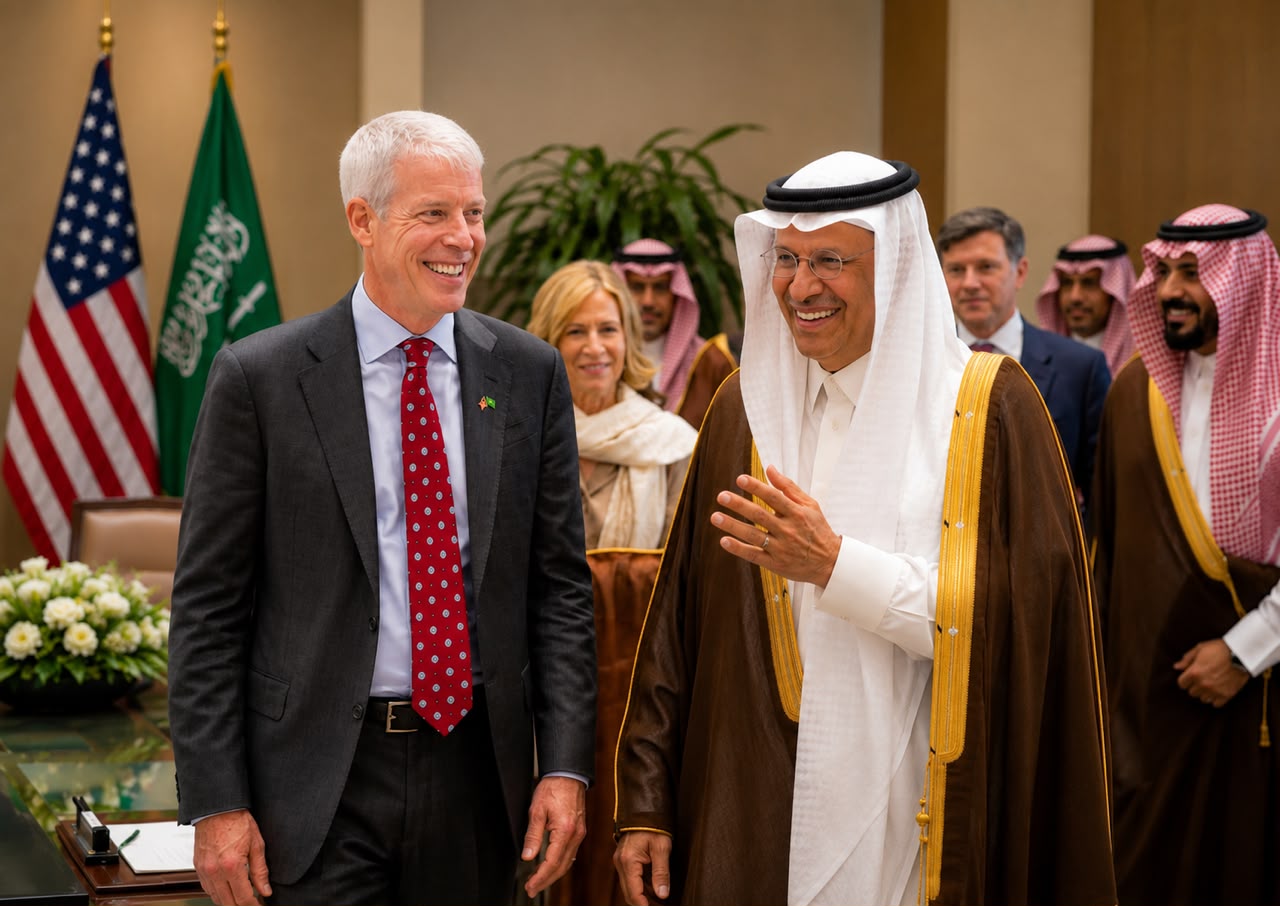
Energy Secretary Chris Wright and Saudi Energy Minister Prince Abdulaziz bin Salman signed two instruments on 22 July. One is the cooperation agreement itself. The other is a bilateral safeguards agreement between the two governments. Together they make American firms the Kingdom’s suppliers of choice for reactors and fuel.
The Saudi civil nuclear package omits what Washington calls the gold standard. That is a binding promise never to enrich uranium and never to reprocess spent fuel. Those are the two industrial steps that turn reactor material into weapons material. The United Arab Emirates gave the promise in 2009. Riyadh has declined to.
It carries no obligation on Riyadh to adopt the Additional Protocol either. Ordinary safeguards let inspectors check what a state has declared. The Additional Protocol is the instrument that lets them look for what it has not. Paired with a comprehensive safeguards agreement, it forms the recognised verification standard. Riyadh has not accepted it.
The bilateral instrument is worth separating from the rest, because the word safeguards is doing two jobs. That agreement binds Riyadh to Washington. It does not bind Riyadh to Vienna. The IAEA has said it is still waiting for the two governments to ask it to put verification measures in place. Its board would then have to authorise them. For now the inspection architecture exists on paper in one capital and nowhere else.
The enrichment position itself is narrower than critics allege and looser than supporters claim. Riyadh may not reprocess American nuclear material. It may not build enrichment technology of its own. What it may do is use American technology to enrich fuel supplied by third countries. Any such plant would sit inside the Kingdom and be run by American companies, and whether it is built at all follows a two-year study.
So the pathway is real, conditional, and entirely in Washington’s gift. Whether anything travels down it is a political question rather than a legal one.
Congress will have the first say. Any transfer of American nuclear technology abroad runs through Section 123 of the Atomic Energy Act, which gives legislators a fixed window to object. That window is ninety in-session days. Blocking the text would then require two-thirds majorities in both chambers to survive a veto. No 123 agreement has ever been stopped that way.
Olli Heinonen ran the IAEA’s safeguards department as its deputy director general. He told ABC News that Washington should never have conceded enrichment “without a really strong inspections regime” anchored in the IAEA. He also expects imitators. Other states, South Korea among them, will pursue the same latent capability.
The reversal came on 23 July. Announcing it on Truth Social, the President made approval conditional on Saudi Arabia joining the Abraham Accords. He added that no enrichment would occur. The White House press secretary confirmed the condition at a briefing hours later. Neither element appeared in the document his own Energy Department had signed the previous afternoon. Riyadh has said nothing in public since.
The Case for Proximity
The administration’s reasoning deserves a hearing. Riyadh has decided to build. A state of that size will find vendors somewhere. Exclude American firms and Russian or Chinese ones take the contracts instead. The terms would then be drafted in Moscow or Beijing.
Marco Rubio made the administration’s guarantee explicit from Manila the day after signature, saying Washington would conclude no agreement anywhere that carried “the risk of proliferation”.
Proximity also purchases oversight. A supplier relationship opens access to safety culture, personnel training, and regulatory design. It brings decades of operational contact. A rejected bidder wins none of that. The Crown Prince has said more than once that his country would match an Iranian weapon. Weighed against that, a supervised Saudi civil nuclear programme beats an unsupervised one. The argument is coherent. It also predates this White House by two administrations.
Restraint Repriced as Currency
What the argument cannot survive is the day that followed the signature. Safeguards hold because they are legal, durable, and indifferent to political weather. A condition announced on a social platform has none of those properties.
The moment enrichment restraint becomes the price of a diplomatic recognition, it stops working as a safeguard. It starts working as an asset. Assets can be traded, discounted, or handed back. Riyadh has now been told in public what its restraint is worth. So has every other capital watching the Saudi civil nuclear file.
The objection is not partisan. A cross-party group of legislators wrote to the Secretary of State in November 2025, pressing for the gold standard in any Saudi arrangement. Senator Ed Markey repeated the warning in February. Gregory Meeks, ranking Democrat on the House Foreign Affairs Committee, wants limits on enrichment and reprocessing written in, with the Additional Protocol alongside them. None of it reached the signed text.
It is not confined to Washington either. Alicia Sanders-Zakre, head of policy at the Geneva-based International Campaign to Abolish Nuclear Weapons, called the Additional Protocol “the highest standard of international nuclear inspections”. Her organisation wants Riyadh to negotiate one without delay.
The Asymmetry Europe Now Owns
Here the file turns European, and the comparison is uncomfortable.
France, Germany, and the United Kingdom negotiated the 2015 Iran accord alongside Washington, Moscow, and Beijing. The three are known collectively as the E3. That accord carried a clause allowing any original signatory to restore United Nations sanctions on its own, without a Security Council vote that Russia or China could veto. The clause is called snapback, and in August 2025 the E3 used it.
United Nations sanctions returned on 28 September. Among much else, they restored a prohibition on Iranian enrichment and reprocessing. The Council reimposed the Union’s own restrictive measures the next day.
Europe thereby advanced a legal proposition. The right to enrich is not sovereign. It is conditional on verified conduct. The condition can be enforced against a state that fails it. That was a serious position, and it cost Europe its remaining channel to Tehran.
Ten months on, the Saudi civil nuclear agreement opens the same capability on the opposite shore of the same waterway. It does so lawfully, and with American help. The E3 position now turns on which government signed which instrument in which decade. Tehran will make that argument at the next Board of Governors. It will not need to embellish it. Neither will Ankara or Cairo, should either revisit its own calculations.
The Position Brussels Has Already Taken
Brussels is not without a stated view. It has simply never applied that view westward. EU and GCC foreign ministers met in extraordinary session on 5 March and committed jointly to preventing Iran from acquiring a nuclear weapon. Saudi Arabia sat on the GCC side of that table.
The language hardened from there. Twenty-seven heads of state and government agreed in European Council conclusions of 19 March that Iran “must never be allowed to acquire a nuclear weapon”. The same paragraph required compliance with legally binding safeguards obligations under the Non-Proliferation Treaty.
High Representative Kaja Kallas had set out the reasoning three weeks earlier. Her statement of 1 March tied regional stability to full Iranian cooperation with the IAEA. It also required observance of the safeguards agreement, and called nuclear safety “a critical priority”. She restated the position after the Foreign Affairs Council on 13 July, alongside a pledge to deepen the Union’s partnership with the Gulf.
Read against the week just past, the phrasing carries a problem. Nothing in either text is wrong. Everything in both was drafted to apply to one country.
The Union’s own Institute for Security Studies warned in March that Europe had been left reacting to a regional order it no longer helps to design. Four months later a thirty-year fuel-cycle arrangement was signed in Washington. No European institution had a paper ready. None has published one since.
The Saudi Civil Nuclear Agreement and Europe’s Missing Seat
The silence is structural rather than rhetorical. EU-Gulf relations still rest legally on the 1989 Cooperation Agreement with the Gulf Cooperation Council. Bilateral arrangements with the six foreign ministries supplement it. Neither layer addresses the fuel cycle.
The 2022 Joint Communication on a strategic partnership with the Gulf was the Union’s first regional strategy. It does raise atomic questions. It confines them to safety, emergency preparedness, and the consequences of CBRN incidents. Fuel-cycle governance appears nowhere in the text. Nor does safeguards adoption. Brussels wrote a Gulf strategy that treats nuclear power as an industrial hazard rather than a strategic variable.
Member states filled the vacuum on their own account. Paris holds a nuclear memorandum with Riyadh. Rome and Madrid carry commercial understandings across the region. These are national positions, not a Union policy. Because they compete, they cancel much of the bargaining weight each might otherwise carry. No common European view on Saudi civil nuclear cooperation exists. So none was sought, and none was missed.
What Brussels Can Still Put on the Table
The 29th EU-GCC Joint Council and Ministerial Meeting convenes in Kuwait on 6 October. It builds on the first EU-GCC Summit, held in Brussels in 2024. Three items belong on that agenda.
One: Additional Protocol adoption as a standing Union request of every Gulf partner. The Emirati arrangement of 2009 covered both halves, the enrichment pledge and the Protocol alongside it. A regional precedent therefore exists, set by a Gulf state rather than imposed on one. Europe should be the party that keeps citing it.
Two: conditionality on the European side of the ledger. Euratom cooperation, European vendor participation, and export licensing for sensitive components are instruments the Union already controls. Tying them to safeguards commitments costs Brussels nothing it currently collects.
Three: a written Union position on fuel-cycle governance across the Gulf. It should be produced before the next agreement is initialled, not after. The Joint Communication is due a revision. This is the gap that revision should close.
A Question That Will Outlast Its Authors
None of this recovers the seat Washington never offered. It establishes something more useful. Europe would hold a table of its own, and a settled view of what belongs on it.
The alternative is the position the Union occupies this week. It enforces a prohibition on one shore of the Gulf. It declines to hold an opinion about the other. And it hopes nobody draws the comparison aloud.
The thirty-year term of the Saudi civil nuclear agreement means this question will outlive the administration that wrote it, the Parliament now sitting, and most of the Commission. Reactors take a decade to build. Brussels has until October to decide whether it is a party to this century’s Gulf nuclear order or an audience for it.
The Weekly Editorial
This is the editorial position of The European Post, published weekly on matters of European and international strategic significance. It represents the view of the Editorial Board.