August 9, 2026
LATEST
New EU Gas Market Rules Take Effect With Consumer SafeguardsDeforestation Regulation Holds Its December Deadline Despite CutsDigital Omnibus Delays Europe’s High-Risk AI Deadline to 2027Europe’s Schools Confront a Widening Basic Skills GapRule of Law Report Finds Progress but Trust Still LagsIRIS2 Gains 66 Satellites as Brussels Signs the Rollout DealNature Restoration Plans Come Due as Member States Race a DeadlineECB Rates Hold at 2.25 Percent as Frankfurt Waits on the DataEU Budget Talks Turn to Cohesion as Ireland Takes OverWildfire Response Stretches Europe’s Emergency Fleet ThinCan Europe’s Quantum Plan Match Its Big Ambitions?Armenia Edges West as Moscow’s Grip Slips AwayEurope Inherits the World’s Aid Bill It Cannot Fully PayAir Passenger Rights Get Their First Overhaul in Two DecadesErasmus Opens a 5 Billion Euro Round for Skills and MobilityCeuta Crisis Pushes the EU Toward Faster Migrant ReturnsBulky Parcels Face a Packaging Crackdown From August 12Can Europe Build Its Drone Wall Before 2030 Arrives?Indonesia’s Trade Deal With Europe Nears Its Final SignatureEurope Leans on Beijing to Keep Climate Talks Alive Before AntalyaNew EU Gas Market Rules Take Effect With Consumer SafeguardsDeforestation Regulation Holds Its December Deadline Despite CutsDigital Omnibus Delays Europe’s High-Risk AI Deadline to 2027Europe’s Schools Confront a Widening Basic Skills GapRule of Law Report Finds Progress but Trust Still LagsIRIS2 Gains 66 Satellites as Brussels Signs the Rollout DealNature Restoration Plans Come Due as Member States Race a DeadlineECB Rates Hold at 2.25 Percent as Frankfurt Waits on the DataEU Budget Talks Turn to Cohesion as Ireland Takes OverWildfire Response Stretches Europe’s Emergency Fleet ThinCan Europe’s Quantum Plan Match Its Big Ambitions?Armenia Edges West as Moscow’s Grip Slips AwayEurope Inherits the World’s Aid Bill It Cannot Fully PayAir Passenger Rights Get Their First Overhaul in Two DecadesErasmus Opens a 5 Billion Euro Round for Skills and MobilityCeuta Crisis Pushes the EU Toward Faster Migrant ReturnsBulky Parcels Face a Packaging Crackdown From August 12Can Europe Build Its Drone Wall Before 2030 Arrives?Indonesia’s Trade Deal With Europe Nears Its Final SignatureEurope Leans on Beijing to Keep Climate Talks Alive Before Antalya
August 9, 2026
LATEST
New EU Gas Market Rules Take Effect With Consumer SafeguardsDeforestation Regulation Holds Its December Deadline Despite CutsDigital Omnibus Delays Europe’s High-Risk AI Deadline to 2027Europe’s Schools Confront a Widening Basic Skills GapRule of Law Report Finds Progress but Trust Still LagsIRIS2 Gains 66 Satellites as Brussels Signs the Rollout DealNature Restoration Plans Come Due as Member States Race a DeadlineECB Rates Hold at 2.25 Percent as Frankfurt Waits on the DataEU Budget Talks Turn to Cohesion as Ireland Takes OverWildfire Response Stretches Europe’s Emergency Fleet ThinCan Europe’s Quantum Plan Match Its Big Ambitions?Armenia Edges West as Moscow’s Grip Slips AwayEurope Inherits the World’s Aid Bill It Cannot Fully PayAir Passenger Rights Get Their First Overhaul in Two DecadesErasmus Opens a 5 Billion Euro Round for Skills and MobilityCeuta Crisis Pushes the EU Toward Faster Migrant ReturnsBulky Parcels Face a Packaging Crackdown From August 12Can Europe Build Its Drone Wall Before 2030 Arrives?Indonesia’s Trade Deal With Europe Nears Its Final SignatureEurope Leans on Beijing to Keep Climate Talks Alive Before AntalyaNew EU Gas Market Rules Take Effect With Consumer SafeguardsDeforestation Regulation Holds Its December Deadline Despite CutsDigital Omnibus Delays Europe’s High-Risk AI Deadline to 2027Europe’s Schools Confront a Widening Basic Skills GapRule of Law Report Finds Progress but Trust Still LagsIRIS2 Gains 66 Satellites as Brussels Signs the Rollout DealNature Restoration Plans Come Due as Member States Race a DeadlineECB Rates Hold at 2.25 Percent as Frankfurt Waits on the DataEU Budget Talks Turn to Cohesion as Ireland Takes OverWildfire Response Stretches Europe’s Emergency Fleet ThinCan Europe’s Quantum Plan Match Its Big Ambitions?Armenia Edges West as Moscow’s Grip Slips AwayEurope Inherits the World’s Aid Bill It Cannot Fully PayAir Passenger Rights Get Their First Overhaul in Two DecadesErasmus Opens a 5 Billion Euro Round for Skills and MobilityCeuta Crisis Pushes the EU Toward Faster Migrant ReturnsBulky Parcels Face a Packaging Crackdown From August 12Can Europe Build Its Drone Wall Before 2030 Arrives?Indonesia’s Trade Deal With Europe Nears Its Final SignatureEurope Leans on Beijing to Keep Climate Talks Alive Before Antalya

Thales Signals Europe’s IRIS2 Satellite Network Stays on Track

Paris: Europe’s IRIS2 satellite programme is running to plan, Thales chief executive Patrice Caine told investors on 23 July, offering fresh reassurance that the bloc’s sovereign broadband constellation remains on course despite its scale and cost. The IRIS2 satellite network is the EU’s third space flagship after Galileo and Copernicus.

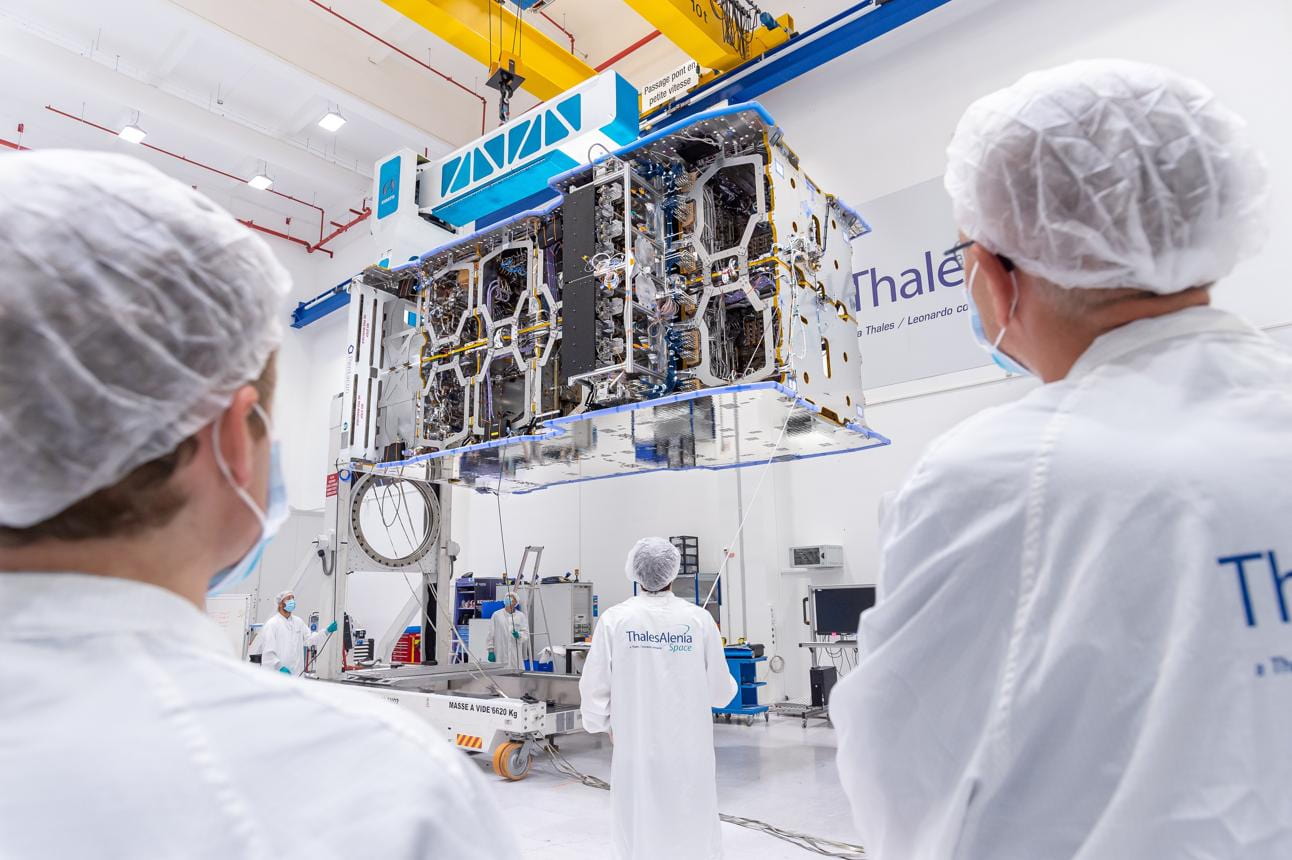
Caine delivered the update during Thales’ first-half results presentation, confirming that development work on the secure communications system is progressing as expected. His comments matter because Thales sits among the industrial players building a constellation that few doubted would face delays.

IRIS2, short for Infrastructure for Resilience, Interconnectivity and Security by Satellite, will comprise roughly 290 spacecraft spread across low and medium Earth orbit. The system is designed to shield government, military, and critical-infrastructure communications from interception and to bridge stubborn digital divides across the continent and beyond.

The programme rests on a concession contract that the Commission signed in December 2024 with the SpaceRISE consortium, led by SES and joined by Eutelsat and Hispasat. That 12-year deal handed the operators responsibility for building and running the network, with services expected from the start of 2030. SES described the signing as the moment IRIS2 moved from ambition to delivery.

Money remains the programme’s most watched figure. Brussels has earmarked 10.6 billion euros for IRIS2, splitting the bill between more than 6.5 billion euros in public funds and over 4 billion euros from industry. The European Space Agency is contributing several hundred million euros toward the most demanding technical elements through its partnership programme.

Officials frame the constellation as a matter of strategic autonomy. As commercial low-orbit networks owned outside Europe expand, EU leaders argue the bloc cannot leave secure government traffic dependent on foreign infrastructure. IRIS2 is their answer, and the Commission has cast it as central to the bloc’s secure connectivity ambitions.

Sceptics note the road ahead is long. The first launch is not envisioned before 2029, and full service only in 2030, leaving years in which budgets, contractors, and technology must all hold together. Large European space projects have slipped before, and the sheer number of satellites raises manufacturing and launch questions that industry has yet to fully answer.

Caine’s reassurance will not silence those doubts, but it does steady them. With one of the constellation’s key contractors publicly declaring the schedule intact, the EU can point to momentum rather than mere paperwork.

The next milestones will test that confidence: firm launch dates, satellite production runs, and proof that the ground segment can knit hundreds of spacecraft into a single secure web. For now, Europe’s most ambitious space bet since Galileo appears, at least, to be flying straight.