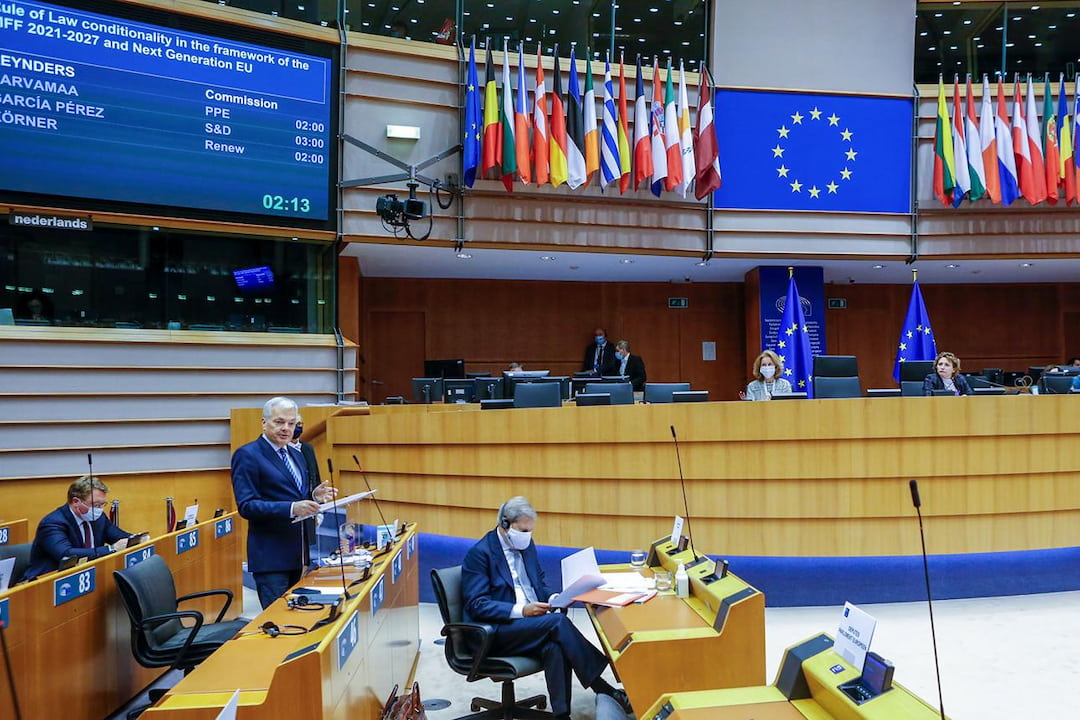
Brussels: The Commission’s annual rule-of-law cycle began life as a diagnostic exercise, a way to name problems without forcing anyone to fix them. That framing no longer holds. With the conditionality mechanism now tied directly to disbursements, the once-academic chapters on judicial independence and media pluralism have become the paperwork that decides whether billions flow or freeze. The shift is quiet but consequential, and it changes how capitals read the report.
What used to be a reputational nudge has hardened into a fiscal lever. When the Commission writes that a member state has failed to insulate prosecutors from political pressure, that sentence can now be cited in a procedure that withholds cohesion money. The reverse is also true: governments that close out earlier recommendations can point to the same document to unlock funds they had been denied. The report has become a ledger as much as an assessment.
This matters because it forces a harder conversation about evidence. A diagnostic tool can afford to be impressionistic. A budgetary trigger cannot. National governments under scrutiny have started to contest the Commission’s sourcing, arguing that civil-society submissions and journalistic accounts are being treated as findings rather than allegations. The Commission, for its part, has tightened its methodology, leaning more on court rulings and structural indicators that are harder to dismiss as political. The result is a slower, more lawyerly process that pleases almost no one.
The deeper tension is constitutional. Several governments insist that the organisation of their courts and the appointment of their judges fall squarely within national competence, and that linking those choices to EU money amounts to coercion through the back door. The Commission counters that sound financial management is impossible where courts cannot be trusted to police the spending of EU funds. Both positions have a logic, and the European Court of Justice has so far sided with the view that conditionality protects the budget rather than dictating constitutional design. That ruling settled the legality but not the politics.
For the citizens these reports are ultimately meant to serve, the stakes are practical. Frozen funds rarely punish the officials accused of backsliding; they stall the regional projects, university grants and infrastructure works that ordinary people were counting on. That uncomfortable fact gives governments a powerful rhetorical weapon, allowing them to recast a rule-of-law dispute as Brussels starving their citizens. The Commission has no easy answer to that framing, which is why it now pairs warnings with detailed roadmaps showing exactly what reforms would release the money.
The coming cycle will test whether the instrument can be both credible and proportionate. Apply it too aggressively and it looks like a political bludgeon; apply it too gently and it confirms the suspicion that the rule of law is negotiable for the right price. The honest position is that the EU has not yet found the calibration, and may never fully find it. What has changed is that the question can no longer be deferred, because the report now does something, and everyone in the room knows it.