Yerevan: There is a peculiar honesty to the way Armenia and the European Union now describe their relationship, which is to say they avoid describing it at all. Officials in Yerevan speak of integration; officials in Brussels speak of partnership; and both sides have quietly agreed not to use the word that hangs over every meeting, which is membership.
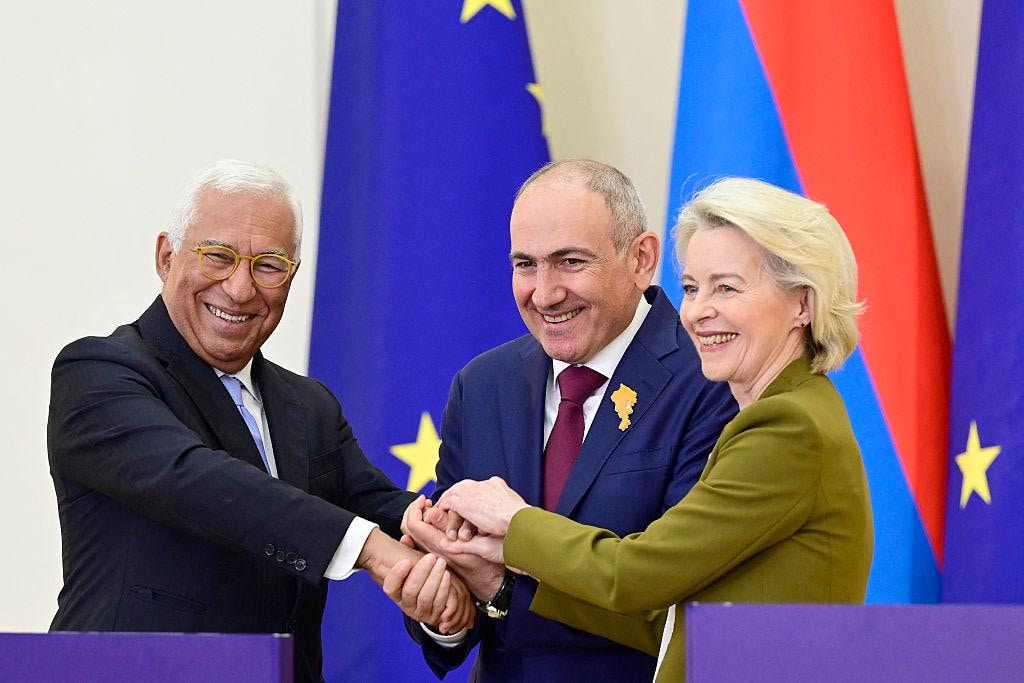
The choreography became unmistakable this spring. On 5 May the two sides held their first-ever summit and signed a Connectivity Partnership knitting together transport, energy and digital links. A month earlier, the visa liberalisation machinery had begun to turn in earnest: the Commission published its first progress report against an Action Plan of 74 benchmarks in May, and on 1 June launched a €2.2 million technical-assistance project to push Armenia toward Schengen visa-free travel. None of this requires a candidacy. All of it points toward one.
What makes the Armenian case unusual is that the political will is running ahead of the geography. Armenia’s parliament adopted an EU Integration Act in March 2025, a unilateral declaration of intent that Brussels neither requested nor formally acknowledged. The foreign minister has said Yerevan will intensify its membership effort through 2026. Yet Armenia remains a member of the Russian-led Eurasian Economic Union, depends on Russian gas and, until recently, hosted Russian border guards. A country cannot belong to two customs unions, and everyone involved knows it.
This is why the visa file matters more than the summit communiqués. Visa liberalisation is the one track on which Brussels can deliver something concrete to ordinary Armenians without forcing Yerevan to choose between Moscow and Europe tomorrow. It is reversible, technical and deniable as a step toward accession, which is precisely what makes it usable. If Armenians can travel freely to the Schengen area within a few years, the political constituency for deeper alignment will build itself, benchmark by benchmark, without a single accession chapter being opened.
The risk is that the ambiguity curdles into disappointment. Yerevan is investing real political capital in a European turn at a moment of acute vulnerability, with relations with Azerbaijan unsettled and the security guarantee it once assumed from Russia exposed as hollow. If Brussels offers connectivity and visas but withholds any horizon of membership, Armenia’s government may find it has spent its credibility on a partnership that looks, to a sceptical public, like the old dependency in a new flag.
For the European Union, the temptation to keep the relationship deliberately vague is strong and not unreasonable. Enlargement fatigue is real, the bloc is already managing accession tracks for Ukraine, Moldova and the Western Balkans, and admitting a small, landlocked state wedged between Turkey, Iran and Azerbaijan would test the Union’s appetite for strategic exposure. But vagueness is a strategy with a shelf life. Armenia is asking, in its own careful way, whether Europe’s open door is real or rhetorical. The honest answer, for now, is that Brussels has not decided, and that the visa file is the place where it will reveal what it actually intends.